Experience in Meditation

What arises in this moment?
“Joy”?
“Agony”?
“Nostalgia”?

Can you openly be present to it?
Whatever it may be?
So many butterflies
And moths, flitting about…

Don’t react. Just feel–fully.
Just anger.
Just lust.
Just sadness.

No narrative yarns following these swarms.
Breathe in.
Breathe out.
No attachment.

Buddha-9897


May this inspire you to meditate.

Gassho!

Gratitude in Difficulty

Here’s another passage from Morning Pages–a practice that I fell out of with a recent work schedule shift, but I’m making every effort to get writing regularly again. I just finished one of my Morning Pages journals, and in the first pages of the new one, I dedicated the efforts to gratitude, as it was the day after Thanksgiving. While I do not want to limit my Morning Pages and their creative openness, I’m taking a meditation on gratitude as a general inspiration for this journal, and this is the second entry with that spirit.


Look! Two days in a row! I’ll get back into this. Well, as I look at these pages, I think on gratitude. Perhaps, a general intention for morning pages is wrong, but I won’t let it guide my writing beyond a general mindset.

It’s hard to feel gratitude sometimes. Your mind can be compressed to a few square inches of mental space where it walks the same grounds of complaints and anxiety again and again. The trick is not to get trapped here and think that those thoughts are the mind. Getting beyond the focus on these gets the mind loose into its true nature–openness.

For instance, this morning, I can’t find my keys–which is a serious annoyance for me. I also have a headache and body pains. I’m hungry. I’m tired. As I focus on these other grievances come out and multiply. A legion.

However, if I take a moment, breathe, and relax into just being here–writing in this particular now–the thoughts slip past.

Here is one of the greatest gifts of mindfulness–setting the mind see and not confusing it with the thoughts that come and go.

Such openness allows the spacious embrace of gratitude to come in every moment, even when you have a headache. 🙂

OLYMPUS DIGITAL CAMERA


Right after I finished writing this entry, I read this passage:

It doesn’t matter what comes up. You don’t have to analyze anything when you are meditating. You can simply maintain your dignified posture and pay attention to your breath. The technique is that you look at the thoughts as they arise and say to yourself, “thinking.” Whatever goes through your mind is purely thinking, not mystical experience. Label it thinking and come back to your breath.

So you are there. You are thinking.You don’t try to get away from your thoughts, but you don’t stick with them or encourage them either. Thought patterns are just ripples on the surface of the pond. They come and they go. They merge into each other, and you take the attitude that they are not a big deal.

Bodily aches and pains and physical irritations also come and go. They may seem more problematic than your thoughts. But in meditation practice you regard physical sensations as also thought patterns. Label them thinking. Aches, pains, pins and needles–all thinking. This keeps everything simple and straightforward, so that you can appreciate everything as port of one natural process.

–Chögyam Trungpa, Mindfulness in Action, pp. 22-23.

May this inspire you to find gratitude even in difficult days. May you see that your thoughts are not your mind.

Gassho!


The Tile/Mirror Paradox

Here’s another unexpectedly delightful swim through deep waters in a set of Morning Pages. I added the last paragraph to pull out that one missing piece (due to the page-length restriction of the original writing), but it’s otherwise just a free flow of thoughts (with one quote I really wanted). Enjoy!


No expectations. Can you let go of them? This moment is rife with possibility, with intricacy, with intensity. Can you experience it without mental filters of what it should be?

Sounds easy enough: right? It isn’t. We are always already running with “should”, concepts, and fantasies. They are the norm so much that we do not even realize their constant operation and that there is an alternative to it.

Yet we are also always already living right in the middle of enlightenment. It’s all around us. We’re part of it–no separation, but we have to stop and see it.

“When Baso told his teacher that he sat in zazen because he wanted to become a buddha, his teacher immediately picked up a tile and began to polish it.
–“How can your polishing make that tile a mirror?” asked Baso.
–“How can your zazen make you a buddha?” asked his teacher.””
–Dainin Katagiri, from You Have to Say Something

This zen parable lights the way. The point is not that zazen is pointless. Rather, zazen is the only point. It is the actualization of the fundamental point. It is enlightenment itself–yet it does not make us buddhas. How so?

What is the difference between the tile and a mirror? What is the difference between a person and a buddha? This much is clear: one does not become the other–as though some alchemical transformation of lead to gold, two fundamentally different elements. If zazen does not make one into a buddha, what does it do?

Is it “doing” anything–this practice of just this, just sitting? –What does a buddha “do” for that matter? Is he some great transcendental subject that obtains the knowledge of the ultimate Object–the Universe, Life, Death, Suffering, Happiness? If we think of it this way, we will labor on, polishing, polishing, polishing, not realizing that we can never make that tile into a mirror.

Yet this zen paradox is more subtle and more elaborate than that. We see the need to polish the tile, deluded into thinking it will become a mirror. What we don’t recognize is that we are already a mirror. The action, the not-doing, the wu wei is seeing this and reflecting the light as one process–no separation, just enlightenment, contained as it might be with the rim of confusion and delusion (as Dogen would tell us–enlightened ones still live in delusion). The point is that we need to see that we are dusty, unreflecting mirrors already. Then the question is no longer–how do I become a mirror as a tile (an impossible task), rather what is shining enlightenment? It is prajna; it is compassion. It is right here, right now–everywhere, always. Then, the path is just sitting with this. It is precisely: not polishing.

DSC_3592

May this elucidate practice as not doing.
May All be happy.
May All be healthy.
May All be at peace.
May All live with ease.

Gassho!
Z

One Empty Mind

One…
Sun shines through clouds
Birds sing in the wind

Empty…
Breeze blows around compassionate statue
Monks sweep, scrub, and smile

Mind…
All flows–just this moment
Not separate–myself, the mountain

Zen
Buddha Dharma
Everywhere, always–Just This

WP_20151018_15_31_37_Pro

WP_20151018_15_08_26_Panorama


May this help you experience the primordial emptiness of mind.

Gassho!

Compassion Can Save Your Life

Compassion can save your life
Deliverance from struggle and strife
No longer living on the edge of a knife
Compassion can save your life

Open eyes–that empathize
Open heart–that can impart
Open mind–judgments unwind
Openness–knowing emptiness

Karuna inspires–not about “me”
Holding wisdom’s hand–All that be
The Way–infinite, nothing outside
No longer separate–in peace “I” reside

Waking up is difficult.
It is realization that peace and happiness were not some distant accomplishment.
They were here all along.
The Buddha resides in the burning house.
The other shore is right here, right now.


May this inspire you to compassion and presence.

Gassho!

Neither This Nor That

Me, myself, and mine
Are not the heart of the divine
“My” Truth? Do you comprehend
What this phrase would intend?
Between extremes–meaninglessness
Or metaphysical seriousness
We swing on conceptual dichotomy
Really invokes experiential lobotomy
Either/or, black or white?
Can All be measured in wrong or right?
Is value so readily inherent?
Is Truth just personally apparent?
Must we choose eternalism or nihilism?
Absolutism and relativism–a schism
De-cide–roots meaning to cut apart
Conceptual delimiting of ideological art
The Way walks through the abyss
The dividing line between–just this
Neither here nor there, this nor that
Wisdom lies not in the distinction I shat
Presence/Oblivion: two sides, same coin
These are not separate–nothing to join

file0001719187149


After a storm at sea the sailor heads for home and quiet harbor.
Tossed by indecision
we must return our unsettled mind to the center.
Tao is within us all.
With many voices it has but one beautiful song;
many aspects but only one essence.
Though we are not bound, we are always connected.

Buddhahood is meditation;
with constant attentiveness our mind travels far:
into the highest hills and all over the world.
Elusive, delicate–we see the cosmos is empty
as well as full.
Nothing beyond, Nothing in hand.
Beauty, spirit, Tao–all one.

–§1 in “Everyday Practice” from The Book of the Heart: Embracing the Tao by Loy Ching-Yuen

Without words, we understand no-mind;
without shape, we understand true nature.
With relaxed mind, we grasp the meaning of Tao;
with the boundless Way, we understand truth.

–§3 in “Everyday Practice” from The Book of the Heart: Embracing the Tao by Loy Ching-Yuen

May this help you see beyond dualism and the relativistic pat on the back that can come with your own Stories–that is “My Truth”.

Gassho!

The River of Life–on Existence and “Separation”

Here’s another set of Morning Pages philosophical thoughts. Enjoy!


Floating through–a bubble on the surface of a river. The fragility of it and the shining beauty–yet not separate from muck and refuse also floating by in the water. Separate? Does such a word make any deep sense? Of course the bubble is distinct from the banks of the river, but where does the bubble end and “the river” begin? Also, could one truly be without the other? You may say that the river could, but it would be a different river, and would either be without the banks? What is separation?

This image is a metaphor for life, and the last point stands to remind us that “my” life as separate, as independent, is equally implausible. The universe would not be the same without me in it, but we usually stop there and make this into some sort of grand creed of the ego–“My existence is of universal importance!!!” Thus do we beat our chests at the confusion and existential anguish of the questions: “Why am I here? What is the point of it all?” Thus do we cover over our fear of death and nonexistence, trying to overlook how that bubble could so easily pop and that we cannot begin to understand or conceive of what it would be like to dissolve from bubble into river–to have the “I” dissolve into whatever it may become when this body pops in its own way.

We must not stop with this roar at the uncertainties of our embodied, impermanent life. The other point was that I am not separate from the universe. The bubble would not be, if not for floating along on the water. Words deceive here. It is not the river, and yet it is the river. It flows differently than the water around it, but it is composed of the same water and shows us merely a different way that all the particulars of the river’s flow can manifest, albeit briefly, as one possible occurrence in the ever-changing flow of flux.

Bubbles floating on a river...

Bubbles floating on a river…

Here is the mystery. Here is Tao, shunyata, Source, or the divine spark. Here is what you should spend your time observing. The universe universes the universe, right here, right now–right everywhere, right always–and “I” am not a separate, “independent” observer. I am that unfolding splendor in one tiny, localized manifestation, clearly not the whole yet not separate from the whole. Such mystery cannot be adequately represented in words, only indicated, only shownLook.

May All be happy.
May All be healthy.
May All be at peace.
May All live with ease.


May this bring you insight and inspire you to look deeply at all you encounter.

Gassho!

Thoughts and Letting Go–The Mind’s Kite

This is my first deep writing in a while. Yet again, it appears unexpectedly in the open space of Morning Pages. Enjoy!


Here we are… Another day. It’s great to be writing in this moment. As I slow down and attend to the process, I feel utterly awash with sensation. There is so much detail–sound, smell, light, touch, vibration–in every moment. Usually, though, we’ve shut much of it out as we narrow our vision/smell/hearing/etc. to some small set of attention. There’s nothing wrong with that. In fact, its’ somewhat necessary. There’s so much to experience that we can’t hold it all at once. It’s the same with our thoughts. A quiet moment of mindfulness reveals that they are a legion; however, in most moments, we’re running along with one in particular as though it were a huge kite yanking along a child on a windy day. The funny thing in each instance is our lack of awareness of the process and possibility in each. With sensation, we forget that there is so much that we are closing out in this moment, or maybe, we don’t forget as much as not even realize that’s happening. With the thoughts, the same: we don’t realize that we are holding onto that kite string and running along with them (the thoughts). Meditation can show us both that there is so much to be aware of in every moment, bodily, and so many thoughts flitting by, mentally. It can open us to our full unfolding, right here, right now. It also shows that those thoughts are not “me”. I don’t have to run along with them. I can just as readily let them go–that kite can just fly away. It is only in grasping to it that I give it the power to pull me here and there. I can just as readily watch it fly on the wind without feeling its pull. Whether that kite is in the shape of the most beautiful butterfly or the most terrifying dragon does not make it any more enduring, any more absolute. It’s just another passing moment, another gust of wind. In grabbing onto the string, I keep it flitting about in the broad, open expanse of my mind; otherwise, it will pass out of sight soon enough, and I have the opportunity to watch it soar by without mistaking that string and kite as an extension of myself–as an immutable truth that defines me.

ttronslien-2497

In this moment and in every “now”, “I” am a flux of all these sensations and thoughts, a huge amount of possibilities manifesting in reality. It’s one small fold of the universe universing itself; it’s an unfolding emergence; it’s a human becoming.

May All be happy.
May All be healthy.
May All be at peace.
May All live with ease.


May this help you let go of that kite, seeing the unfolding potential that is in every moment. May you find the liberation of not grasping onto thoughts and definitions, thereby taking the first steps out of the orbit of samsara.

Gassho!

Path of the Dharma: Dhammapada–Chapter 23: The Elephant

Note: I’m going to move forward in the book to this late chapter and then skip back to a couple earlier sections. Also, the passage below, although long, is not the complete chapter, rather about 2/3 of it. I chose this particular selection from it to emphasize one point of content, honing the Manjushri sword of wisdom.


Patiently I shall bear harsh words as the elephant bears arrows on the battlefield. People are often inconsiderate.

Only a trained elephant goes to the battlefield; only a trained elephant carries the king. Best among men are those who have trained the mind to endure harsh words patiently.

Mules are good animals when trained; even better are well-trained Sind horses and great elephants. Best among men is one with a well-trained mind.

No animal can take you to nirvana; only a well-trained mind can lead you to this untrodden land.

The elephant Dhanapalaka in heat will not eat at all when he is bound; he pines for his mate in the elephant grove.

Eating too much, sleeping too much, like an overfed hog, those too lazy to exert effort are born again and again.

Long ago my mind used to wander as it liked and do what it wanted. Now I can rule my mind as the mahout controls the elephant with his hooked staff.

Be vigilant; guard your mind against negative thoughts. Pull yourself out of bad ways as an elephant raises itself out of the mud. — Trans. Easwaran

455 (75)

The well-trained mind will take you along the path like the well-trained elephant carries the rider.

Something about the metaphor in this chapter struck me profoundly. The image of the well-trained elephant is very clear, and yet again, we have a comparison that distinguishes the path to nirvana from the other. In this first passage, the Buddha makes clear that the best quality to cultivate is a well-trained mind. This echoes the main message in the other sections we’ve discussed so far. He emphasizes here, however, that the only thing that will allow you passage to nirvana is a well-trained mind. The previous sections didn’t emphasize this destination.

Perhaps, we should take a moment here and question what exactly nirvana is. Otherwise, we run the risk of falling into undefined terms and elaborate concepts without understanding the intention of this message, rather falling prey to our own fancies and preconceptions. This task of considering nirvana may sound easy, but it isn’t and could be written about at much greater length. The word “nirvana” has a certain exotic and fantastical feel to it, at least from my perspective. I remember using it as a child to indicate having reached some ideal and unassailable state–a perfection of sorts that once attained never falls away. Such an understanding reiterates familiar metaphysical dichotomies of being fallen and transcending our state of lack to a completion in the ideal. The two phrases I just used indicate two familiar examples of this–Christianity (transcending fallen state–the lacking nature of sin–through the perfect grace of the ideal: God and Christ) and Western philosophy’s metaphysical systems in general from Plato onward (contrast of the lacking living world with the ideal one which is the Truth, the Real world behind the shadow one that we are in–appearance vs. essence). While there may be arguments for such an understanding of nirvana from passages in the Pali canon, it does not fit well with this section from the Dhammapada.

This passage makes clear that the path to nirvana is the path of the well-trained mind. The examples here show that the well-trained mind is not swayed away from the good, selfless presence in the world (as discussed in my first selection from the Dhammapada) by lust, laziness, etc. We’re shown through the metaphor of the trained elephant that the mind can be trained so that it does not wander about, and this, just this, is the path to nirvana. It’s not acquiring some special state (which wouldn’t fit with the Buddha’s emphasis on impermanence anyway) or going somewhere else outside the “ordinary” world (Where would such a place be anyway???). Rather, it’s being fully immersed in the world with our mind as it is underneath all the constant layers of distractions and compulsions.

We often think of nirvana as the result of enlightenment, highlighting the profound wisdom in this path/practice (to be enlightened is to have seen the Truth), but we could also cast it as liberation; that is another, if not equally emphasized, “attainment” (there’s really nothing to attain, more like something to lose) of Buddhist practice, and with that re-thinking, we can see that the path of the trained elephant is simply that–liberation from the myriad sufferings of a confused mind. This regal animal can bear us to the core of our own happiness, revealing our own basic goodness beneath the desire, aversion, and ignorance of our untrained mind.

eo0mAzay

Walking the path step by step…


In case we conclude that a capitalized Mind is something other than our usual one, Huang Po deflates all delusions about its transcendence.:

“Q: From all you have just said, Mind is the Buddha; but it is not clear was to what sort of mind is meant by this “Mind which is the Buddha.”
Huang Po: How many minds have you got?
Q: But is the Buddha the ordinary mind or the Enlightened mind?
Huang Po: Where on earth do you keep your “ordinary mind” and your “Enlightened mind”?”

A familiar implication is the Chan/Zen insistence that enlightenment is nothing more than realizing the true nature of the ordinary activities of one’s everyday mind. When Hui Hai was asked about his own practice, he replied: “When I’m hungry I eat; when tired I sleep.”

The Pali texts of early Buddhism do not emphasize “everyday mind” in the same way, for they often contrast the consciousness of an ordinary person (puthujjana) with the liberated mind of an awakened arahant. Yet there is the same focus on not-clinging, a notable example being in the “Book of the Six Sense Bases” in the Samyutta Nikaya. There the Buddha repeatedly teaches “The Dhamma for abandoning all.” He emphasizes that practitioners should develop dispassion toward the six senses and their objects (including the mind and mental phenomena) and abandon them, for that is the only way to end one’s suffering.

“Through dispassion [his mind] is liberated. When it is liberated there comes the knowledge: “It’s liberated.” He understands: “Destroyed is birth, the holy life has been lived, what had to be done has been done, there is no more for this state of being.””

Listening to this discourse, “the minds of the thousand bhikkus were liberated from the taints by nonclinging.” The absence of grasping is what liberates.

“Truly, is anything missing now?
Nirvana is right here, before our eyes.
This very place is the Lotus Land, this very body, the Buddha.”–Hakuin

Passage taken from David R. Loy’s A New Buddhist Path, pp. 50-51.

May this inspire you to train your mind and release the mind that grasps so that you too may achieve liberation–the well-trained mind will bear you on the path to nirvana.

Gassho!

Heartbreak Wisdom Journal–Entry 12: Heartmind’s Abundance

Being dumped and left behind, completely forgotten by a great Romantic Love, feels much like being forsaken by a deity. On some level, this is precisely true. Love as great object of inspiration has forsaken you, left you alone to find your way in existence without it. Here echoes the existential dilemma of Sartre: alienation. You’re on your own in finding your meaning in life now, and your choices no longer involve the creation of a shared meaning with another person.

This feeling of forgottenness and abandonment has been biting at me for months. Social media hasn’t helped. I’ve seen the contacts I once had slowly forget my existence. Such is to be expected and is not anything wrong on their parts, but it just emphasizes the feeling of alienation even more. The constant reminder of this in the noise of social media babble has, along with a few other motivations, pushed me to close my main social media account for now. In a strange way, it’s been liberating. I feel that I’m taking up the solitary path that is discussed in the Dhammapada; like the well-trained elephant, I’m learning to take on the trek through the jungles by myself, relaxing in the journey yet staying on course.


Recently, I did a particular meditation for the first time in months. In it, you center for a few minutes while holding your hands over your heart with your thumbs and pointer fingers together in the shape of a triangle. After breathing and centering for some time, you ask yourself, or rather, plant the question: “If I planted my heart, what would grow?”  You then sit with whatever answer comes to form in your mind, not forcing, not judging, just observing. The last time I did this, I had some intense yet interesting experiences (you can read about them here). This time’s experience of the meditation was also intense but very different from the last.

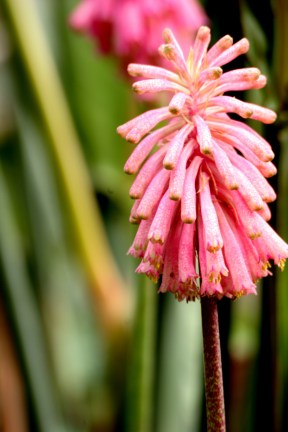
My question first met with a blank, and then, a stalk with a pink flower popped out. At first, it was the bleeding heart flower but became a larger, bell-shaped flower.

file5601245095844

From this:

file000599422326

To something closer to a single one of these:

Then, another and another popped up. Eventually, they started to lean down and crumple. I had a sudden fear that they were withering and dying from some blight, and indeed, they soon disappeared. However, the ground then gave birth to green leaves, like those from orchids, coming out of the ground by the hundreds, spreading out and out and out. I was struck by the abundance of this–an overwhelming sense of compassion and generosity.

I was almost in tears of gratitude as I came out of this meditation. I realized again, that the problem of this kind of pain only bites and tortures when focused on “me“. The question isn’t what I can, should, or will do for myself. That will continue the focus on the pain that is here, never getting beyond it and keeping the story locked in my orbit, reinforcing that story even. Instead, how can I give to all? If my focus becomes about abundance outward, I’ll find lushness throughout existence. Then, it’s not about me. It’s about the universe. It’s about All.

Identification born of ignorance is a source of grief, and its fading a move toward freedom, as I learned in the days following the death of my only daughter, Ona. She had been congested; her doctor failed to notice her swollen ankles and pale complexion. She was a cherubic child, and we, too, were slow to appreciate the extent of her listlessness. A trip to another physician led to a rush to the hospital; Ona died that night. Her heard had a hole in it and could not keep up with the increased burden of pneumonia.

Days and nights followed in a blur of emotion. Relatives wept with us, visitors came and went, sleep was elusive. The pain made a home in my body and lived there. I had never known such grief. Yet, sometimes, I was able to experience this grief in a nonidentified way, noticing feelings rise and fall, as I did in meditation. And I began to detect a pattern. Whenever a telephone call came–yet another person expressing sympathy–my grief erupted anew. Emotion welled up from my belly through my heart, my head flushed with sensation, my eyes filled with tears.

Watching this time and again, I saw how, at the moment of contact with the caller, an image formed in my mind: the father who lost his child. Instead of experiencing the shifting emotions of the moment–now sadness, now disbelief, now compassion for my wife–I inhabited the image of someone overwhelmed with grief. I identified with that fabricated image, stepped into it as if boarding a train, and became overwhelmed. The immediate suffering was compounded, distorted, and amplified. Knowing this was freeing. Once I discovered this pattern, I was able to watch the train come into the station but not board it. I still felt grief: Ona was of my heart; her absence was confusing and painful. But when I stopped stepping into the mental-emotional construction of “the grieving father,” that pain became less sharp and turbulent because it was not proliferated into a “second arrow” of suffering.

Insight Dialogue:The Interpersonal Path to Freedom, Gregory Kramer, pp. 65-66


Later on in the evening, I read the following in Matthieu Richard’s “Happiness” before falling asleep.

As the pain that afflicts us grows stronger, our mental universe contracts. Events and thoughts continually rebound off the walls of our circumscribed inner prison. They speed up and gather force, every ricochet inflicting new wounds. We must therefore broaden our inner horizons to the point where there are no walls for negative emotion to bounce off of. When these walls, built brick by brick by the self, come tumbling down, suffering’s bullets will miss their mark and vanish in the vast openness of inner freedom. We realize that our suffering was forgetfulness of our true nature, which remains unchanged beneath the fog of emotions. It is essential to develop and sustain this broadening of the inner horizons. External events and thoughts will then emerge like stars that reflect off the calm surface of a vast ocean without disturbing it.

One of the best ways to achieve that state is to meditate on feelings that transcend our mental afflictions. If, for instance, we gradually let our mind be invaded by a feeling of love and compassion for all beings, the warmth of such a thought will very likely melt the ice of our frustrations, while its gentleness will cool the fire of our desires. We will have succeeded in raising ourselves above our personal pain to the point where it becomes almost imperceptible.

Exercise: When you feel overwhelmed by emotions
Imagine a stormy sea with breakers as big as houses. Each wave is more monstrous than the last. They are about to engulf your boat, your very life hangs on those few extra yards in the rushing wall of water. Then imagine observing the same scene from a high-flying plane. From that perspective, the waves seem to form a delicate blue-and-white mosaic, barely trembling on the surface of the water. From that height in the silence of space, your eye sees those almost motionless patterns, and your mind immerses itself in clear and luminous sky. The waves of anger or obsession seem real enough, but remind yourself that they are merely fabrications of your mind; that they will rise and also again disappear. Why stay on the boat of mental anxiety? Make your mind as vast as the sky and you will find that the waves of afflictive emotions have lost all the strength you had attributed to them.

After reading this, I lay there in bed and started winding my mind into sleep. As I closed my eyes, I saw the image of a statue of an elephant’s head facing me. It was ancient, long forgotten in some lost glade of the Indian wilds. It was overgrown with grass and hanging vines, although only partially–his regal head was still clearly visible as well as the details of the carving. The foliage hung gently, emphasizing his calm majesty, and the light green was punctuated at the crown of his head and along the edges of the ears with light pink flowers–the same that I had seen in my meditation. His calm warmth inspired me and reminded me that the selfless path to nirvana is described in the Dhammapada as the training of the elephant. This ancient wisdom is still here to calmly inspire and point out the path, overgrown as the symbols may be, even in the darkest times of our lives. That smiling, beautiful tranquility is right here to be seen. I drifted off with this serene joy.

elephant cc

Something like this guy, but just the head from straight on–face to face, and much closer…


At a retreat about 2 years ago, the shaman in charge told all of us that the point of what we were doing was to get beyond the head and into the heart. He was completely correct, but maybe, it was in an even deeper manner than he realized.

Mahayana Buddhism urges practitioners to rouse bodhicittaBodhicitta is translated usually as awakened mind or awakened heart and sometimes as noble mind or noble heart. The point I want to pull out here is that mind and heart are not clearly distinguished as separate in this Sanskrit word. When we Westerners say “mind”, we generally think only of the intellect, but ultimately, mind is all of our experience. All experiences we have in our lives are filtered by our mind. Our emotions, our thoughts, our perceptions, all take place within our receptive engagement with the universe–consciousness: mind. If anything, part of our problem as Westerners is that our usage of these words has tried to split out emotions, “heart”, from what we’ve made into a more idea-laden space of “mind”. However, psychology would show us that even emotions are tempered by our concepts, (hi)stories, and social constructs. Our experience of heart is not separate from our experience of mind. It really is Heartmind (inspired by Sanskrit’s lack of clear distinction between the two).

Opening the heart and traveling into its depths then is both getting beyond the head AND awakening the mind–the heartmind. Really reaching into these depths of mindheart is stepping past all of our identifications and constructs. It’s finding the empty and open potential for all unfolding in this moment–sheer luminosity. We can call it creative force, Source, Tao, or buddha-nature, but opening to this emptiness behind/within All, shunyata, is the great spiritual journey of the warrior who seeks to awaken the heart. Seeing this, even briefly, goes beyond intellectual constructs of self and lights the abundant fire of compassion that is bodhicitta; it makes the awakened heartmind beat with abundance.


Life is a dream,
the years pass by like flowing waters.
Glamour and glory are transient as autumn smoke;
what tragedy–for with the sun set deeply in the west,
still there are those
lost among paths of disillusionment.

Our heart should be clear as ice.
Forget all the worldly nonsense.
Sit calmly, breathe quietly, heart bright and spotless as an empty mirror.
This is the path to the Buddha’s table.

The Book of the Heart: Embracing the Tao, Loy Ching-Yuen, “On Tao: §3”

May this inspire other warriors to rouse bodhicitta and let their heartminds overflow with abundance. May the training of self, the harnessing of the process of walking the path–the trained elephant–act as a guide and inspiration on the path.

Gassho!


Previous Heartbreak Wisdom Journal Entry– Entry 11: Just Live
Next Heartbreak Wisdom Journal Entry– Final Entry: Letting Go of Letting Go

Previous Older Entries Next Newer Entries