“Whatever arises”

This is another passage taken from a recent morning pages session. Again, I’ve skipped past some initial words to get to the insightful part.


So, I feel a bit tired this morning–also due to a couple extra hours at work last night. However, I’m glad to show up again today, no matter what arises. “Whatever arises” is a mantra I’ve had in mind a lot recently. Ultimately, I feel that it captures the liberation from samsara of the Buddha way. The Buddha resides in the burning house. The Buddha’s path doesn’t lead to some special place beyond the world we live in or transcend it through some sort of sleight of hand: appearing here but residing elsewhere. No, the Buddha experiences nirvana in samsara. He merely presides with joy, with loving-kindness, calm-abiding, no matter what arises. In explaining equanimity like this to friends, they misunderstood it as complacency. I understand why one might think that, but that’s not it. The Buddha is not telling us to not walk a path, to not cultivate certain ways or positions. Reading The Dhammapada quickly makes it clear that the Buddha way requires an ongoing engagement that prefers the greater joy over the lesser. However, a great part of this joy is in meeting the challenges of change and the snares of Mara with a peaceful smile–nonattachment to conditions being any particular way. Come what may; whatever arises.

It may be easy to rail against this again, but a look at the Tao Te Ching or even the Stoic works of Epictetus or Marcus Aurelius would bring us to similar, if not the same, conclusions. Equanimity does not mean non-action or passivity: complacency. Imagine Buddha walking across India again and again for 45 years after his enlightenment, teaching everywhere he went. Imagine Marcus Aurelius writing his “Meditations” at night on the battlefront. Wu wei, the right action of skillful means, requires seeing reality as it is–the unfolding flux of Tao, emptiness’ dance–and flowing with that change without attachment. This is doing without doing: not forcing the world, rather acting along with whatever arises. It’s not inaction or reactivity; rather, it’s working in accordance with nature, a properly attuned action with Tao. This is a key to the Way of the Sage, the Way of the Buddha, and the Way of the Lover of Wisdom (a philosopher).

DSC_0052


For comparisons with the comments on wu wei at the end, look at my posts on the Tao Te Ching, particularly: Tao a Day–Verse 8: In Accordance with Nature, Tao a Day–Verse 26: Inner Virtues, and Tao a Day–Verse 63: Doing without Doing.

May this inspire you to be at peace, whatever arises.

Gassho!

Path of the Dharma: Dhammapada – Chapter 12: “Self”

Disclaimer: This book has 26 chapters, and I highly recommend you get a copy and read them all. I’ve had to pick and choose, and in so doing, much is passed over. I only hope to emphasize what is key for getting to the other side, but even in my choices, it would be too long to write out each whole chapter, so I have to pick selections from them as well.


Learn what is right; then teach others as the wise do. Before trying to guide others, be your own guide first. It is hard to learn to guide oneself.

Your own self is your master; who else could be? With yourself well controlled, you gain a master hard to find. (Chapter 12, Verses 158-160)

Stephen Ruppenthal introduces this chapter in my translation with an analysis of how the Buddha does not specify his position on what the self is; he cites the Buddhist scholar/philosopher par excellence, Nagarjuna. The Buddha, indeed, does not posit: “The self is X”. However, both here and in the opening lines of the first verse, (“All that we are is the result of what we have thought” see my previous post on the first chapter here), the Buddha makes clear that the self is something that can be trained. As such, it is something that can change; thus, it follows the Buddha’s emphasis on impermanence as does all else. The Buddha does not posit here that there is no atman (a soul), but he does say that the self is something that can be trained, mastered, and he indicates that the spiritual path is one in which you master yourself. The Buddha doesn’t posit anything about the self’s nature, as that would go entirely against the point (i.e. positing something that “atman is”.). Rather, he indicates selflessness, or as is often described as the Buddha’s position: no-self. As he says later in chapter 20: “All states are without self; those who realize this are freed from suffering.” He displays to us that what we label self is not fixed or permanent, rather a dynamic process: one that can be trained and mastered. A permanent, unchanging thing is not open to such dynamism. A biography I have recently read about the Buddha expressed the subtleties of this stance very well:

This was the last thing Gautama wished to communicate. He believed that in this life we inherit the karmic consequences of our actions in past lifetimes, and that when we die, our future existence will depend on our moral state in this one. Having been brought up to believe implicitly in rebirth, this didn’t raise for Gautama or his listeners the metaphysical problems it brings to many who hear these ideas today. He was trying to get away from metaphysical abstractions and point people towards the kind of experience they could detect and observe. Of course, Gautama was saying, every person, including a Buddha, thinks, feels and experiences; the point is that how we think and feel shapes the kind of people we become in the future. The self, therefore, is a process and the task is to shape it. The wanderers should stop asking of life, ‘What is it?‘ or ‘Where is the true self?‘ They should look, instead, at their actual experience and ask, ‘How does it work?‘ Sue Hamilton succinctly encapsulates Gautama’s approach: ‘That you are is neither the question or in question: you need to forget even the issue of self-hood and understand instead how you work in a dependently originated world of experience.’ (Blomfield, Gautama Buddha: The Life and Teachings of the Awakened One, p. 151)

whirlpool-waves

The self is a process that changes with time like the flow of a river (read Hesse’s famous “Siddhartha”) or the waves ebbing and flowing on an ocean. Note: the flux of some processes can take a very, very long time–such as the erosion of a mountain. That does not make the mountain a permanent, solid entity…

In the quoted passage from Chapter 12, as elsewhere in the Dhammapada, the Buddha tells us to guide ourselves to develop our own wisdom (especially if no wise people are around to guide us–he clearly states it is better to go alone than follow the spiritually immature) and master our own minds. No one else can master them for us. This is the most fundamental aspect of the path–the aspect that wholly depends on our own efforts and no one else’s.

The evil done by the selfish crushes them as a diamond breaks a hard gem. As a vine overpowers a tree, evil overpowers those who do evil, trapping them in a situation that only their enemies would wish them to be in. Evil deeds, which harm the doer, are easy to do; good deeds are not so easy. (Chapter 12, Verses 161-163)

This injunction to not do evil comes right after the call to master the self. How are they connected and what exactly are we supposed to avoid? The answer could readily be seen in the twin verses of the opening chapter already discussed in my previous post. Self-mastery, the proper way to guide yourself, is to tame your thoughts in such a manner that will bring you away from sorrow and closer to joy beyond death–nirvana. It’s a taming that cultivates selfless thought–thought in accordance with the Eightfold Path, rather than the selfish thoughts that our mind is constantly lost in as untamed monkey mind. Selfless thought shapes the mind in a way that brings joy and nirvana. Selfish thought molds the mind in a way that brings sorrow and samsara.


May this help you see your “self” in a light that allows you to cultivate joy for yourself and others. May you be inspired to read through this great spiritual work and find the path to liberation from suffering. May you have the generosity, energy, discipline, patience, meditative insight, and wisdom to walk it.

Gassho.

Waking Up Now, Not Waiting for “It” to Be All Over

The following set of morning pages were written about hearing Avicii’s “Wake Me Up”. I’m taking out some of the more personal rigamarole to get straight to the point.


It was spun crap about living in the moment. How is that position always turned into a justification for hedonism? Compile a set of moments that you want. Continue to do so. That’s the path to happiness. Such is the implied conclusion of that point of view. In comparison, I’m drawn to a Taoist-Buddhist-Stoic idea of happiness. It’s easy to show up to the moments you like, but if that’s the case, happiness is and always will be externally dependent.

The Sage, the Buddha, the Wise: these individuals don’t require conditions to be just right to be happy. They have cultivated an internal wealth that is not dependent on the schemes of the ego to get everything just right. Rather, they realize, as Lao Tzu tells us in the Tao Te Ching that everything changes, so controlling conditions through force cannot last.

So “waiting to be woken up when it’s all over” is always going to be lost (during and after) and never will realize it. It’s lost in the ego’s search for deliverance–a way out. The “all over” is the escape of better, wanted conditions. The Sage smiles upon such inherent delusion. S/he just lives with joy, no matter what comes–a blooming lotus in the muddy waters.

water lily


For comparison, read my posts on similar points including: Tao a Day: Verse 26 – Inner Virtues, Path of the Dharma: The Dhammapada – Chapter 1: “Twin Verses”, and Nothing to Do.

May this bring you the resolve to cultivate your own inner strength, your own wakefulness, and your own pure heart without relying on the world to give you the never existent stability of “just right”.

Gassho!

Nothing to Do…

If, if, if…
A set of checkboxes
Mark them all, and…
Get happiness?
Even a spiritual path–
A pursuit of spiritual materialism
An accumulation of ego
The doing of an “I”
“My attainment”
A misperception
Of Truth
“I” am not solid–an illusion
The word, a placeholder,
A Transcendental Unity of Apperception
My “Higher Self”?
Not like anything conventionally conceived:
The ebb and flow of everything
Not separate from it-
A divine chaos–unfolding
The beautiful, empty, mysterious Tao
Emerging-abiding sway of all difference
The path: There’s nothing to “do”
Nowhere to “go”
Enlightenment is here: in this moment
Nirvana in samsara
Just live: realize this one step.

file0001052140987


Inspired by a wonderful meditation this morning and all the wise things I regularly read: in this case, I’ve been particularly moved by Dainin Katagiri’s You Have to Say Something. This passage clarifies some of the final lines:

So, how can we practice zazen as an end in itself? All you have to do is take a step. Just one step. Strictly speaking, there is just one thing we have to face, and nothing else. If you believe there is something else besides this one thing, this is not pure practice. Just take one step in this moment with wholeheartedness. Intellectually, we think about the past and the future, but if we take one step, this shore and the other shore are now. Taking one step already includes all other steps. It includes this shore and the other shore. This one step is zazen.

I’ve also been amazed by a recent find of Loy Ching-Yuen’s The Book of the Heart: Embracing Tao. I would put it up alongside the Tao Te Ching and the Dhammapada; it’s a beautiful intertwining of Taoism and Buddhism written by a true master from about a century ago. I plan on writing about several passages in the future. For now, enjoy these selections from the sections On Tao:

3. Life is a dream,
the years pass by like flowing waters.
Glamour and glory are transient as autumn and smoke;
what tragedy–for with the sun set deeply in the west,
still there are those
lost among paths of disillusionment.

Our heart should be clear as ice.
Forget all the worldly nonsense.
Sit calmly, breathe quietly, heart bright and spotless as an empty mirror.
This is the path to the Buddha’s table.

5. What labor we expend sorting out our mundane chores year after year.
But doing them without regret or tears,
without resistance,
that’s the real secret of wu wei
like the mountain stream that flows unceasingly:
Elsewise, all we do goes for nought.

We can hold back neither the coming of the flowers
nor the downward rush of the stream;
sooner or later, everything comes to its fruition.
The rhythms are called by the Great Mother,
the Heavenly Father.
All the rest is but a dream;
We need not disturb our sleeping.

To see his brilliant fusion of Buddhism and Taosim better, compare this quote with my analysis of wu wei here and my analysis of the famous lines about flowers falling in Dōgen’s Genjōkōan here.
Finally, my words here make subtle references to Chögyam Trungpa, Immanuel Kant, Martin Heidegger, and Gilles Deleuze, and this meditation and wordplay would never have come to be if I hadn’t recently read the Dalai Lama’s How to See Yourself as You Really Are, all of which (these myriad sources!) I highly recommend to anyone willing to begin a spiritual path with heart.


May this inspire your own investigations and journeys along the path, fellow wanderers. May you find ideas to play with and solace in the beautiful words of all these masters who have brought these insights into my life.

Gassho!

Showing Up?

I wonder right now how much of our lives are lived waiting for the next moment–in anticipation of something else. I just sipped my coffee, and I realized as the taste hit my tongue along with the tender reaction against the hot fluid that for the most part, these sips are taken automatically–rushing to do the next thing. It’s hardly even noticed because your mind is focused on whatever you are very briefly interrupting by picking up the coffee cup or whatever you will be doing as soon as you set it down.

I just took another sip, and I intentionally slowed down, feeling the heat from the coffee rising up against my face, looking down and seeing my reflection in the coffee: my eyes and nose rippling in the dark. How little are we present to our lives?

You might say that you show up all the time, but most any examples you would give would be the handful of moments that you look forward to–your escape from all the things you don’t want to be present for. It’s easy to show up for things you like. In fact, most people try to handle their lives by trying to make it all something they like, but this doesn’t save them from illness, old age, loss, and death. You’re going to be in moments you don’t want to be in–traffic jams, public restrooms, cat barf, and flubbed orders at restaurants… heartbreak, false friends, body aches, and self-righteous dunces.

file0001429396083

It’s hard to show up for the moments you don’t like

The question: Can you show up to all these moments too? Can you be present to all the things you don’t like? Can you sit with the world as it is with equanimity? Can you let this grow into the tender openness of compassion for all? I dare you to try.


May this help you develop mindful presence in all of life’s situations.

Gassho!

Riding the Radio Waves

Calmly, smoothly
Life trickles in
Drops of experience
Joy, sadness, beauty

Underneath, an unease
Reaching a crescendo
Barreling forward
Into the unknown
The drops–life–
Increase in intensity

This wave crashes down
All becomes still
Yet only momentarily
Soon, rising again

IMG_2141

We ride the waves
Moving forward
Excited? Scared?
Or something else–
Empowered with Equanimity
Going with the flow of all:
The Watercourse Way
Smiling at the emptiness:
The Bodhisattva Way

Don’t fear the insecurity,
The “chaos”
Enjoy the luminous ride:
Distinguish waves from ocean


This writing was inspired by this song (Radio Waves because the song is Radio Protector):

May those who read this and who hear this music find their own equanimity in the luminous ride of life.

Gassho!

Heartbreak Wisdom Journal — Entry 8: Reclaiming Shards of the Past

For the longest time, I’ve been unable to listen to one of my favorite songs. Why? During my time with my ex, it became a song about our relationship, and sometimes, even she called it “our song”. This song is “Your Hand in Mine” by the ever-magnificent Explosions in the Sky. This post-rock anthem has always tugged at my heartstrings, despite having listened to it hundreds of times.

After being dumped, the reminders of everything were just too much to listen to this song. At this point, it still plucked at those heartstrings but in a way that I could not bear. I’d just skip it whenever I heard it. Recently, though, I found myself listening to this song again one morning over my ritual cup of coffee. Not only did I listen to the song once, I repeated it numerous times, taking a simple joy in listening to this beloved song for the first time in a long while.

It’s very difficult to get past the emotion in such things. Most people try their damnedest to forget by covering up their past or running from it. That’s not really moving on though (See an earlier post on this here). That’s just as reactive as clinging to something, and running like that leaves unresolved issues, untended wounds seeping deep inside. It takes time and patience–a resolve and open courage–to face the terrors and tortures that you experience in life and sit through them, yet there is no better way to be authentic and to walk your life’s path with a compassionate and awakened heart.

I’ve also found an ability to listen to this song recently which has always symbolically reminded me of the connection of the love between me and her. Now, the pain of that connection is no longer frightening or anxiety-provoking. It just is. I can hear these songs and experience the joy and beauty of them along with residual feelings of pain and sadness. That no longer scares me. After all I’ve been through in the last few months. I can sit with equanimity through many more of life’s challenges; strong, courageous, and awake–the tender presence that gives birth to deep compassion.


Thoughts and emotions will always arise. The purpose of practice is not to get rid of them. We can no more put a stop to thoughts and emotions than we can put a stop to the worldly circumstances that seemingly turn for or against us. We can, however, choose to welcome and work with them. On one level, they are nothing but sensations. When we don’t solidify or judge them as good or bad, right or wrong, favorable or unfavorable, we can utilize them to progress on the path.
We utilize thoughts and emotions by watching them arise and dissolve. As we do this, we see they are insubstantial. When we are able to see through them, we realize they can’t really bind us, lead us astray, or distort our sense of reality. And we no longer expect them to cease. The very expectation that thoughts and emotions should cease is a misconception. We can free ourselves from this misconception in meditation.
In the sutras it says, “What good is manure, if not to fertilize sugar cane crops?” Similarly, we can say, “What good are thoughts and emotions–in fact all of our experiences–if not to increase our realization?” What prevents us from making good use of them are the fears and reactions that come from our self-importance. Therefore, the Buddha taught us to let things be. Without feeling threatened or trying to control them, just let things arise naturally and let them be.
When ego-mind becomes transparent through meditation, we have no reason to be afraid of it. This greatly reduces our suffering. We may actually develop a passion for seeing all aspects of our minds. This attitude is at the heart of the practice of self-reflection.
-Dzigar Kongtrül, “It’s Up to You”, pp. 8-9

pablo (2)


May this inspire you to find your own ability to let things be and to utilize your own experiences to increase your realization.

Gassho!

Previous Heartbreak Wisdom Journal Entry– Entry 7: Letting Go of the Person You Used to Be (Part 2)
Next Heartbreak Wisdom Journal Entry– Entry 9: Scar

Just Be

This moment
Arises & Disappears
Like a soap bubble
Blown by a playful child,
Shimmering with rainbows,
Floating gracefully
Or awkwardly,
Popping suddenly,
With only the trace
Of memory

20150405_083325

Each moment,
No matter the agony
Or ecstasy,
Is just like this.
With each,
Let it just be.
Trying to hold onto the bubble
Pops it sooner
Trying to pop it,
Leaves soapy hands.

Just be in every moment
Those bubbles come and go
Shining luminously
Then disappearing
Just as in a dream


See also:

Water’s Flux
Tao a Day: Verse 16 – Emptiness
The Practice
The Waking Dream
Suffering and Sweetness

Path of the Dharma: Dhammapada – Chapter 1: “Twin Verses”

This opening chapter shows the way by pointing out the enlightened path and comparing it to the deluded path. The amazing thing about this opening passage is its balance between solid ethical philosophy/cognitive-behavioral psychology and more austerely poetic spiritual maxims. It’s pretty long, so I’ll only cover part of it, and I’ll go through that part in pieces.

All that we are is the result of what we have thought: we are formed and molded by our thoughts. Those whose minds are shaped by selfish thoughts cause misery when they speak or act. Sorrows roll over them as the wheels of a cart roll over the tracks of the bullock that draws it.

All that we are is the result of what we have thought: we are formed and molded by our thoughts. Those whose minds are shaped by selfless thoughts give joy whenever they speak or act. Joy follows them like a shadow that never leaves them. — Trans. Easwaran

This initial chapter is called “Twin Verses”, and the reason is clear here. We have the deluded and enlightened paths–samsara and nirvana–side by side, twinned in the same structure and style of explication.

IMG_1959

The first sentence is the same in both, and it reveals the importance of karma in a way that resonates with Western philosophy and cognitive psychology. Aristotle’s Nicomachean Ethics couches virtuous (that is excellent) action in an ongoing awareness of oneself within a social landscape. This requires an ongoing examination of how I have been molded by my background–upbringing and origin–and how I am molding myself further with each thought and action. Another familiar parallel is cognitive-behavioral psychology, which is more or less the successor of a Stoic understanding of the mind. Our thoughts mold our perception of ourselves and the world. In that sense, all that we are and all that the world is are the thoughts that mold us/it. Therapy, then, becomes an engagement to change the thoughts that harm us and the related behaviors to those thoughts. With these comparisons, the relevance of the Buddha’s position for us from the West is made clear.

Our two paths are displayed before us, and this is where the Buddha goes dramatically beyond these familiar points of comparison. The deluded path of ongoing suffering is the path of selfish thoughts. This includes all the plans oriented on my own aggrandizement. Out of the just listed Western parallels, the Stoics would be the only ones to make this dramatic leap (I’m reminded here of Marcus Aurelius speaking of being a citizen of the Universe). Selfish thoughts, even those oriented toward my success, my story, and my truth, even when they don’t harm others, will lead ultimately to dukkha, i.e. suffering, discontent, and continual yearning.

Why? This is a path that continually tries to get beyond the inevitability of impermanence. It’s an ongoing attempt to rig the game just right to get me that happiness of success that will never dissipate, never change, never fade. If I try hard enough… If I plan thoroughly enough… If I get the conditions just right…

Notice how all these thoughts are turned inward. If the world gives to me just right, I will be happy. That is the crux: external conditions have to be right, whether following the path of avoiding pain or pursuing pleasure. The energy of this system goes from outside to inside, from the world to me, thus the inward nature of these thoughts. “I” become the focus and goal of thoughts set up toward making my life just perfect. Even if that perfection includes others, it’s still about my perfect life.

In comparison, the enlightened path is one of selfless thought (and action). Such people (at least attempt to) give joy to all in all their speech and action (that which follows from thought), and hence, they are regularly cultivating joy in situations. It follows them everywhere. This invites a larger discussion of Buddhist psychology and karma, but let’s put this simply: the first path keeps the selfish person in an ongoing chain of cause and effect. His or her actions bring consequences that maintain an enduring cycle of felt dissatisfaction and of fighting to be free of this dissatisfaction with subsequent action … which is ultimately not fully satisfying. Selfish thought leads to selfish action which leads to the karmic consequence of this never-ending cycle: samsara. The other path invites us to at least see the difference. Then, perhaps, we have a gap after selfish thoughts arise–before we speak or act on them. Realizing that they lead only to sorrow, we instead change our thoughts, speech, and actions to more selfless ones. With time, this practiced self-reflection becomes a new mold for our thoughts, and selfless thoughts come on their own. With such a shift, we attempt to give joy to all, attempting to help them find peace, happiness, and health (by inspiring them to step beyond sorrow-laden paths as well). With this, we first begin cultivating more positive chains of consequences (as if that’s a necessary motivation), and ultimately, we step beyond the cycle of ongoing dukkha–that karmic chain is broken.

Notice that this second passage focuses on the selfless person giving joy, not getting it. Here, we have the contrast that this path is not inward-oriented like the first, in the sense of seeing the world’s purpose as to give to me or for me to take from it. Instead, this is outward-oriented. My thoughts are aimed out from myself toward the joy of all. The energy of this system now moves from me outward, rather than the inward grasp of appropriation for self. Through such a step beyond concern about my own joy, beyond “I”, me, and mine, I paradoxically realize that very joy in myself.

Let these discussions open one other passage for consideration:

“He insulted me, he struck me, he cheated me, he robbed me”: those caught in resentful thoughts never find peace.

“He insulted me, he struck me, he cheated me, he robbed me”: those who give up resentful thoughts surely find peace.

For hatred does not cease by hatred at any time: hatred ceases by love. This is an unalterable law. — Trans. Easwaran

Again, I’m reminded of Western philosophy in that one of Nietzsche’s greatest concerns is man’s propensity for “ressentiment”–more or less, resentment. The problem is precisely how inwardly driven this is–it’s literally a feeling again and again, a “re-sentir” (to feel again). This keeps us trapped and tortured, perpetually reactive, rather than vibrant, active, and creative. We get again and again, but we only get the pain of a stung mind, an envenomed heart. As in the passage of Thus Spake Zarathustra (II, 29–The Tarantulas), we feel the toxic bite of the tarantula, again and again, stagnant and rotting with emotional poison, and with Nietzsche, according to Deleuze, the problem is that this reactivity, this “feeling again”, lies throughout our entire human psychology. So the question becomes how do we step beyond this into that active state, rather than feeling reactivity everywhere?

To exemplify this problem, we can take another verse from chapter 18 of the Dhammapada:

There is no fire like lust, no jailer like hate, no snare like infatuation, no torrent like greed.

Notice that all of these are reactive evaluations–wanting to have what one does not have or jealousy of what someone else has (which is really another version of the same). In each, we become trapped in or tortured by reactivity. Hate, the jailer, is an instance of not wanting, and as such, it is wanting. It is not wanting a situation or person to be as he/she/it is, so it is wanting to have the world be completely different for me. (See my comments on love and hate in Love, Rebounds, and Relationships: Part 3 – Love and Metaphysics and also my comments on hope and fear in Reiki-The Five Precepts: 2nd Precept-Faith)

In comparison, the Buddha offers the selfless, enlightened path, one that is not stung by holding on to the continual, reactive poison of internalized wrong done to self:

For hatred does not cease by hatred at any time: hatred ceases by love. This is an unalterable law.

To let go of the resentful thoughts, the bars of the prison of hate, we cannot negate that person or thing out there which has wronged me. This is the most basic impulse in us, but as Gandhi said: “An eye for an eye makes the world go blind.” Selfish action to escape pain, begets another and another, and moreover, it begets this same resentful and retaliatory (as with hatred) reactivity in others. The only way to get beyond this is to selflessly give–to love–rather than to selfishly take–to hate (remember that hate wants the world to be utterly different in a way more suitable to me; it is a wanting, and it can lead to the subsequent action of taking, through negation). This means even giving up the self-righteous thoughts of being wronged. You instead give yourself to the world, finding connection with it, finding the suffering in those who have “wronged” us, finding the compassion of an awakened heart.

IMG_9929_statue

In conclusion, let’s offer this passage of Red Pine’s translation of Verse 63 of the Tao Te Ching which I discussed in a recent post. These guiding words for the Sage go hand in hand with the Buddha’s words for the arhat who walks the selfless path of love, peace, and joy:

Act without acting
work without working
understand without understanding
great or small[,] many or few
repay each wrong with virtue
– Trans. Red Pine


May this inspire you to read the rest of this beautiful chapter and the whole book. May it show you the first steps on the selfless path, and may you begin to walk it towards joy, peace, and love.

Gassho!

Ayn Randian Dreams (Nightmares?) — A Philosophical Mosaic

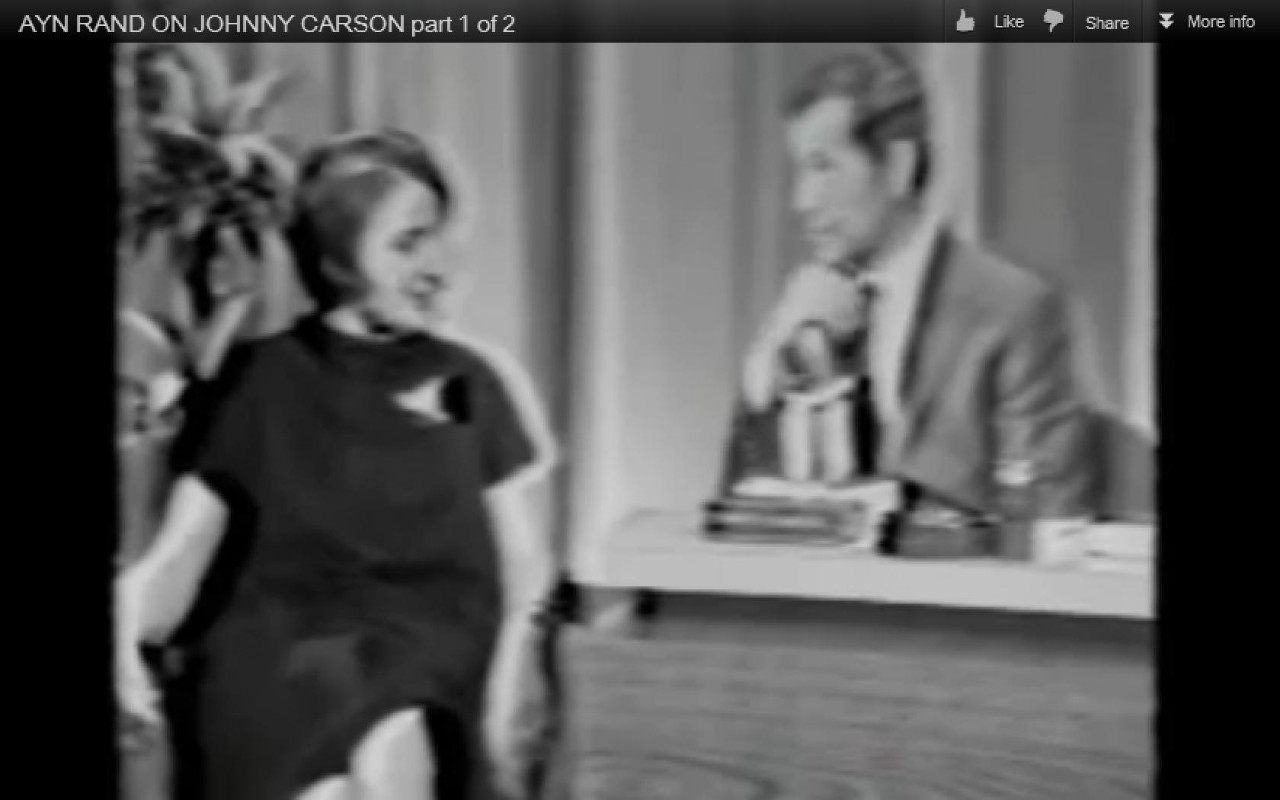
I saw a clip–
A grey, hazy time capsule,
Chronicling our past
Yet so present…
Still a specter
Which dominates our minds

Ayn Rand on Johnny Carson???
She expounds,
In a gratingly brittle voice:
The virtue of greed
The reason in selfishness
Only a system
In which
Every man pursues
His own “Reason”
Is one
In which
Humanity can be
Actualized
Capitalism is this system?
Surely a jest!
Each man is not free
Nor guided by his reason
In our system
Of markets
Of money
Of subjugation
–All for profit…

cq5dam.web.1280.1280

She says at the outset:

Man’s proper ethics, or morality, is a morality of rational self-interest. Which means that every man has a right to exist for his own sake, and he must not sacrifice himself to others or sacrifice others to himself (brief pause) that the achievement of his own rational happiness is the highest moral purpose of his life. As a consequence of that, the only system, the only political system, that expresses this morality is the system of laissez-faire capitalism, by which I mean full, unregulated, uncontrolled capitalism, a system based on the recognition of rights, including property rights…

Yet capitalism seeks
To subvert fellow men
Sacrificing others to one’s reason
Readily
Often
Systemically
In the name of Profit,
The almighty God
–The only self-interest
Which receives worship,
The singular idol
Sitting atop
The altar of industry
Do you not believe me?
The annals of history
Surely show
Such systemic sacrifice of others
Upon the altar of Profit

The “Reason” of true Philosophers
Would not aim at this
As Wisdom, the Good, or Love
Those are the true aims
Of “Reason”;
Not this solipsistically myopic,
Self-serving materialism
Should we see this
As worthy successor
To profound analyses of eudaemonia?
I laugh
What other response is fitting?
As Nietzsche once said:
“Not with anger, rather with laughter does one kill.” *

What of the “Reason” of the Stoics?
Would they not scoff as well?
Laughing at how poorly,
How childishly,
You, lady with delusions of grandeur,
Have misunderstood
The entire Universe
And our place in it
Those who vouch
For other such
Individualistic notions
Of Truth and Wisdom
Are equally lost.
No authentic seekers of Truth…
Merely idealistic demagogues
Preaching greed from soapboxes,
Rather than providing wisdom
Or anything of substance.
They are lost
Yet declare it insight
Seeing shadows on the wall
As deep, whole, and true
Rather than with the wise sight
That has seen the sun
The sight that sees them
As empty figures


The immature are their own enemies, doing selfish deeds which will bring them sorrow. That deed is selfish which brings remorse and suffering in its wake. But good is that deed which brings no remorse, only happiness in its wake.

Sweet are selfish deeds to the immature until they see the results; when they see the results, they suffer. Even if they fast month after month, eating with only the tip of a blade of grass, they are not worth a sixteenth part of one who truly understands dharma.

As fresh milk needs time to curdle, a selfish deed takes time to bring sorrow in its wake. Like fire smoldering under the ashes, slowly does it burn the immature.

Even if they pick up a little knowledge, the immature misuse it and break their heads instead of benefitting from it.

The immature go after false prestige – precedence of fellow monks, power in the monasteries, and praise from all. “Listen, monks and householders, I can do this; I can do that. I am right and you are wrong.” Thus their pride and passion increase.

Choose the path that leads to nirvana; avoid the road to profit and pleasure. Remember this always, O disciples of the Buddha, and strive always for wisdom.  — The Dhammapada; Chapter 5, Lines 66-75


A human being is a part of the whole called by us “the universe,” a part limited in time and space. He experiences himself, his thoughts and feelings, as something separate from the rest–a kind of optical delusion of consciousness. This delusion is a kind of prison for us, restricting us to our personal desires and affection for a few person nearest to us. Our task must be to free ourselves from this prison by widening the circle of understanding and compassion to embrace all living creatures and the whole of nature in its beauty.  — Albert Einstein, found in The Places that Scare You by Pema Chödrön

May this bring you to think differently about yourself and your place in society and the universe. May it bring you to desire authentic wisdom and reason. May it inspire you to the love of wisdom (philosophy) and lead you down the path of many questions and insights.
Gassho!

*”Nicht durch Zorn sondern durch Lachen tödtet man.” — Nietzsche, Also sprach Zarathustra; Vom Lesen und Schreiben

Previous Older Entries Next Newer Entries