Path of the Dharma: Dhammapada – Chapter 12: “Self”

Disclaimer: This book has 26 chapters, and I highly recommend you get a copy and read them all. I’ve had to pick and choose, and in so doing, much is passed over. I only hope to emphasize what is key for getting to the other side, but even in my choices, it would be too long to write out each whole chapter, so I have to pick selections from them as well.


Learn what is right; then teach others as the wise do. Before trying to guide others, be your own guide first. It is hard to learn to guide oneself.

Your own self is your master; who else could be? With yourself well controlled, you gain a master hard to find. (Chapter 12, Verses 158-160)

Stephen Ruppenthal introduces this chapter in my translation with an analysis of how the Buddha does not specify his position on what the self is; he cites the Buddhist scholar/philosopher par excellence, Nagarjuna. The Buddha, indeed, does not posit: “The self is X”. However, both here and in the opening lines of the first verse, (“All that we are is the result of what we have thought” see my previous post on the first chapter here), the Buddha makes clear that the self is something that can be trained. As such, it is something that can change; thus, it follows the Buddha’s emphasis on impermanence as does all else. The Buddha does not posit here that there is no atman (a soul), but he does say that the self is something that can be trained, mastered, and he indicates that the spiritual path is one in which you master yourself. The Buddha doesn’t posit anything about the self’s nature, as that would go entirely against the point (i.e. positing something that “atman is”.). Rather, he indicates selflessness, or as is often described as the Buddha’s position: no-self. As he says later in chapter 20: “All states are without self; those who realize this are freed from suffering.” He displays to us that what we label self is not fixed or permanent, rather a dynamic process: one that can be trained and mastered. A permanent, unchanging thing is not open to such dynamism. A biography I have recently read about the Buddha expressed the subtleties of this stance very well:

This was the last thing Gautama wished to communicate. He believed that in this life we inherit the karmic consequences of our actions in past lifetimes, and that when we die, our future existence will depend on our moral state in this one. Having been brought up to believe implicitly in rebirth, this didn’t raise for Gautama or his listeners the metaphysical problems it brings to many who hear these ideas today. He was trying to get away from metaphysical abstractions and point people towards the kind of experience they could detect and observe. Of course, Gautama was saying, every person, including a Buddha, thinks, feels and experiences; the point is that how we think and feel shapes the kind of people we become in the future. The self, therefore, is a process and the task is to shape it. The wanderers should stop asking of life, ‘What is it?‘ or ‘Where is the true self?‘ They should look, instead, at their actual experience and ask, ‘How does it work?‘ Sue Hamilton succinctly encapsulates Gautama’s approach: ‘That you are is neither the question or in question: you need to forget even the issue of self-hood and understand instead how you work in a dependently originated world of experience.’ (Blomfield, Gautama Buddha: The Life and Teachings of the Awakened One, p. 151)

whirlpool-waves

The self is a process that changes with time like the flow of a river (read Hesse’s famous “Siddhartha”) or the waves ebbing and flowing on an ocean. Note: the flux of some processes can take a very, very long time–such as the erosion of a mountain. That does not make the mountain a permanent, solid entity…

In the quoted passage from Chapter 12, as elsewhere in the Dhammapada, the Buddha tells us to guide ourselves to develop our own wisdom (especially if no wise people are around to guide us–he clearly states it is better to go alone than follow the spiritually immature) and master our own minds. No one else can master them for us. This is the most fundamental aspect of the path–the aspect that wholly depends on our own efforts and no one else’s.

The evil done by the selfish crushes them as a diamond breaks a hard gem. As a vine overpowers a tree, evil overpowers those who do evil, trapping them in a situation that only their enemies would wish them to be in. Evil deeds, which harm the doer, are easy to do; good deeds are not so easy. (Chapter 12, Verses 161-163)

This injunction to not do evil comes right after the call to master the self. How are they connected and what exactly are we supposed to avoid? The answer could readily be seen in the twin verses of the opening chapter already discussed in my previous post. Self-mastery, the proper way to guide yourself, is to tame your thoughts in such a manner that will bring you away from sorrow and closer to joy beyond death–nirvana. It’s a taming that cultivates selfless thought–thought in accordance with the Eightfold Path, rather than the selfish thoughts that our mind is constantly lost in as untamed monkey mind. Selfless thought shapes the mind in a way that brings joy and nirvana. Selfish thought molds the mind in a way that brings sorrow and samsara.


May this help you see your “self” in a light that allows you to cultivate joy for yourself and others. May you be inspired to read through this great spiritual work and find the path to liberation from suffering. May you have the generosity, energy, discipline, patience, meditative insight, and wisdom to walk it.

Gassho.

The Practice

We go through
Day by day
Expecting…
More of the same
Routines, comfort
–Both good and bad,
“The same” returns

Yet, Life is full
Of happenings
–Unforeseen,
Unwanted
Chaotic
In a word:
Change

In a moment,
All can turn
That is the Truth
Such is All
The Universe:
Impermanent
Flowing–in flux

buddha-statue-378137_1280

All changes. Practice embraces this.

The Practice:
To accept this
As Truth and Path
Without attachment
To the way things were
Or the way things could be
Find comfort in the
Emptiness
And show up
With Compassion
For it All
Impartial:
Bearer of
Awakened Heart
Fearless and open

A Human Becoming

Heart beats–*ka-thump… ka-thump”
Breath inward/outward–*hnnnn…ahhhh…*
Thoughts zoom by–*”I should go do…”*

Feelings come & go–agony & ecstasy
Days pass–work, sleep, routine, adventure
Years flourish & wither–seasons, periods, phases

Connections are made & lost
Wrinkles appear & hair recedes
Scars & memories accumulate

Birth, birth, birth
           &
Death, death, death
—  In every moment
    With each heartbeat & breath

Tell me:
Where is the static “I” underneath the process of life?
Where is this being that endures
When all else arises and ceases?
—  A story, a fiction, a masterpiece of self-creation & self-deception

You are not a human being.
You are a human becoming
—  A realization of unfolding potential, moment by moment
An emanation of openness, that is: basic goodness

file0001379279594


Water’s Flux

Indigo waters gently stir
Under a night sky, black as emptiness
Foggy lights behind – the only luminescence
Ripples gently skim the surface,
Lapping at the dock’s beams
Lip, lup, lap, lup…

The water shimmers as it moves
Undulations in dim, pale light
A glittering, indigo, velvet flow
With each lap, the lake changes,
Water moves, dirt and particles shift
With every moment, fluctuation

The lake remains, but
It is imperceptibly different
I meditate – looking on the splendor
Of flux, of impermanence
As each ripple rolls toward me
Breathing in and out
Changing microscopically
With the lake
The “I” that appears the same
Just as the lake seems constant

Heartbreak

I recently had a tarot reading to get insight into my life outside of the perspectives of friends and family, beyond the spheres of people who already know me. My reader, a middle-aged black woman with thick dreds, was an interesting voice to hear amid the many others in my life. She did several spreads to see where I am at and how to overcome my current difficulties. I initially was pretty quiet and vague, but as what she was saying touched on several layers that she didn’t know about/talk about, I opened up to her.

Her initial message, and it remained the most stressed throughout, was about my job and how to regain some personal autonomy in relationship to career. She said something about it that really struck me: I’m heartbroken about my job. She clarified that heartbreak can occur in more than just our romantic lives, and many never even think about heartbreak with a job.

As she spoke, and more so after the reading, I realized how heartbroken I am right now. I have heartbreak related to love, job, home, family, and friends. Everything seems to float without stability, path forward, or clarity for the greater flow of my life. So many things I love have been cut out of my existence, have been dramatically altered, or have consistently done me ill while claiming to do me well. How do you move forward through such miasma? I have by the only way I know how: nurturing myself. Hence, I have been writing so much, meditating, and exercising. I have been talking things out with friends, and I’ve even been developing my intuition more by using the I Ching and tarot as oracles to broaden my perspectives about my life. Finally, beyond my usual self-care in times of difficulty, I’ve tried to improve my situation. If I’m heartbroken, particularly about my job, let me remedy that.

A few weeks ago, I did a meditation. Although not intended, it too was about heartbreak. I sat on the floor and breathed deeply with my hands over my heart in the shape of a triangle. I felt the energy pulse out of these three sides, throbbing out and reaching into the world around me. After some time, I put my hands down and asked myself: “If my heart were planted, what would it grow into?” I saw a vibrant blue flower open up, both beautiful and melancholy, filling my chest. When it opened, a personal object (I’m not willing to share this detail here) was dark and lifeless in the flower’s center. It felt like the culmination of a sad message, emphasizing my separation and loss of love, indicating the death of a deep connection. Then, the object shattered and bright, spiky, red petals burst forth, making the flower vibrant and hopeful. However, this did not seem like an erasure of the old, rather a rebirth from/of it. Like the phoenix, the new grows from the ashes of the old. The object shattered and reformed a few times, telling me that the break offers the possibility of growing into something more beautiful, powerful, healthy, and alive.

As for all of you, I’ll let you make what you will of such a meditation, but to me, it says one thing about heartbreak: even when things are very painful and it all feels meaningless, the possibility for change, growth, and rebirth lies hidden within that experience. It may be hard to see it, and it may be even harder to continue onward towards that, but it’s there, somewhere, just waiting for the moment to burst forth.

symptoms-of-a-broken-heart

Something new could pour forth from that hole…

This reminds me… I recently read a friend’s linked article about how we should court heartbreak to grow; we should break up and leave relationships behind when they become difficult because we’ll grow towards something better, and we’re doing ourselves a service. What I’m saying here does not support that at all. One thing that’s become clear to me in the last few months is how deeply we get caught up in our stories about ourselves. Some of my other posts touch on this. Leaving relationships, courting heartbreak, for personal growth, for pursuing your own narrative can be quite a confused and lost approach. Perhaps there could be value in this, but it is something that should not be taken lightly and certainly should not be presented as a hard and fast rule. It should be something that is examined through work with a therapist, someone who can challenge and disentangle the bad faith of the stories we tell ourselves, the things we refuse to see about ourselves, and the difficulties for personal growth in our relationships that we are unwilling to show up to and face for our own improvement. The problem with the stance in that article is not recognizing the opportunity in the difficulty of interpersonal dynamics to grow and change for the better. Breaking away is not what presents the room for growth; it’s the challenge of facing change that presents it. You can either own up to your place in a relationship and ask your partner to do so with you, working together for growth, or you can throw that all behind for “my growth”, “my story”, “my truth”. I’m not saying that the second option is always confused and self-involved, hardly, but I think there is a much greater likelihood of that being the case than that path being an authentic, examined, and clear engagement with all of the issues I’m presenting here. The point: heartbreak, when it comes, can be an opportunity for growth, but you shouldn’t seek to break your own heart in order to grow towards something “more authentic to you”. There is already authenticity in your connections; otherwise, it wouldn’t break your heart to leave them (not that I’m saying it isn’t hard to leave relationships that are bad for you; of course it is, but there is at least something good in the ones that really break your heart down to the foundations–real heartbreak, not just loss), and if your connections are that meaningful, there’s something to be gained from them if you are willing to dance with your partner and they are too.

This post has become a much longer meditation on heartbreak than originally envisioned. Let’s summarize what I would like to share about heartbreak. 1) you can be heartbroken about many more things in your life than just romantic relationships. 2) if you are going through heartbreak, do what you can for yourself to survive and eventually thrive. If you can work toward changing your situation, do it. Be your own healer, and remedy yourself. 3) heartbreak does not mean the end. There is possibility for new growth in the death of the old. 4) don’t throw things away from a willingness to break your own heart out of some simple idea of it being your story. Really think about relationships and how to grow in them. They hold potential if you are willing to dance with your partner and love together.

A great and famous writer recently told me to experience heartbreak in order to improve my writing. He said that going through heartbreak would offer the opportunity to process things and write better. Whether that’s true or not, I’m definitely doing that now, and I thank you all for sharing in that process. I hope that this post gives you your own insight and inspiration, especially if you have your own pained heart to heal.

I know… The heart chakra isn’t directly about what I’m discussing here, but maybe your growth lies in this aspect of your relationship with All coming into a healthier alignment. Maybe your heart needs healing in more ways than one…

Gassho

Transition – The Great Crossing

I’ve recently been undergoing a lot of transition in my life. Love, job, home, family, friends—it’s all up in the air! When life goes through such phases, it’s really hard to find your way, to even make sense of everything that is happening.

I’ve sought solace in many ways, but one of the best has been asking questions to the “I Ching”. I have consulted the Book of Changes now and then for years, but around this time of change, one reading has felt more profound than any before—salient, powerful, and important.

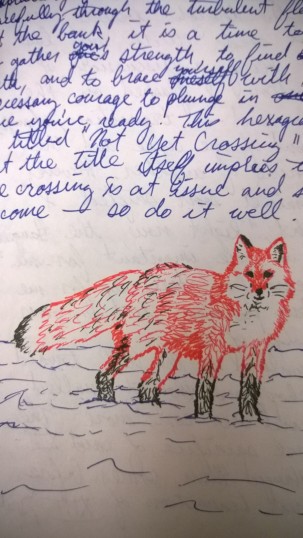
I recently threw hexagram #64, the final hexagram. The allegory of this hexagram speaks volumes about transition. A fiery red fox stands at the bank of a great river. To cross, he must plan his way and adapt to the swift current as he carefully crosses. His fur flashes red above the cool, coursing water, a small patch of flame over this much greater deluge, threatened to be snuffed out by it. We all must make our great crossings at times. We, like the fox, can feel overwhelmed by the sheer magnitude of the obstacles, of the changes we face. It really does feel like any misstep could lead to us being overwhelmed and swept away by the water of flux.

Yet, like the fox, our strength is to be found in ourselves, and even the greatest obstacles are not too great. With patience and cunning, we foxes can see how best to get to the other side. With a swiftness of foot and an adaptability for plans, we can move gracefully through the turbulent flow. At the bank, it is a time to gather your strength, to find your path, and to brace yourself with the necessary courage to plunge in once you’re ready. This hexagram is titled “Not Yet Crossing” or “Not Yet Across”, but the title itself implies that the crossing is at issue and soon to come, so do it well!wp_20141003_16_22_56_pro

I think the deeper meaning of facing transition like this is expressed well in one book I have on the I Ching called “The Living I Ching” by Deng-Ming Dao. He writes of this hexagram as the ending of one cycle and the beginning of a new one. This is what great transition is: a crossing from the old to the new, a movement from one side to the other.  He speaks of the meaning for the person crossing through transition as such: “This, then, is the river we ford: the border between one cycle and the next. How amazing. How outrageous. All along, we have been striving to blend with change. We have used the river as a metaphor for natural and harmonious living. And yet here, now, is the crucial message: understand change not by riding the river, but by facing it, confronting it. Cross it.” In other words, gather your strength when faced by this kind of change. Break from one cycle to the next by really facing the river and finding your way across it through determination, cunning, courage, and adaptability. You are the hexagram’s fire over water, and you can make it to the other side. The only way to cross is to accept the risk of the journey. You have to believe in yourself and have faith in the process of transition. All is not lost, even though you are not across just yet. With proper action, this time holds the possibility within it of the completion of crossing (hexagram 63) and the birth of a new cycle.

I hope that this allegory and interpretation will help inspire you through any transition you are experiencing. Remember your strength and cunning when faced by the seemingly insurmountable. You have every ability to cross on into a new stage. You may just not see how yet. Be patient, look closely, and breathe deeply. Your path forward will soon be clear. Are you ready? Remember: you are just as cunning, curious, and swift as the fox.

Be Well!

Gassho

Change and Continuity

A journey back, a return,
To a former home and old friends.
So much change in a place
Once familiar, and yet…
An underlying aspect
Remains the same.
Friends too! Different lives,
But something about them
Still beats the same rhythm.

Awash in a sea of discontinuity
With a few undulating waves
Of continuity. I look back
Over the years.
“I” have changed—another person.
Yet again, somehow the same.

What changes? What grows?
Or withers away?
Our thoughts? Our souls?
Our bare nature—
Merely biological shifts?
Yet something abides…

file4461296531239

Everything changes, but our choices
And actions
Are ours.
We continue on as time-beings,
For the time being,
By committing to what we value,
What we want to continue
Into the future.
Sometimes, experience leads us
To new values—new projects,
Commitments, and masterpieces,
But we also have the power
To make the future
Through our commitment and choice,
Through our love.

A Scab

I pulled a scab off my knee today.
The red, irritated skin underneath
Breathed with fresh life.
No longer a tingling itch
Behind a brown carapace.
No longer a patch of “skin”
Lacking the intimate
Sensitivity of touch.
I felt renewed, yet vulnerable
And aware of my frailty.

The skin was scraped away
In a moment – blood
Suddenly seeping out
Of an aching hole,
A surprising, spontaneous lack
Of a piece of me,
So minor and present
Merely moments before.
Now, two weeks later,
The red of the blood
Matches the newly born,
Red skin…

I now have a scrape on my heart,
A place of lack, ache, and emotions
Seeping through to fill the wound.
How long will this take to heal?
When will I peel back
The crystallized feelings
Finding a renewed, yet vulnerable
Heart underneath?

Your Story?

I laugh, worry, press, scheme, cry, give up, and struggle—focused on my “story”.
The wind blows. The world turns, and the sun emits myriad rays.

Everyone muddles through their lives—wrestling between belief and meaninglessness, life and death.
Bacteria, plants, animals, protozoa, and fungi all come into being and fade away without a second thought.

Empires rise and fall. Man kills man en masse in the name of creed, country, and consumption. Each time, a certainty of cause drives strife and sacrifice.
Mass extinctions occur. Meteor strikes and ice ages change the shape of the world and the life on it. The only traces—fossils and craters.

We produce, consume, and dominate. Reason shall bend nature to its will through science and progress!
As species go extinct, the biosphere adapts. Everything goes onward, no matter our intentions. All changes—only organizing principles remain constant.

So what is your “story”? There is only one—the Being of Becoming, an ongoing, splendorous festival of universal emergence.

Festival of universal emergence.

Next Newer Entries