On Memories

Here’s another philosophical entry from Morning Pages. This one jives on both hermeneutics (with some inspiration from my reading of the Tractatus by Wittgenstein as well) and Buddhism (at the end) with a final nod to some of the thoughts I encountered in David Loy’s The World is Made of Stories, a philosophical masterpiece of hermeneutics in its own rights. I hope that you enjoy and ponder your own experiences from this.


(The opening of the entry dealt with thinking back on an event from almost five years ago and memories of it.)

Trips into memory are so strange. I think that we can readily grab onto them too much. A memory is like a painting–an interpretation of a landscape and a moment of time. It’s a perspective–necessarily limited, and like a painting or a picture, the image itself fades with time, and our interaction with it now in the present is another interpretation. We see it from our current understanding, and it’s difficult to know/remember that our nostalgic reliving of a previous experience is an interpretation of an interpretation–not absolute, not complete. This is the beauty of it: our experience is artwork–a tapestry that is woven over and over again.

file0001482310676

Free image found at morguefile.com, like many others on this blog

Although it is a truth (I experience what I do; that is true), it is not the Truth. It’s not a science or an in-depth recording of the “facts” (we might point out here that even these are interpretations, but more methodical, at least). Understanding this can allow us to be more compassionate to ourselves and others. It can allow us the clarity to see our place in the universe… How can we find enlightenment if we are unfamiliar with the nature of our delusion? We can’t if we grasp with certainty and dogma onto the legitimacy of our perspective, our experience, as the Truth. We have to be open to see our story-ing and to try to see beyond it to other perspectives. Sometimes, revisiting a memory gives us just enough of a jolt of our current story in the act of juxtaposition that we are pulled beyond in just a moment… It’s not always the case that we cling to memories without the realization of interpretation; sometimes, they’re a reminder of just that–we are built of stories, all of them interpretations, all the way down…


May this help you see your memories and your experience with insight and wisdom.

Gassho!


A Philosophical Knot: Un/conscious Agent

Here’s a rather philosophical set of Morning Pages. I’m capping it off with a quote from Wittgenstein to pull out one subtle allusion.


I hear the hum of vents as I sit here in the office this morning and focus. One astounding thing about meditating for me is the regular realization of how much of my experience passes by unnoticed. There is so much sound, smell, sight, sensation that goes by without my conscious processing of it. Perhaps the word “conscious” here leads us in troublesome philosophical directions. The problem with the term, as I stop now and really think about its usage, is that it is attached to the concept of a unified “I” that is the agent of consciousness.

However, if I drive for a while and suddenly realize that “I” wasn’t present for the last few minutes, does this mean that I “unconsciously” drove? This forces the familiar dichotomy of the unconscious as a secondary or, perhaps better said, primary agent behind the actions of the conscious agent. Philosophy then struggles with identity: trying to untangle the relationship between the two–are they separate? One conjoined and twisted Siamese twin?

Yet, we’ve presupposed a uniform whole in this agent (whether the conscious or unconscious one). We’ve presupposed an answer to the question of what/who “I” am in the analysis of an activity, thereby creating our own philosophical knot.

file0001419241930

If “I” am a flux of several different multiplicities, assemblages, compilations, etc. coming together in this moment, “conscious” and “unconscious” become much more dynamic and engaged in the activity itself rather than unanalyzed concepts of agency and identity.


115. A picture held us captive. And we couldn’t get outside it, for it lay in our language, and language seemed only to repeat it to us inexorably.

118. Where does this investigation get its importance from, given that it seems only to destroy everything interesting: that is, all that is great and important? (As it were, all the buildings, leaving behind only bits of stone and rubble.) But what we are destroying are only houses of cards, and we are clearing up the ground of language on which they stood.

119. The results of philosophy are the discovery of some plain piece of nonsense and the bumps that the understanding has got by running up against the limits of language. They — these bumps — make us see the value of that discovery.

123. A philosophical problem has the form: “I don’t know my way about.”

203. Language is a labyrinth of paths. You approach from one side and know your way about; you approach the same place from another side and no longer know your way about.

309. What is your aim in philosophy? — To show the fly the way out of the fly-bottle.

–Selections from Wittgenstein’s Philosophical Investigations, trans. G.E.M. Anscombe, P.M.S. Hacker, and Joachim Schulte


I’m not trying to tear down “I” or “conscious” as meaningless. I do, however, hope to point toward how these words become laden with confusion and theory. My musings began on how many things are unexperienced in my experience: sounds and sensations simply do not register in the awareness of consciousness (whatever that may be), but some aspect of “me” is aware of them and acts upon them with skill, as per the driving example. The un/conscious “I” does not necessarily need some sort of soul in the driver’s seat, so to speak, a metaphysical subject who lies behind those actions and is aware of them or somehow pseudo-un-aware of them (and the Unconscious rises here as a problem because if it is the awareness in unawareness, the one who drives without being “conscious” as I, so to speak. Is it another soul? Another agent that shares this body?). “I” am some sort of combination of processes happening at once, a part of the world around me, acting and engaged in it. This is described perfectly well with “I drove to work, unaware”. It’s only in delving into those words, looking for some deeper meaning beyond the general meaning expressed in their usage that they become a knot of philosophical conundrums and issues of metaphysics.


On Friendship: Views of a Philosopher and of a Zen Priest

At times, I have been dismayed at how readily others are called friends. In this post, I’ve taken passages from Aristotle and Katagiri Roshi to examine what deep friendship is. Aristotle shows us that there is only one complete friendship–one that is an equal and mutual giving that comes from the desire to better the excellence, the good, in another; while Katagiri shows that while we walk alone through life, we can encounter true friends who show us wisdom and noble action. Katagiri tells us how to recognize them when we encounter them and how to act toward such true friends. On some level, these two expositions are dramatically different, but on some level they are the same. Katagiri emphasizes how one could be a friend for the universe with the example of the Buddha in mind. This goes much beyond the rarefied virtue of those magnanimous souls that, rare indeed, can share this equality of virtue enhancement a la Aristotle, yet is it not true that such a friend, the true friend in line with the example of the Buddha, seeks to uphold the best in all that exists, the basic goodness that underlies every sentient being, taking pleasure in this simple act of goodness for its own sake? Both indicate that this friendship is rare, but it is also clear that this is what friendship really is: sharing a deeper truth with someone who brings it out in you as well.

hands-compassion

So there are three species of friendship, equal in number to the kinds of things that are loved; for in accordance with each, there is a reciprocal loving which one is not unaware of, and those who love one another wish for good things for one another in the same sense in which they love. So those who love one another for what is useful do not love one another for themselves, but insofar as something good comes to them from one another. And it is similar with those who love on account of pleasure, since they are fond of charming people not for being people of a certain sort, but because they are pleasing to themselves. So those who love for what is useful have a liking based on what is good for themselves, and those who love for pleasure have a liking based on what is pleasant to themselves, and the other person is loved not for what he is, but insofar as he is useful or pleasant. Therefore, these are friendships of an incidental kind, since it is not insofar as the one loved is the very person he is that he is loved, but insofar as he provides, in the one case, something good, or in the other case, pleasure. Hence, such friendships are easily dissolved, when the people themselves do not stay the way they were, for when the others are no longer pleasant or useful they stop loving them. And what is useful does not stay the same, but becomes something different at a different time. So when that through which they were friends has departed, the friendship is dissolved, since the friendship was a consequence of that.

But the complete sort of friendship is that between people who are good and are alike in virtue, since they wish for good things for one another in the same way insofar as they are good, and they are good in themselves. And those who wish for good things for their friends for their own sake are friends most of all, since they are that for themselves and not incidentally; so the friendship of these people lasts as long as they are good, and virtue is enduring. And each of them is good simply and good for his friend, since good people are both good simply and beneficial to one another. And they are similarly pleasant since the good are pleasant both simply and to one another, for to each person, actions that are his own and such as his own are according to his pleasure, while the actions of the good are the same or similar. And it is reasonable that such friendship is lasting, for all those things that ought to belong to friends are joined together in it. For every friendship is for something good or for pleasure, either simply or for the one who loves, and is from some sort of similarity, and in this sort all the things mentioned are present on account of themselves, since in this sort the people are alike, and all the rest of it; and what is good simply is also pleasant simply, and these things most of all are loved, and so the loving and the friendship among these people is the most intense and best.

But such friendships are likely to be rare for such people are few. Also, there is an additional need of time and intimate acquaintance, for according to the common saying, it is not possible for people to know one another until they use up the proverbial amount of salt together, and so it is not possible for them to accept one another before that, or to be friends until each shows himself to each as lovable and as trusted. Those who quickly make gestures of friendship toward one another want to be friends, but are not unless they are also lovable and know this, since wishing for friendship comes about as something quick, but friendship does not.

Affection seems like a feeling, but friendship seems like an active condition, for affection is no less present for inanimate things, but loving in return involves choice, and choice comes from an active condition. And people wish for good things for those they love for those others’ own sake, not as a result of feeling but as a result of an active condition. And by loving the friend, they love what is good for themselves, for when a good person becomes a friend, he becomes good for the one to whom he is a friend. So each of them loves what is good for himself, and also gives back an equal amount in return in wishing as well as in what is pleasant; for it is said that “friendship is equal relationship,” and this belongs most of all to the friendship of the good.

–Selections from Aristotle’s Nicomachean Ethics, Book VIII, Chapters 3 & 5, translator: Joe Sachs


The Buddha also taught that if you come across a true friend–one who is noble, fearless, thoughtful, and wise–then walk with that friend in peace. If you find such a friend, you can walk together for life. But don’t be too eager to find such a friend. If you become greedy for such a friend, you will be disappointed, and you will not be able to live in peace and harmony with others.

Learning to live alone also means that, whatever the situation, you have to live quietly. All you have to do is just walk, step-by-step. It’s not so easy, but it’s very important for us. And if we are not too greedy, the good friend will appear.

In ancient times in India, people would look to find such a good friend meditating in the forest. If they found such a person, they would sit with him. This is how it was with Buddha. As people began to gather around him, he called them shravakas, which means “listeners.” The relationship between the Buddha and those who came to listen to his teaching was not like that of a boss and an employee or a parent and child. It was more like that of a master and an apprentice. If you go to see and listen to such a wise friend, you are not a student, exactly; you are just a listener. The idea of being called a student came about in a later age.

At the time of the Buddha, there were four castes of people, and depending on caste, there were many formal rules for how people should address one another. But the Buddha was beyond classifying or discriminating among people. He used the same kind, gentle, and polite form of expression to address everyone, no matter what the station. He only said, “Welcome.” That’s it. People didn’t go through any particular ceremony that certified them as followers of the Buddha. They just received this simple greeting. This is the origin of the sangha.

In Sanskrit the term sangha literally means “group.” It was used to refer to religious groups as well as political groups. When the Buddha visited different regions, the people would gather together to listen to his teaching and to practice together. Then, after he left, they would settle into small groups or take up traveling.

Today, how do we find a wise friend? I don’t know. There is no particular pattern. But even though you might not find a good friend in the world, still you can find a good friend in the example of the Buddha. And if you do come across such a friend, walk with him. Just remember, if this person is a good friend for you, he is also a good friend for others, so don’t attach too strongly to him.

You can feel something from such persons as you walk with them. And remember, though they are human beings living now, through them you can meet the Buddha. And through the Buddha, you can see such a good, pure friend.

–Dainin Katagiri, You Have to Say Something: Manifesting Zen Insight, pp. 54-55.


May this set of thoughts give you insight into friendship and how to act as a friend. May you aspire to being a noble, fearless, thoughtful and wise friend who takes pleasure in the good of others rather than the incidental connection of usefulness or mundane pleasure.

Identity and Change–An Impersonal Philosophy

Here’s another philosophical jaunt through the open writing of Morning Pages.


I’m sitting here dazed. I was blinded by light as I stood in line. My eyes are still swimming from it.

What if Plato’s metaphor for seeing the truth is singularly inept? By this, I refer to walking out into the light of the sun and escaping from the cave of ignorance in The Republic. What if it’s closer to bad faith? The truth of things is always right at hand, but we don’t want to look at it. Fearing the truth of death, we instead cover it over. We build up the soul in counterpoint to the ultimately impersonal–Death. Death comes for all in every moment. It does not respect us as individuals. Every moment dies. The secret here is that Death has a Janus-mask which has opposite faces–the old, stern, grinning skull alongside the crying baby’s soft face full of potential. Death is a Janus-mask with Birth as Birth and Death come together. Separating them is impossible. Each arising signals an eventual departing. Each departing brings a new arising. The Janus-mask covers the true face: Change.

All of this, Birth, Death, Change, is utterly impersonal. It all happens no matter what we want and, sometimes, despite what we want! However, these events don’t happen due to the consideration and judgment of our personal circumstances by some divine personage who denies or accepts our pleas. They simply happen. It’s nothing personal.

We try to cope with these changes by finding meaning behind them. We ascribe some personal consideration behind them that explains them away. These prayers were answered because God had mercy, but those weren’t because in his infinite wisdom He knew better than I did and is teaching me a lesson, etc., etc., etc. With such explanations, these events have a personal story rather than the mysterious unfolding of a cosmic emergence. They become known to me rather than questions, difficulties, problems that I have to grapple with. It’s a lot easier to cover over the difficult truth–Being is mysterious, and “I” am just another dying process in the middle of it that doesn’t know/understand the significance of the whole thing–than to face it. Facing it takes an existential courage: resoluteness. It takes a willingness to look at it directly and continue despite all the niggling stories, thoughts, and ideas that come up and try to make us look away. These thoughts and ideas churn on in desire, aversion, and ignorance, and they try to make the ultimate counterpoint to this Truth; they aim at building an edifice that will provide undying security from the impersonal cosmic process of Birth/Death/Change. The ultimate security?–A stronghold, a cut off piece of territory from the whole that asserts its independence from the process of change–the sovereign nation of “Self”. It is “identity” in the strong, logical sense of “A = A”. Here Death is denied and fought off, again and again, as the attempted castle crumbles day by day, made of sand–constantly built up anew while denying that this never-ending rebuilding occurs. Identity–a form of bad faith? In a sense, the ultimate form: that which chooses to misunderstand being by overlooking the ongoing impermanence of everything.


It’s been a while since I wrote the entry above. It came out so powerfully, much more charged than many of my posts while riffing off of Plato, Buddhism, Sartre, and Heidegger all in one go.

Please don’t misunderstand, however. I’m not saying that we aren’t individuals. If I eat, it doesn’t fill your stomach. However, we grab onto our bodily existence as separate and emphasize this over and above the elaborate interconnectedness and interdependent nature of everything about existence. Your body is a product of an elaborate history that goes back to the Big Bang. Exploding stars, crashing asteroids, mass-extinctions, forgotten civilizations, and so many more moments have factored into your existence, and you breath air, shed skin, and digest other organic and inorganic matter that recycles into the Earth. Light from a nearby star powers your entire physical existence, directly or indirectly-it warms your planet, makes plants grow which feed animals (including you), and makes life on this planet possible. Furthermore, your body releases heat–IR radiation–some small amount of which vibrates out throughout the greater planet and universe. You are part of the cosmos. You aren’t separate at all. Not really. You are like a flower–growing from a seed, turning into a bud, blossoming into a wondrous natural emergence, slowly withering away, and falling off the plant. However, just like the flower, the flower is not separate from the sun that nurtures its growth, the water that falls as the rain, and the dirt which holds the rainwater for the roots and provides nutrients as well, also offering a place for the fallen flower to be shuffled back into the cycle of life. It’s all one interdependent arising. You are a process, an unfolding of the universe–a human becoming–not a thing, not an it, not a permanent identity.

file8421283869374

Our identities are concepts, impermanent by nature. Such concepts are clearly known in the cessation of ignorance. One does not enhance the happiness or compassion of the “I”; instead one sees through the “I” concept entirely. The Buddha said, “The tides of conceiving do not sweep over one who stands upon these foundations [of wisdom, truth, relinquishment, and peace].” In the moment when conceiving stops–especially self-conceiving–we are freed from the selfish hungers, because we are freed from the constructed self-concept that sustains them. In this moment we are freed from what practitioners of Ordinary Mind Zen call “the self-centered dream.” This freedom is possible. Indeed, if we are attentive, we will notice that freedom visits us each time the mind relaxes out of self-sustaining tensions.

These specks of liberation multiply and link together as understanding grows. This is the alchemy of non clinging. Sometimes, too, there is an avalanche of awakening, which may be sustained by the steadiness of mind engendered by meditation. In the moment of liberation, we cease to cling to an imagined stability or security in what is always changing. We cease our quest for pleasure in what is painful and for an enduring identity in the flux of personal and social fabrications. In the absence of clinging something wonderful is possible.

Beyond the hungers and ignorance is a very high happiness. The self is no longer birthed, in this life or in others. More simply, we cease to believe in the dream of “me” that the mind continually weaves. In this joy, rapture and equanimity conjoin. Wisdom vanquishes constructed identities which liberates generosity and love from the anchors of self. There is acceptance without greed, discernment without rejection, and stability without the illusion of permanence. This is an ongoing moment in life’s process that the Buddha described as “beyond reasoning” and “sorrowless” and “the stilling of the conditioned–bliss.” Nirvana is also called the deathless. It is what my teacher Ananda Maitreya simply referred to as coolness. Thanissaro Bhikkhu, an American Buddhist monk and translator, refers to nirvana as unbinding.

It is tempting, almost unavoidable, to idealize this unbinding. We take it to be inhuman, almost sterile in its purity. But logic and the very earthy stories of the Buddha’s later years tell us otherwise. Even when ignorance has vanished as a dominating force in our lives, we still have bodies, and they still defecate, age, and hurt. We still engage in relationships, and it is still complex. The body still hungers, and the mind still constructs. The key difference is that we do not react to the hungers of the body and heart, and we do not believe the constructs of the mind. We remain human–just not ignorant.

–Insight Dialogue: The Interpersonal Path to Freedom, Gregory Kramer, pp. 67-69.

May this help others see Truth without being blinded by their own stories.

Gassho!

Story-ing

Here’s another excerpt from Morning Pages that got to the heart of my walk along the Path of late.

Edit (7/27/15): I’m adding the end of a second and a third set of Morning Pages (excerpts) separated by second and third horizontal lines. They are both closely related to this post and add to it, extending the depth of the questions and ideas presented here.


That reminds me of story-ing. I finished, “The World is Made of Stories” last night. This small book is truly a seminal philosophical work presented in a simple style. I’m pulled back into hermeneutic analysis again. It’s refreshing.

I’m realizing that some of the most sound advice I ever provided was when I told my ex to be careful with the stories she told herself. She had some intense storying and revising of history. That led her down the path she’s on now, and I’m not sure whether she realizes all of this.

I don’t say these things in judgment. It’s not that her story is the “wrong” story, rather a story. All of our understanding is an interpretation–a story, and as all stories are, it is one that interprets things in a particular way, thereby drawing particular consequences. There’s nothing wrong about this, but each interpretation casts things in a particular way.

file7391308350582

We all tell and re-write our stories about ourselves. There’s nothing inauthentic to that. It’s a coming to grips with our place in the universe–a making sense. However, we should be aware of how we are creating a “self” through story.

I’m starting to think of the stories I’ve told myself, and I think with time, I’m moving away from standard ones. I’m moving towards those of the bodhisattva instead of the individual trying to get conditions just right for happiness.

Does that make all of my reading and writing a sort of narrative therapy? Perhaps it does. I’ve been gaining particular story-telling skills, stylistic usages, archetypes, and genres to help me re-story my-“self”.

The interesting thing about this as pointed out in the book several times is that this story is about unstorying, not-storying, de-selfing. The Buddhist path is about finding the “no-thing-ness” at the heart of existence that is the formlessness behind form–emptiness. The emptiness is the Truth to our existence and cannot be storied. It defies the personal security of identity built up in stories.

How do we balance that with living a storied existence? I’m not completely sure. That’s where the path of study and discipline continues to lead. I look forward to discussing that with others who walk this challenging Way, who tell this unique and beautiful Story.


I suppose that you could argue that this (the previous part of this entry talks about just writing whatever comes to the pen in jotting down Morning Pages) clears the mind as well. “The Artist’s Way” described it as though that were the case. There’s something to be said for this–letting juices flow and getting them all on paper. However, I think that simple expression doesn’t always make idle thoughts/feelings go away/come out for good. If they’re part of a larger pattern, expressing them as important could reinforce them.

We are storied beings, and the stories we tell ourselves can get stronger and more nuanced with repetition. Individuation is pushed as a boon in this culture–our story. However, this leads to our feelings of separation and loneliness. It’s a never-ending game to assert “my” existence. Samsara spins here, round and round.

So, ultimately, although I’ve tried to write simply and without intention toward pre-thought ends, I have tried to avoid letting this just be a space to spill out all my “me” stories–letting it instead be a place to express the ideas and discoveries that blossom as words run across the pages. The stories we tell are the patterns that bind. I try to let this be a space that is free of those patterns, but of course, at times, I throw these thoughts/difficulties/stories that I’m dealing with on the page. Sometimes, there’s much more difficulty to write around them than to simply write them.

Can this be done from simple awareness? Can it be an identification of the thoughts and stories at play without continuing them? “Thinking”? Can one freshly see that these stories are arising without clinging further to reactions which spin the story onward? Can these simply be mere thoughts passing by without becoming sold as solid, enduring truths? Can we experience this moment without clinging to “my” story?


As I hear the music, I think of “stories” again. We truly write the narrative of our lives for better or worse, yet we can’t control all of the elements–born prince or pauper, in America or Africa, raised in a religious community or by a small family of atheists–we can only control how we write our reaction to these elements–how we weave them together into our story. However, we tend to either overemphasize “My” Story–the aspect of myself in it–or act as though my interpretation is not part of it at all, as though meaning were just cast upon me–pre-written. In other words, we often overlook this act of story-ing and how it works in our lives. We then overlook how our stories are intertwined with myriad others. The world, our lives, are made of them.


May this make you aware of the “story” of “your” life and the deeper aspect that cannot be storied.

Gassho!

This Moment–All Moments: Wonder

I’ve been reading too much recently to really write other than morning pages, but this (and a couple other entries to come) have been quite amazing and worthy of being shared.


I woke up in the middle of the night and was unable to go back to sleep. Oddly, I feel fine-ish. The fatigue is starting to creep in, but I have coffee at hand.

Man, it is easy to lose focus when tired. I’m realizing that now. Everything is pulling me away from writing this now. However, this is a moment to practice–as all moments are.

There is so much here–the entire universe–in this moment. Refrigeration systems click and whir behind me. The man across the table cuts into his pastry–the tines of the fork cut through and clink on the porcelain plate. Music jingles on the speaker above me. Others all sit at tables–looking at computers, reading newspapers, sipping coffee, or simply staring off into space. Baristas chatter about the day at the counter behind me. The front door opens with a brief whoosh of air, and another customer walks in. Cars zoom by in both directions out the window in front of me… I could go on.

Yet, it would be so easy for someone to say that this is boring here–that nothing is happening. What is boredom–looking for something else, something more interesting than now, here? What are we looking for? Can this fidgety desire be seen and questioned when it arises?

Really, all manner of things are happening in this moment. On a scientific level–molecules of gas are zipping around the room, gaining energy from the IR radiation–heat–streaming in through the glass door. Elsewhere in the room, air flutters and the gas loses that energy as cold air blows in from a vent in the ceiling–an AC unit working to keep the room cool despite that IR radiation streaming in–defiant for customers’ pleasure… At the same time, customers breathe in this gas, going through tubes, bronchioles, and the bloodstream. It is distributed throughout their bodies and fuels the chemical reactions that keep them alive. There’s a huge amount of complexity to this organic machine–churning though chemical reactions and physiological processes which take years for doctors to study and yet still holds many mysteries for the inquiring minds of science. Furthermore, this complex being is one that is billions of years in the making! Millions of years of evolution have brought rogue protein chains to this complex, self-aware animal writing these words today. Beyond that, there were billions of years involved in the formation of this planet, the solar system, the galaxy, and the universe. This moment is connected to all of history. It is an emanation of all–a manifestation of a complex web of karma, reaching all the way back to the Big Bang.

file0001190356464

Understandably, there may not be enough “going on” at the superficial level to hold our attention, but this moment is still a miracle, as all are.


May this inspire you to look at every moment with wonder.

Gassho!

Reiki: The Five Precepts (Gokai – 五 戒) – 3rd Precept: Gratitude

Just for today:
Don’t hold on to anger
Don’t focus on worry
Honor all those who came before
Work hard on self-improvement
Be kind to all living things
– Reiki Center App, Windows Phone

Now:
Peace
Faith
Gratitude
Actualization
Compassion
– My shortened mantra of the precepts


“I want”–there may be no more fundamental aspect of our psychology, or at least, our standard psychology of samsara. Freud placed the wanting aspect of the self as the original identity of the psyche. In doing so, he hardly broke the mold (no matter what the psychology or literature textbooks might lead you to think)–stealing from and echoing his precursors in Western philosophy, reaching all the way back to Plato. No, this position is not new or radical. Reading Plato’s “Phaedrus” will quickly disabuse the reader of any notion that Freud’s positions regarding the systems of the tripartite psyche or the driving nature of desires were revolutionary. He took a lot from Nietzsche, Plato, and his mentor, Charcot, at the very least. However, Freud succinctly identified a part of our experience with his descriptions of the id as primary: we feel driven through life by desire. In a certain sense, how could it be otherwise?

On another philosophical note, Aristotle’s entire system is about the becoming of things into their end product (a woefully quick and dirty summary that does not do full justice to this dynamic thinker). His physics and his understanding of behavior are teleological–that is, everything is oriented toward its telos: its goal, its fruition, its end. Desire drives us towards ends. For Aristotle, the end that all behavior aims at is happiness (eudaimonia–which is not quite the same as our standard understanding of “happiness” now; just as one swallow does not make a spring, for Aristotle, a fine moment does not make eudaimonia. Rather, eudaimonia is always in action, always in development through a well-lived life by sets of standards that cultivate excellence requiring an ongoing examination and engagement). We desire happiness and we act to move toward it.

Buddhism actually agrees that we all aim for happiness. However, and in a certain way Aristotle would agree: Buddhism thinks that we misunderstand happiness and its pursuit. True happiness is not to be found in the neverending chase of desire. As Zen Master Dainin Katagiri said, “Desires are endless.” How could we ever think that we could pin them all down just right to get an ongoing sensation of tickled nerves? It sounds silly, but that’s precisely what we do when we seek “happiness” as it is standardly understood. No, happiness is not that, Buddhism reveals; rather, it is finding joy in this moment, whatever arises. This doesn’t mean that we obliterate desire, as some people imagine when they envision a Buddhist monk. Hardly. Meditation and mindfulness are not about blotting out every thought and desire. That’s precisely why Katagiri Zenji said that desires are endless: it would be ridiculous to even posit blotting out the flow of thoughts as a path. Instead, we are supposed to see them arise one by one without investing in them and getting entangled with attachment. From a related perspective:

Desire that has no desire
is the Way.
Tao is the balance of wanting
and our not-wanting mind.
-Loy Ching-Yuen, The Book of the Heart: Embracing Tao

Such a path takes a lifetime of training the mind, or rather, it’s an ongoing engagement of a present mind in every moment. Every moment is a journey, walking the way with mindfulness. With cultivation, the happiness of being simply what one is comes forth instead of the ongoing chase after what one wants to be (or have), the anxious flight from what one does not want to face, and the hazy-eyed ignorance of the ways of the universe. As Dōgen Zenji would remind us–every moment is a miracle; miracles are not the grand, crazy moments when huge desires are fulfilled, fears avoided, or laws of nature superceded. On the contrary, every moment is a miracle–even the mundane annoyances like washing the dishes.

A key first step to finding the miracle that is in every moment is cultivating gratitude. Usui-sensei’s 3rd precept tells us to be grateful, and perhaps, its position as the 3rd of 5 precepts, the middle precept, is no accident, as it is the heart of practice. In fact, the precepts are meant to be recited while holding the hands together in the pose of “Gassho” (have a look at my original post on the Reiki precepts for a refresher on this). This gesture is an expression of gratitude. So, as we recite all the precepts, they are framed by this gesture, and this precept of gratitude stands in the middle of each recitation–its beating heart.

The Reiki center app translates this precept as “Honor all those who came before”. True gratitude does not lie in the hazy avoidance of averting your gaze from that which you don’t want to see/admit. That’s merely bad faith. Instead, gratitude sees this moment in all its particulars, all of the conditions at play in it–arising and disappearing, just as they are. “Whatever arises”. True gratitude honors all of these current conditions as well as all of the conditions that came before–the causes and precursors to now, necessarily entangled with this moment. True gratitude is grateful for this unfolding karmic situation, no matter whether “I” like “it” or not.

Again, the moment of washing dishes deserves our gratitude just as much as the moment of a bite of ice cream that made those dishes dirty. Seeing the entire karmic unfolding of each moment and smiling at it, whatever arises, that’s our true path to happiness. If we can even begin to do this for just a few minutes a day as Usui prescribed (30 minutes in the morning and the evening: “Do gassho [the hand position of gratitude and blessing in Buddhism–hands held in front of neck/face with palms together] every morning and evening, keep in your mind and recite” (Steine, The Japanese Art of Reiki”)), we’ll find that there is truth to what he said about the precept recitation practice: it’s a key to health and happiness. This practice can truly grant “happiness through many blessings”. The heart of this happiness beats with the pulse of gratitude.


Buddhist lore states that the Buddha taught the precious opportunity of having a human life. His parable: imagine a planet that is covered by one giant ocean. On the ocean, a wooden yoke floats in the water, tossing violently to and fro with the ebb and flow of the ocean’s waves. A blind turtle swims in the ocean and rises to the surface once every 100 years. Being born as a human being is even more unlikely than the blind turtle rising to the surface and sticking his head through the hole of the yoke by “blind” luck. The conditions of your life are greatly precious, and each moment is an opportunity to take up a path of enlightenment and compassion for all. If you see this preciousness instead of your myriad stories of “me” which are intertwined with a neverending web of desires, gratitude can open to the way things are, and action can be taken to walk this path with open eyes, knowing that the opportunity of this life–the chance to cultivate wisdom and compassion–is not permanent and could end at any time.

May this inspire you to gratitude for your precious life, and through the regular practice of reciting these precepts, may you find gratitude for the way things are as well as the true happiness that goes beyond the eternal game of fulfilling selfish desires.

Gassho!

Previous Reiki: The Five Precepts Post – 2nd Precept: Faith
Next Reiki: The Five Precepts Post – 4th Precept: Actualization

Slowing Down to See Our Place–Beyond Solipsism

Here’s another musing from my morning pages that I thought worth sharing.


It’s interesting how some mornings just feel awkward and clumsy. It’s almost like the entire world is out to get you. I just had a pile of clumsiness a moment ago. What to do? I noticed that the first instinct is to blame things–as though my phone could be actively choosing to defy me–or in a more general way, we can say that today is a “bad day”–as though the stars were aligned in the sky in such a way as to make everything bad for us today. However, how often are such things a sign that we are not paying full attention to what we are doing or that we are doing things poorly–half-assed?

I just slowed down and tried to be mindful, and guess what? The world wasn’t out to get me. Stuff remained stuff, lifeless, obeying the laws of physics, but my interpretation changed from making the world about “me” into looking at my action in the world. Suddenly, it was easier rather than harder. The separation of victimhood disappeared, and I flowed with it all again.

street-sign-141361_1280

How often do we interpret the world and our lives like this? It seems a more or less constant thing, and I don’t say any of this in judgment, merely in measurement of the banality of all this. We see the world through our own two eyes, always within our own perspective. Is it really any wonder then that we so readily see it in terms of me?

Even Western metaphysics struggles with this solipsism. The one thing that Descartes could not doubt was the existence of his thinking self. Thus, the I that thinks, that feels, that experiences is the ground for all truth. Yet, is this even sensible? This has not answered what “I” is as thinking thing and assumes that the grammatical description of subject doing activity to object (in this case: “I doubt everything”) is an accurate description. In this sense, I mean that it is accurate that there is a separate “I” from the doubts. What if the doubts are the “I”? What if the thinker is not separate from the thinking–unfolding together?


What I would add to this fragment is that we take our position as solid, enduring identity which the world revolves around far too seriously. Then, everything becomes our own personal world, and we see ourselves both as separate from our actions and as the center of a drama/tragedy/set of happenings. In truth, you stubbed your toe, dropped your phone, and spilled your coffee. None of these were out to get you. You weren’t mindful. Your mindfulness slips even more when you get angry at these things and say that life is too hard, that it all sucks, etc. You could instead choose to laugh at yourself for your various slips and goofs, taking ownership of them as your own missteps, and if the world is responding to you, it’s reminding you to wake up to yourself and what you are doing.

May this help you look at even the smallest of your interactions and engagements differently. May such new insight bring you the ability to laugh instead of being angry and be attentive and purposeful instead of continuing to be clumsy.

Gassho!

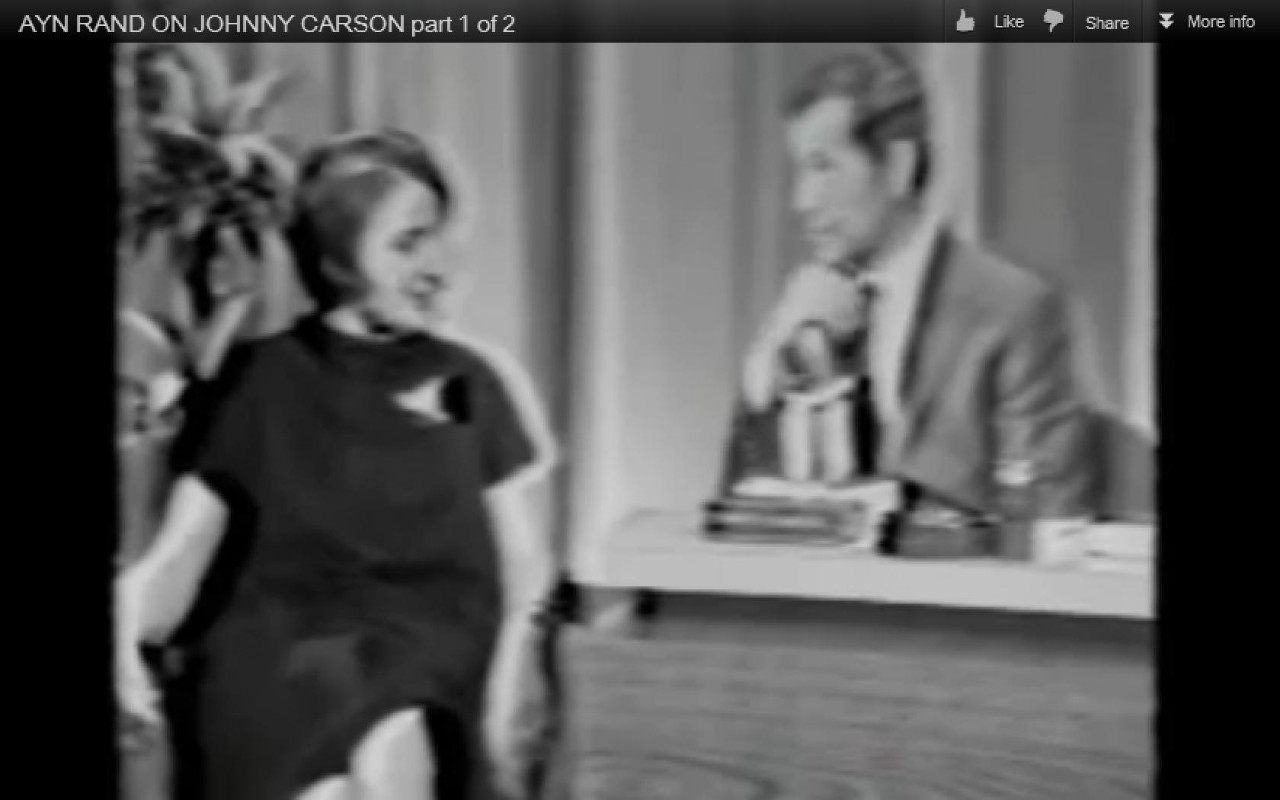
Ayn Randian Dreams (Nightmares?) — A Philosophical Mosaic

I saw a clip–
A grey, hazy time capsule,
Chronicling our past
Yet so present…
Still a specter
Which dominates our minds

Ayn Rand on Johnny Carson???
She expounds,
In a gratingly brittle voice:
The virtue of greed
The reason in selfishness
Only a system
In which
Every man pursues
His own “Reason”
Is one
In which
Humanity can be
Actualized
Capitalism is this system?
Surely a jest!
Each man is not free
Nor guided by his reason
In our system
Of markets
Of money
Of subjugation
–All for profit…

cq5dam.web.1280.1280

She says at the outset:

Man’s proper ethics, or morality, is a morality of rational self-interest. Which means that every man has a right to exist for his own sake, and he must not sacrifice himself to others or sacrifice others to himself (brief pause) that the achievement of his own rational happiness is the highest moral purpose of his life. As a consequence of that, the only system, the only political system, that expresses this morality is the system of laissez-faire capitalism, by which I mean full, unregulated, uncontrolled capitalism, a system based on the recognition of rights, including property rights…

Yet capitalism seeks
To subvert fellow men
Sacrificing others to one’s reason
Readily
Often
Systemically
In the name of Profit,
The almighty God
–The only self-interest
Which receives worship,
The singular idol
Sitting atop
The altar of industry
Do you not believe me?
The annals of history
Surely show
Such systemic sacrifice of others
Upon the altar of Profit

The “Reason” of true Philosophers
Would not aim at this
As Wisdom, the Good, or Love
Those are the true aims
Of “Reason”;
Not this solipsistically myopic,
Self-serving materialism
Should we see this
As worthy successor
To profound analyses of eudaemonia?
I laugh
What other response is fitting?
As Nietzsche once said:
“Not with anger, rather with laughter does one kill.” *

What of the “Reason” of the Stoics?
Would they not scoff as well?
Laughing at how poorly,
How childishly,
You, lady with delusions of grandeur,
Have misunderstood
The entire Universe
And our place in it
Those who vouch
For other such
Individualistic notions
Of Truth and Wisdom
Are equally lost.
No authentic seekers of Truth…
Merely idealistic demagogues
Preaching greed from soapboxes,
Rather than providing wisdom
Or anything of substance.
They are lost
Yet declare it insight
Seeing shadows on the wall
As deep, whole, and true
Rather than with the wise sight
That has seen the sun
The sight that sees them
As empty figures


The immature are their own enemies, doing selfish deeds which will bring them sorrow. That deed is selfish which brings remorse and suffering in its wake. But good is that deed which brings no remorse, only happiness in its wake.

Sweet are selfish deeds to the immature until they see the results; when they see the results, they suffer. Even if they fast month after month, eating with only the tip of a blade of grass, they are not worth a sixteenth part of one who truly understands dharma.

As fresh milk needs time to curdle, a selfish deed takes time to bring sorrow in its wake. Like fire smoldering under the ashes, slowly does it burn the immature.

Even if they pick up a little knowledge, the immature misuse it and break their heads instead of benefitting from it.

The immature go after false prestige – precedence of fellow monks, power in the monasteries, and praise from all. “Listen, monks and householders, I can do this; I can do that. I am right and you are wrong.” Thus their pride and passion increase.

Choose the path that leads to nirvana; avoid the road to profit and pleasure. Remember this always, O disciples of the Buddha, and strive always for wisdom.  — The Dhammapada; Chapter 5, Lines 66-75


A human being is a part of the whole called by us “the universe,” a part limited in time and space. He experiences himself, his thoughts and feelings, as something separate from the rest–a kind of optical delusion of consciousness. This delusion is a kind of prison for us, restricting us to our personal desires and affection for a few person nearest to us. Our task must be to free ourselves from this prison by widening the circle of understanding and compassion to embrace all living creatures and the whole of nature in its beauty.  — Albert Einstein, found in The Places that Scare You by Pema Chödrön

May this bring you to think differently about yourself and your place in society and the universe. May it bring you to desire authentic wisdom and reason. May it inspire you to the love of wisdom (philosophy) and lead you down the path of many questions and insights.
Gassho!

*”Nicht durch Zorn sondern durch Lachen tödtet man.” — Nietzsche, Also sprach Zarathustra; Vom Lesen und Schreiben

Next Newer Entries