Tao a Day – Verse 26: Inner Virtues

Heavy is the root of light
still is the master of restless
thus a lord might travel all day
but never far from his supplies
even in a guarded camp
his manner is calm and aloof
why would the lord of ten thousand chariots
treat himself lighter than his kingdom
too light he loses his base
too restless he loses command
– Trans. Red Pine


I present this translation first to show how mysterious the Tao Te Ching can be. Translators often turn it in their own way to express their understanding of it to readers. Let’s ponder this translation which attempts to get as close to the original text as possible before moving on to another translator’s expression of the meaning.

I feel that the first four lines are key to the meaning of the verse. The first two lines tell us that light comes from heavy and that stillness supersedes restlessness. The Tao Te Ching emphasizes time and again this distinction about how certain qualities are primary and represent the more primordial nature of potential — of Tao. A good example is that hardness comes from softness. Here, it seems that the secondary qualities of lightness or restlessness lead away from the virtue of the primary qualities, and it’s implied that a follower of the Way will cultivate the primary qualities of heaviness and stillness. What’s so important about these two qualities? They’re not readily moved. In other words, they are not reactive to the external changes of the world. They work along with the ways of the world without reacting in either the senses of being swept along with them or fighting back against them. Lines three and four complete this personal teaching of Te (virtue) in saying “thus” (not that this implies a conclusion from the first two lines) the lord travels at length without leaving his supplies. The supplies are these qualities which keep the lord stocked for any situation that life brings, no matter how far he may go or what he may do. These virtues are internal strengths of proper relationship with Tao, and no matter what happens, the walker of the Way can bring these along and act in accordance with the Tao.

The rest of the passage emphasizes that the ruler has the proper relationship of treating himself well (treating himself no less than he does his kingdom). This means that he cultivates these inner supplies of stillness and heaviness: not being swayed by reactivity–rather, acting in accordance with his kingdom from this fundamental inner stillness of the potential for perfectly attuned action in all situations, the action in accordance with nature–wu wei. Rather than being reactive and trying to rule her kingdom through force, she sees the Tao and rules in a way that flows with its unfolding. Such virtue is not about imposing his ends or acting in order to impose his story upon the world; rather, her stillness mirrors the manifestation of the world–this is precisely the path of one who walks the Way. The one who walks the Way cultivates the proper relation with the external world of the “kingdom” by developing the virtues of the internal qualities of stillness and heaviness. Being a Sage entails a perfection of understanding of the Tao in one’s own personal character. The Te, your virtue, is a personally perfected mirrored manifestation of the Tao, the origin and nature of everything. Te mirrors Tao. The microcosm displays the secret of the macrocosm.

Now, for comparison, Jonathan Star strengthens this analysis through his own poetic translation:


The inner is foundation of the outer
The still is master of the restless

The Sage travels all day
    yet never leaves his inner treasure
Though the views are captivating and beg attention
    he remains calm and uninvolved
Tell me, does the lord of a great empire
     go out begging for rice?

One who seeks his treasure in the outer world
    is cut off from his own roots
Without roots, he becomes restless
Being restless, his mind is weak
And with a mind such as this
     he loses all command below Heaven
-Trans. Jonathan Star

May you cultivate your own stillness in studying the Way.

Gassho.
Tao a Day – Verse 8: In Accordance with Nature

The best way to live
is to be like water
For water benefits all things
and goes against none of them
It provides for all people
and even cleanses those places
a man is loath to go
In this way it is just like Tao

Live in accordance with the nature of things:
Build your house on solid ground
Keep your mind still
When giving, be kind
When speaking, be truthful
When ruling, be just
When working, be one-pointed
When acting, remember–timing is everything

One who lives in accordance with nature
does not go against the way of things
He moves in harmony with the present moment
always knowing the truth of just what to do – Trans. Jonathan Star

For comparison:

The best are like water
bringing help to all
without competing
choosing what others avoid
they thus approach the Tao
dwelling with earth
thinking with depth
helping with kindness
speaking with honesty
governing with peace
working with skill
and moving with time
and because they
don’t compete
they aren’t maligned – Trans. Red Pine

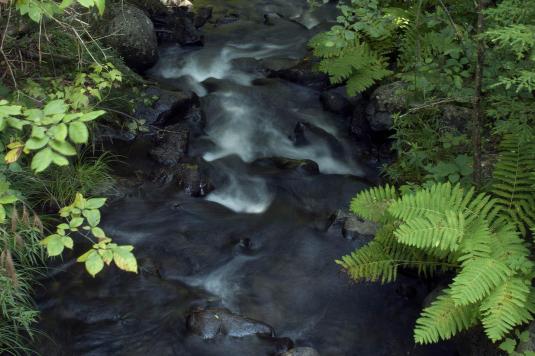
IMGP5855


Although these two translations have some differences, I think the message is the same. The best way to live is one that flows along with the changes of life being able to adapt with them (“without competing” “in accordance with the nature of things”). Such a way benefits all by moving in accordance with them, rather than fighting against all out of self-interest. Notice, however, that this flexibility, receptivity you might say, does not mean that you don’t act–being dragged along with the flow. Rather, you act with virtue, straightforwardness, and a simplicity of purpose. For instance: “When speaking, be truthful” (“speaking with honesty”). Speech is meant to communicate, that means sharing the truth with others, not holding back and competing by using words to promote your own self-interest through deceit. Thus, speak to speak: speak with honesty. The same follows for the others. Of these two translations, Red Pine worked hard at compiling the most authentic rendition of the text (what we have is based on various copies hundreds of years after the original, which is lost) and translating that quite close to the words (not poetically). As such, I find Jonathan Star’s take of “thinking with depth” and turning it into “Keep your mind still” interesting. This fits well with the entirety of the Tao Te Ching and Taoism’s emphasis on seeing the Tao rather than conceptual thinking. Thought then, should get to the real heart of things, the Tao, which means keeping the mind still from the distractions and divisions of conceptual thought. However, I find the “governing with peace” of Red Pine a bit more interesting than “When ruling, be just”–“justice” is an impossibly difficult concept (just look at the history of philosophy, such as Plato’s “Republic” if you think I’m off). Who can say what justice is? Thinking of this could create endless discourse of conceptual analysis. However, governing with peace is more in line with the intuitive understanding of the Sage, seeing what fits in accordance with the nature of things and moving along with it, as water does.

Our takeaway: Live in accordance with the nature of things, with the flexibility and sustaining nature of water. This opens the way of “doing without doing” – wu wei, which doesn’t mean inaction, rather appropriate action: speaking fully, working fully, etc. It should be pointed out that being able to act so deftly comes from the sight of the Tao, the ability to see the way of things is necessary to move in accordance with them. Furthermore, moving with the way of things not only meets no resistance, it helps the whole as well: Water “benefits all things” (“bringing help to all”). In these points, we are reminded of the importance of intuitive insight in Taoism alongside a simple compassion found in working with Tao, and we can see the resonance with the prajna (knowledge of the way things are) of Buddhism and the skillful action that comes in acting from that knowledge in showing compassion to all, rather than pursuing your “self”.

May this help you find the Way.

Gassho.

Tao a Day – Verse 16: Emptiness

A couple weeks ago, I began a practice of reading one verse from the Tao Te Ching everyday. I will continue until I finish the whole book. I’ve read it before and consider it a masterpiece of both metaphysics and spirituality. There are few works as simple, inspiring, and profound. I will try to post a reading on a verse or a passage from a verse from time to time to share the beauty of this work. The following is Verse 16.

Become totally empty
Quiet the restlessness of the mind
Only then will you witness everything
unfolding from emptiness
See all things flourish and dance
in endless variations
And once again merge back into perfect emptiness-
Their true repose
Their true nature
Emerging, flourishing, dissolving back again
This is the eternal process of return

To know this process brings enlightenment
To miss this process brings disaster

Be still
Stillness reveals the secret of eternity
Eternity embraces the all-possible
The all-possible leads to a vision of oneness
A vision of oneness brings about universal love
Universal love supports the great truth of Nature
The great truth of Nature is Tao

Whoever knows this truth lives forever
The body may perish, deeds may be forgotten
But he who has Tao has all eternity
– Trans. Jonathan Star

Emptiness

Recently, I read some of Alan Watts’ book on Taoism (Tao: The Watercourse Way). In his chapter on wu wei, the well-known “doing without doing”, he contrasts Zen Buddhism and Taoism in that both aim at getting a deeper understanding of reality and then acting in accordance with it. He claims that the difference is that Taoism tries to get the student there through an intuitive understanding pulled out through poetic descriptions and paradoxical stories, whereas Zen approaches it through long and thorough meditation. I think this is accurate to an extent, but I think that Watts is a bit disparaging in his treatment of Zen in his discussion. Both approaches try to get us to see the way things are. The Buddhists guide us toward prajna (knowledge) in realization of Dharma (reality, the truth, the way things are, the law), and with the Tao Te Ching, Lao Tzu tries to get us to grasp the insight of Tao (the Way, the totality of all, the way things are and their source). The approach may differ, but the goal is roughly the same! I think this verse speaks to the parallels between these paths. Meditation is a way of realizing the emptiness and stillness that Lao Tzu emphasizes here–it is a way of getting an intuitive understanding beyond concepts. Both aim at getting past the duality of conceptual thought. The Taoist aim of transcending conceptual thought is stated very clearly in the following passage from Verse 1 as well as the already quoted Verse 16:

A mind free of thought,
     merged within itself,
     beholds the essence of Tao
A mind filled with thought,
     identified with its own perceptions,
     beholds the mere forms of this world.

The emptiness in 16 and “essence of Tao” in 1 are the metaphysical aspect of reality, of Tao, and I find the expression of it here and elsewhere in the Tao Te Ching quite inspirational. Tao is both the origin of the 10,000 things and those 10,000 things as well. In other words, Tao goes beyond the “mere forms of this world”, as their dynamic source of never-ending unfolding and change. Here’s an example in Verse 1:

Tao is both Named and Nameless
     As Nameless, it is the origin of all things
     As Named, it is the mother of all things

Here, we see that our concepts–our thoughts of forms and the words with which we name them–are not the source of the forms which we experience. The things we name are not that which creates those things, yet Tao is both the things named and that which cannot be named–that is, their source. This focus on origin or source and its distinction from the forms of the world leads us to philosophy’s most fundamental question (according to Heidegger’s take): “Why are there beings at all instead of nothing?” Lao Tzu answers without further explanation of why: “There is Tao.” Tao is both this mysterious, ungraspable origin that fluctuates all beings, pulsing with new forms–the ebb and flow of change–as well as those changing forms.

From a very different philosophical background, Wittgenstein delineates the world of forms in his Tractatus Logico-Philosophicus as all that can be said. That which cannot be said must be passed over in silence: it must be shown; moreover, this inexpressible dimension is the mystical (i.e. the metaphysical). [Please note that these quotes have numbers. It’s just a numbering system in that book. I keep it here for you to look them up on your own] ” 6.522 There is definitely something inexpressible. The inexpressible shows itself. It is the mystical” (Es gibt allerdings Unaussprechliches dies zeigt sich, es ist das Mystische.). Previous to this, Wittgenstein points out that the mystical (i.e. metaphysical) nature of the World is not in the how of it–the facts of it–rather in its existing at all: “6.44 The mystical is not how the world is, rather that it is. ” (Nicht wie die Welt ist, ist das Mystische, sondern dass sie ist.) The world–the set of forms that can be perceived and named, i.e. that which can be spoken–is not the mystical, the metaphysical. The metaphysical must be shown as it is beyond that which can be said; this is done through words, but the words themselves do not represent this aspect of reality–they merely indicate it, pointing towards it. Here, in the first verse of the Tao, the indicated mystical aspect of existence is the Nameless, TaoLao Tzu’s masterpiece tries to show us this metaphysical origin beyond the forms we perceive and can express, and much like the paradoxes of Zen koans, he stretches language’s expression to point the way to that intuitive understanding, showing it as a Sage–inviting us to empty our mind and experience the ever-unfolding emptiness of the eternal process of return.

Next Newer Entries