Compassion in Action

Pets and loving words
–to the mewling cat
Water, care, and joy
–to the potted plant
Stopping to help
–a lost stranger
Truly seeing and engaging
–all those you meet

Our days
Filled
With others
With opportunities
To realize:
Despite the millions
Of heartbeats & breaths,
My life
–Within a magnificent
Universe
So grand, vast,
And full of happenings
Each passing & flowing

The realization:
It’s not all about me

The opportunity:
To wake up
To take care of others
To awaken the heart

The enlightened path:
Lit by the lantern
Of this awakened compassion
–The lantern of bodhicitta
Yet still with the darkness,
Your own human limitation of vision,
All around
This is a journey
Not a destination

The deluded path:
Shuffling through blackness,
Never looking past
Your own toes,
Holding this vision
As the greatest Truth

A difficulty of understanding:
Compassion helps lovingly
Meaning–sometimes–
It tears down
The masks of ego
And games of self-involvement
Helping others,
Awaken too


Tao a Day — Verse 38: The Sage’s Relation to “Self”

To give without seeking reward
To help without thinking it is virtuous–
     therein lies great virtue
To keep account of your actions
To help with the hope of gaining merit–
     therein lies no virtue

The highest virtue is to act without a sense of self
The highest kindness is to give without condition
The highest justice is to see without preference
– Trans. Jonathan Star (excerpt – opening lines)


We live in a time of little virtue. We are told to look out for number one. Famous writers have propounded philosophies in which greed is a great virtue which helps everyone. It seems that all around us, most of the time, people are concerned most about what they will get out of a situation; we are told that this is natural and good to be self-involved like this.

From a certain perspective, spirituality is in utter opposition to such a view. The stance of what can I take, what can I get, is yet another way of maintaining the certain safety of ego. It upholds I, me, and mine, and it furthers the goal of solidifying them as of the utmost importance. According to the Tibetan Buddhist teacher Chögyam Trungpa, spirituality moves against this but stands in constant danger of falling into the traps of ego-fulfillment. We all too readily fall into spiritual practice as something to hoard, something to show that I’m wiser than others, or something that makes me remarkable and worthy of being looked up to by others as a guru, realized one, or some other egoic hero. The Buddhist emphasis on the practice of compassion is both a means to reach enlightenment, and at the same time, compassion–focusing on others as more important than “me”–keeps us from falling prey to these traps. I’m not implying that Buddhism is superior to other spiritual disciplines. Hardly. I’ve known Christians and pagans who displayed compassion first and foremost, and their spiritual practices and personal virtues were all the more noteworthy and admirable because of this outward oriented engagement with the world.

The Sage also exemplifies the Te (virtue) which does not focus on self above all else. She gives without seeking reward. She does not tally up her great deeds. Instead, she, like water, acts in a way that supports all, rather than herself. This was discussed in a previous post about being in accordance with the flow of nature–the unfolding of Tao. Having virtue, Te, is completely about actualizing the Tao as the microcosm of the macrocosm. That was discussed in my post on inner virtues to some extent. In this case, let’s remember that the Tao continuously gives the 10,000 things. It is both the origin and totality of all. This totality continues to ebb and flow into being. It continually gives. Nothing statically remains as some sort of beloved object that Tao holds onto for itself. Rather, Tao loves bringing forth the ever-arising new of change. So why do we grasp at possessions and holding back that which is mine, when Tao shows us to move and flow: to give and support life without interest in self-bolstering?

Tao supports all. Those seeking to cultivate Te should as well. I heard an interesting Dharma talk last night in which the priest ended in saying that compassion is being able to hear whatever another person has to say without limiting those words to what we want to or are able to hear from “my” perspective. Letting go of oneself enough to be completely present to what appears (in this example, the words of another) is Te–it is being in harmony with nature and being able to act within that harmony, wu wei. Thus, the Sage responds to what arises: recognizing that “The highest justice is to see without preference.” The Sage opens his eyes, sees the world as it is–Tao, and acts skillfully from this proper seeing. Such a proper seeing shows that the “self” is an ever-unfolding process of emergence, one that mirrors Tao: the appearance and disappearance of the 10,000 things of Tao–the mysterious flux of universal becoming in all its myriad forms.

Having “Te” requires seeing and actualizing “Tao”


Here is the rest of the verse for further reading. Have a look at the closing lines if nothing else:

When Tao is lost one must learn the rules of virtue
When virtue is lost, the rules of kindness
When kindness is lost, the rules of justice
When justice is lost, the rules of conduct
And when the high-blown rules of conduct are not followed
people are seized by the arm and it is forced on them
The rules of conduct
are just an outer show of devotion and loyalty–
quite confusing to the heart
And when men rely on these rules for guidance–
Oh, what ignorance abounds!

The great master follows his own nature
and not the trappings of life
It is said,
“He stays with the fruit and not the fluff”
“He stays with the firm and not the flimsy”
“He stays with the true and not the false”
-Trans. Jonathan Star

Tao a Day – Verse 26: Inner Virtues

Heavy is the root of light
still is the master of restless
thus a lord might travel all day
but never far from his supplies
even in a guarded camp
his manner is calm and aloof
why would the lord of ten thousand chariots
treat himself lighter than his kingdom
too light he loses his base
too restless he loses command
– Trans. Red Pine


I present this translation first to show how mysterious the Tao Te Ching can be. Translators often turn it in their own way to express their understanding of it to readers. Let’s ponder this translation which attempts to get as close to the original text as possible before moving on to another translator’s expression of the meaning.

I feel that the first four lines are key to the meaning of the verse. The first two lines tell us that light comes from heavy and that stillness supersedes restlessness. The Tao Te Ching emphasizes time and again this distinction about how certain qualities are primary and represent the more primordial nature of potential — of Tao. A good example is that hardness comes from softness. Here, it seems that the secondary qualities of lightness or restlessness lead away from the virtue of the primary qualities, and it’s implied that a follower of the Way will cultivate the primary qualities of heaviness and stillness. What’s so important about these two qualities? They’re not readily moved. In other words, they are not reactive to the external changes of the world. They work along with the ways of the world without reacting in either the senses of being swept along with them or fighting back against them. Lines three and four complete this personal teaching of Te (virtue) in saying “thus” (not that this implies a conclusion from the first two lines) the lord travels at length without leaving his supplies. The supplies are these qualities which keep the lord stocked for any situation that life brings, no matter how far he may go or what he may do. These virtues are internal strengths of proper relationship with Tao, and no matter what happens, the walker of the Way can bring these along and act in accordance with the Tao.

The rest of the passage emphasizes that the ruler has the proper relationship of treating himself well (treating himself no less than he does his kingdom). This means that he cultivates these inner supplies of stillness and heaviness: not being swayed by reactivity–rather, acting in accordance with his kingdom from this fundamental inner stillness of the potential for perfectly attuned action in all situations, the action in accordance with nature–wu wei. Rather than being reactive and trying to rule her kingdom through force, she sees the Tao and rules in a way that flows with its unfolding. Such virtue is not about imposing his ends or acting in order to impose his story upon the world; rather, her stillness mirrors the manifestation of the world–this is precisely the path of one who walks the Way. The one who walks the Way cultivates the proper relation with the external world of the “kingdom” by developing the virtues of the internal qualities of stillness and heaviness. Being a Sage entails a perfection of understanding of the Tao in one’s own personal character. The Te, your virtue, is a personally perfected mirrored manifestation of the Tao, the origin and nature of everything. Te mirrors Tao. The microcosm displays the secret of the macrocosm.

Now, for comparison, Jonathan Star strengthens this analysis through his own poetic translation:


The inner is foundation of the outer
The still is master of the restless

The Sage travels all day
    yet never leaves his inner treasure
Though the views are captivating and beg attention
    he remains calm and uninvolved
Tell me, does the lord of a great empire
     go out begging for rice?

One who seeks his treasure in the outer world
    is cut off from his own roots
Without roots, he becomes restless
Being restless, his mind is weak
And with a mind such as this
     he loses all command below Heaven
-Trans. Jonathan Star

May you cultivate your own stillness in studying the Way.

Gassho.

Tao a Day – Verse 8: In Accordance with Nature

The best way to live
is to be like water
For water benefits all things
and goes against none of them
It provides for all people
and even cleanses those places
a man is loath to go
In this way it is just like Tao

Live in accordance with the nature of things:
Build your house on solid ground
Keep your mind still
When giving, be kind
When speaking, be truthful
When ruling, be just
When working, be one-pointed
When acting, remember–timing is everything

One who lives in accordance with nature
does not go against the way of things
He moves in harmony with the present moment
always knowing the truth of just what to do – Trans. Jonathan Star

For comparison:

The best are like water
bringing help to all
without competing
choosing what others avoid
they thus approach the Tao
dwelling with earth
thinking with depth
helping with kindness
speaking with honesty
governing with peace
working with skill
and moving with time
and because they
don’t compete
they aren’t maligned – Trans. Red Pine

IMGP5855


Although these two translations have some differences, I think the message is the same. The best way to live is one that flows along with the changes of life being able to adapt with them (“without competing” “in accordance with the nature of things”). Such a way benefits all by moving in accordance with them, rather than fighting against all out of self-interest. Notice, however, that this flexibility, receptivity you might say, does not mean that you don’t act–being dragged along with the flow. Rather, you act with virtue, straightforwardness, and a simplicity of purpose. For instance: “When speaking, be truthful” (“speaking with honesty”). Speech is meant to communicate, that means sharing the truth with others, not holding back and competing by using words to promote your own self-interest through deceit. Thus, speak to speak: speak with honesty. The same follows for the others. Of these two translations, Red Pine worked hard at compiling the most authentic rendition of the text (what we have is based on various copies hundreds of years after the original, which is lost) and translating that quite close to the words (not poetically). As such, I find Jonathan Star’s take of “thinking with depth” and turning it into “Keep your mind still” interesting. This fits well with the entirety of the Tao Te Ching and Taoism’s emphasis on seeing the Tao rather than conceptual thinking. Thought then, should get to the real heart of things, the Tao, which means keeping the mind still from the distractions and divisions of conceptual thought. However, I find the “governing with peace” of Red Pine a bit more interesting than “When ruling, be just”–“justice” is an impossibly difficult concept (just look at the history of philosophy, such as Plato’s “Republic” if you think I’m off). Who can say what justice is? Thinking of this could create endless discourse of conceptual analysis. However, governing with peace is more in line with the intuitive understanding of the Sage, seeing what fits in accordance with the nature of things and moving along with it, as water does.

Our takeaway: Live in accordance with the nature of things, with the flexibility and sustaining nature of water. This opens the way of “doing without doing” – wu wei, which doesn’t mean inaction, rather appropriate action: speaking fully, working fully, etc. It should be pointed out that being able to act so deftly comes from the sight of the Tao, the ability to see the way of things is necessary to move in accordance with them. Furthermore, moving with the way of things not only meets no resistance, it helps the whole as well: Water “benefits all things” (“bringing help to all”). In these points, we are reminded of the importance of intuitive insight in Taoism alongside a simple compassion found in working with Tao, and we can see the resonance with the prajna (knowledge of the way things are) of Buddhism and the skillful action that comes in acting from that knowledge in showing compassion to all, rather than pursuing your “self”.

May this help you find the Way.

Gassho.

Heartbreak Wisdom Journal – Entry 2: Gentleness Toward Your Experience

“Love Love Love” by Of Monsters and Men

&

“Reminder” by Mumford and Sons

Until recently, if I heard these songs, I would almost instantly be brought to tears. Such lines, as: “So I watched the world tear us apart. A Stoic mind and a bleeding heart — You never see my bleeding heart…” were enough to bring the depths of my pain and anxiety to the fore, washing over me like a great tidal wave. The other day, one of the two popped up on my phone, and I found myself smiling gently, enjoying the melody and accepting the myriad feelings that bubbled up.

Some might be confused: “Why not just remove them from your phone?” I cannot hide every reminder of my past and my heartbreak. That would be inauthentic, childish, and extremely difficult. It would be like trying to stubbornly deny that the sun rises in the east and sets in the west while doing my damnedest to never look up at the sky.

The tender heart of the warrior makes friends with the feelings that come up, no matter what they may be. The warrior knows that trying to eradicate or obliviate what we feel just keeps us stuck in our painful patterns. Opening to them tenderly allows room for kindness to oneself… and to others.

As a counterpoint, the song that reminds me of this tender, gentle presence is:

 “Megan” by Anesthesia


What helps more than anything is to be gentle toward yourself. Gentleness doesn’t mean being all “poor baby” or coddling yourself in any way. Real gentleness has much more precision and intelligence than that. Gentleness means simply that you acknowledge and embrace your own experience from moment to moment, without judgment. Without trying to fix it. Without feeling ashamed of it or, if you do feel ashamed of it, you do not feel ashamed of your shame! In this way, gentleness is actually an advanced form of bravery. You aren’t afraid to take on your own suffering, even though you don’t know how or when it will end; still, you agree to feel it. Somehow, this acceptance begins to calm things down. On its own timetable, gentleness begins to pacify even the most raging emotions. Gentleness is the spiritual and emotional warrior’s most powerful weapon.

The best way to cultivate gentleness toward yourself, thought by thought and moment by moment, is through the sitting practice of meditation. In fact, meditation, which is sitting with your self, your thoughts, emotions, and yearnings, and simply allowing them to be as they are, is the practice of gentleness itself. There is no better teacher than this.

Most likely, there will be only a few times in your life when you’ll reach the limit of what you can bear. It may be from falling ill, the death of a parent, or even the loss of a most precious possession, such as your home, and of course it can also be because of a broken heart. To face these extraordinary times, you need to take extraordinary measures. Most of the tactics touted as “extraordinary measures,” however, are really ways of escaping the reality of what we must face: our emotions. Certainly drinking, drugging, random sex, and sleeping all the time are ways to avoid emotional pain, but even healthier means, such as positive thought, physical exercise, therapy, or simply forcing yourself to move on are also methods of stepping away from what ails you, rather than toward it. Stepping toward it and going into it do not just mean lying around crying all the time. It means meeting your emotions and relating to them, not as enemies to be conquered, but as wounded friends from the front, needing your loving attention. — Susan Piver, The Wisdom of a Broken Heart, pp. 48-49

The Strength of the Warrior


Previous Heartbreak Wisdom Journal Entry: Entry 1: Wounded Heart’s Tender Flesh
Next Heartbreak Wisdom Journal Entry: Entry 3: Wounds

Love, Rebounds, and Relationships: Part 3 – Love and Metaphysics

When I first started writing these posts on love, I was confounded in part by a friend’s post. There was some shared comment about Love being everywhere with some sort of sentiment that everything is all beautiful, shiny, good. While I don’t want to vouch for negativity and be a naysayer, there was something disconnected and starry-eyed about the whole thing. It felt just as unrealistic as someone being very jaded and nihilistic. Such odd emotional feedback on my end as a reader gave me pause, and I thought about why it felt so … off. This post will examine the thoughts I came to.

In the two previous posts on Love, I’ve challenged some of the ways that the word is used and understood. Specifically, I’ve questioned the idea of Love as some sort of completion of self through the Other, and I’ve also questioned the seeming simplicity of the concept, trying to show that it’s a mysteriously deep experience for us to investigate.

To move forward with this post, I have to back-pedal just a bit. There is clearly a core to the experience of love despite the complexity that I have previously outlined. That core is a positivity. To love is to feel some sort of positive connection, a positive regard toward the loved. I think that that captures the core idea of love. From such a simple definition, hate–a negative refusal of something–is the opposite. This simple distinction is utterly familiar: Love–ultimate Good; Hate–ultimate Bad. This is one of the most basic dualities.

This is why vapidly saying that everything is Love without clarification sounds so checked out. Furthermore, I suppose that part of that feeling for me was knowing about and having received a lot of vitriol and negativity from this person regarding her life. “Everything is Love” is not the case just because you’ve turned your eyes away from the parts of existence you don’t like. Those things continue to exist.

No matter how you spin it there are numerous things in life that most would consider bad. There’s loss in its myriad guises, including death. There’s rape and murder. There are myriad diseases that eat your insides in misery like ebola or grow and slowly turn your body into a defiled ball of pain like cancer. The world is full of traffic jams, inconsiderate people, obnoxious sounds, putrid smells, headaches, natural disasters, injured pets, screaming children, petty revenge, and the dog shit you stepped in on your way to work. This list could go on much, much longer. There’s a reason that theologians have struggled with questions regarding why this is the world we have with all its pain and suffering, with all of these “bad” things if God is all powerful and all Good. This is a conundrum that shouldn’t readily be tossed aside by a simplistic usage of words.

I will do my best to address the problem. Love is indeed everywhere, but not like the relative understanding we have. Love is not everywhere in the sense of everything being positive, good things for us to like, or that are beneficial for us. It may come as a surprise, but it’s a truth you should come to terms with, and the sooner, the better: the Universe with its billions of years of existence and trillions of stars is not about you and what you like. It’s not here to make you happy, and it has no concept of good and bad that it uses to order existence. Again, to return to the point, Love is everywhere, but that’s because everything that exists does exist. If there is any animating metaphysical principle, it has brought this universe into existence out of some sort of intention, some sort of desire for it to be so. This is Love. It is an unfolding of that which wants to be, that which loves to become. This is Love without any duality of good and bad. It includes your highest moment of ecstasy and the most excruciating physical pain you’ve endured, your favorite dessert and that dog shit you stepped in. It is both far more profound and more mundane than any of the dualistic ways we think of love. From a metaphysical standpoint, we can take Aristotle’s famous culmination of his Metaphysics as the principles of the Universe being “Thought thinking itself” and change it into “Love loving itself”.

One thing that a meditation practice aims to get past is the dualistic way we see the world. With the prajna of our awakened and engaged perspective, we can get a sight of this absolute Love that is unfolding around us all the time beyond our more self-interested and relative concepts of Love–the Love of the wanting self.

May all who read this see and find Love.
Gassho


Kahir, the fifteenth-century Sufi poet, writes, “The universe is shot through in all parts by a single sort of love.” This love is what we long for. When we bring Radical Acceptance to the enormity of desire, allowing it to be as it is, neither resisting it nor grasping after it, the light of our awareness dissolves the wanting self into its source. We find that we are naturally and entirely in love. Nothing is apart or excluded from this living awareness.

Over the next few days, each time I opened deeply to the force of longing, I was filled with a refreshed and unconditional appreciation for all of life. In the afternoons I would go outside after sitting and walk in the snowy woods. I found a sense of belonging with the great Douglas firs, with the chickadees that landed and ate seeds from my hands, with the layered sounds of the stream as it flowed around ice and rocks. … When we don’t fixate on a single, limited object of love, we discover that the wanting self dissolves into the awareness that is love loving itself. — Tara Brach, Radical Acceptance: Embracing Your Life with the Heart of a Buddha pp. 154-155.

file000413731081

Heartbreak Wisdom Journal – Entry 1: Wounded Heart’s Tender Flesh

Disclaimer: I’ve been working through heartbreak still. It’s a process. Although I’m much better than a couple months ago, I still work through sadness while diligently pursuing a path of compassion and learning. Each day goes by, and each day, I show up and practice a bit more. I recently purchased a book to work through to help me with processing all the challenges and opportunities of a broken heart. It’s called “The Wisdom of a Broken Heart”. The book recommends keeping a “Heartbreak Wisdom Journal” as part of the process, with many included activities to get you to see your situation more clearly and tenderly. I’ve started this journal and thought I would share some of the posts here for anyone else who may benefit from sharing the process of heartbreak.

A book to work and write through…


After starting this yesterday [there was an initial exercise in the book with some basic questions], I had strange dreams in which Lisa told me how little she loved me and for how long that had been the case. It was very upsetting. I think that sitting calmly through my feelings for months and reading many of the same books that inspired Susan Piver’s The Wisdom of a Broken Heart have put me several steps ahead of her initial points. However, I realize now that the feelings continue to drag on because I have not fully walked toward them and invited that pain into my tender heart: fully taking up the warrior’s heart.

These dreams felt like the opening of a wound–the emotional pus oozed out. The tender flesh underneath has much to heal and much to offer.

The point when I knew that The Wisdom of a Broken Heart was perfect for my healing process was when I was reading the introduction and found that the author was inspired in her heartbreak by the same book that touched me and brought some sense back to my shattered world a couple months ago. Furthermore, she quoted a passage from the book that sticks with me more than most any other. I will share it here in greater length than she did:

When you awaken your heart in this way, you find to your surprise, that your heart is empty. You find that you are looking into outer space. What are you, who are you, where is your heart? If you really look, you won’t find anything tangible and solid. Of course, you might find something very solid if you have a grudge against someone or you have fallen possessively in love. But that is not awakened heart. If you search for awakened heart, if you put your hand through your rib cage and feel for it, there is nothing there except for tenderness. You feel sore and soft, and if you open your eyes to the rest of the world, you feel tremendous sadness. This kind of sadness doesn’t come from being mistreated. You don’t feel sad because you feel impoverished. Rather, this experience of sadness is unconditioned. It occurs because your heart is completely exposed. There is no skin or tissue covering it; it is pure raw meat. Even if a tiny mosquito lands on it, you feel so touched. Your experience is raw and tender and so personal.

The genuine heart of sadness comes from feeling that your nonexistent heart is full. You would like to spill your heart’s blood and give your heart to others. For the warrior, this experience of sad and tender heart is what gives birth to fearlessness. Conventionally, being fearless means that you are not afraid or that if someone hits you, you will hit him back. However, we are not talking about that street-fighter level of fearlessness. Real fearlessness is the product of tenderness. It comes from letting the world tickle your heart. You are willing to open up, without resistance or shyness, and face the world. You are willing to share your heart with others. –Chögyam Trungpa Shambhala: The Sacred Path of the Warrior, pp. 31-32

Warriors Rejoice at the Great Eastern Sun!

Months ago, I wrote a poem about a scab over my heart. This was right before I had my heart broken completely. Maybe it’s time to pick at that scab and reveal the tender flesh beneath… Then again, I think I have already started doing just that.


Next Heartbreak Wisdom Journal Entry: Entry 2: Gentleness Toward Your Experience

The Way is in the Heart

WP_20141216_00_11_26_Pro

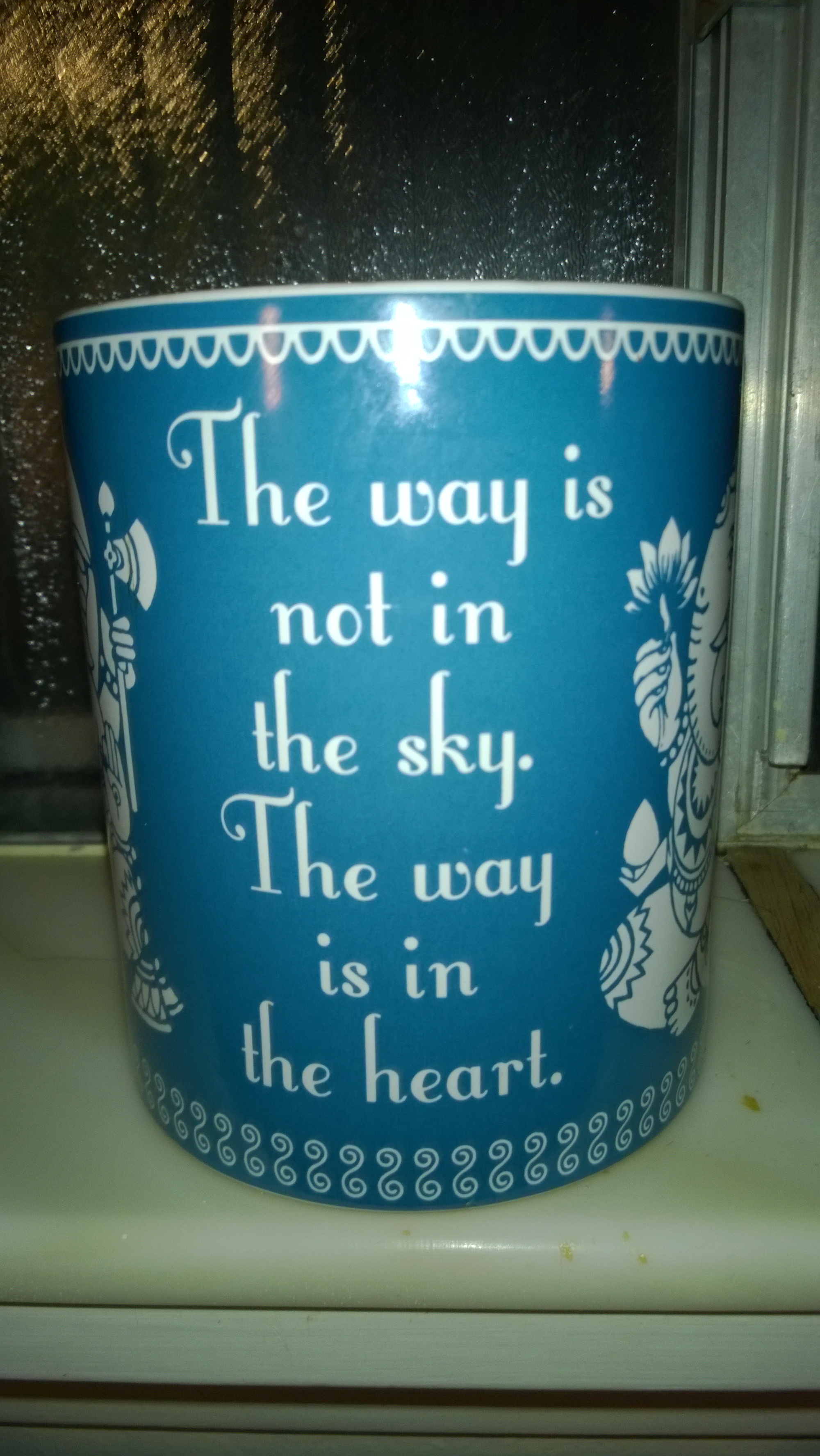
This simple mug, found at a local Ross for a few dollars, has a profound message. The way of an engaged and authentic human life is not to be found in the abstract ideals of dogma and speculations about eternal metaphysical systems. Rather, it is to be found in the concrete embodiment of this body, in the compassionate beat of your heart.

The opening of Jack Kornfield’s book, “A Path with Heart: A Guide Through the Perils and Promises of Spiritual Life”, expresses this lesson deftly:

In undertaking a spiritual life, what matters is simple: We must make certain that our path is connected with our heart. Many other visions are offered to us in the modern spiritual marketplace. Great spiritual traditions offer stories of enlightenment, bliss, knowledge, divine ecstasy, and the highest possibilities of the human spirit. Out of the broad range of teachings available to us in the West, often we are first attracted to these glamorous and most extraordinary aspects. While the promise of attaining such states can come true, and while these states do represent the teachings, in one sense, they are also one of the advertising techniques of the spiritual trade. They are not the goal of spiritual life. In the end, spiritual life is not a process of seeking or gaining some extraordinary condition or special powers. In fact, such seeking can take us away from ourselves. If we are not careful, we can easily find the great failures of our modern society–its ambition, materialism, and individual isolation–repeated in our spiritual life.

Of course, we are individuals, bodies with extremely sensitive nerves which intimately map all the pains and pleasures that the world offers us. We seek out the positive sensations that these senses perceive, and as such, of course we desire these higher goods, ultimate “goods” or the purest pleasures one might say, promised in spiritual pursuits. This is what gets us started. Otherwise, why would we begin? In any path, even if advanced, there will be some small shadow of that egoistic motivation. That’s why Dōgen, one of the greatest Zen ancestors, says: “Those who greatly realize delusion are buddhas. Those who are greatly deluded in realization are living beings” (Genjōkōan in the Shōbōgenzō). To put this as simply as I can, as embodied individuals with a limited perspective, we struggle to realize the greater picture of a huge, interconnected, flowing universe of which we are part (in fact, not “part” per se as this can imply separation–there is no separation). We create elaborate stories of “Me” and accumulate myriad possessions as “Mine”. One particularly cutting and separative term I’ve experienced many times of this type is “My Truth”. This individualizes and upholds the ego’s limited perception above all else, thereby glorifying the Self as spiritual ideal (what Chögyam Trungpa would call “spiritual materialism“) and misunderstanding the concept of truth as well (for example, while a schizophrenic’s experience of a hallucination is true insofar as we can believe that he or she experiences it, it is not true in the same sense as “Water freezes at 32°F.”). From our limited perspective, we can aspire to greater understanding, insight, and experience. This is why buddhas greatly realize delusion–out of their self-centered motivation, they begin practice. They are also living beings (a buddha is clearly a living being!), still feeling some sense of separation and individuality even when realizing the greater truth that all is one. Hence, they are greatly deluded in realization.

The danger here for Dōgen is as Kornfield mentioned. A path without heart can mean: “Furthermore, there are those … who are deluded within delusion.” Those are the practitioners of spirit who get trapped in their pictures of the world, their fabrications, and their value systems. They fall into their own fantasies of being heroes or heroines. Rather than compassionately and vulnerably opening their hearts to the universe, this is selfishly putting on armor to protect their ego, their persona, their “story”–it’s a security blanket.


I’ve said that a way with heart is embodied rather than abstract and openly vulnerable and compassionate rather than egoistic and self-protective. The Buddhist idea of bodhicitta is the perfect expression of this. It translates to “awakened heart” or “noble heart”. However, citta in Sanskrit means both mind and heart in English. They don’t have quite as clear of a distinction as we do in the English language. However, this is apt – the heart (poetically meant) has an understanding–a very visceral and experiential one that grounds more than the airy concepts of the mind (from our Western understanding of “mind”). The heart pumps life throughout our entire body day in and day out for our entire lives–taking the air and nutrients from the world and circulating it through our entire bodies, making that external stuff into our bodies and taking the waste of our bodies to be returned to the world. Last, but perhaps most importantly, the heart is the symbolic organ of compassion–with phrases like “opening your heart” or “have a little heart”. The heart chakra is a perfect example of this in the Indian energetic system of the chakras–the point of connection, compassionate connection rather than individuated separation, with all life and existence. It is the symbolic seat of being open to and aware of the sacredness and wonder of everything rather than the self-centered idea of “My Truth”. In fact, in some of my reading about the heart chakra, I’ve read that developing and focusing on the energy of this green, open chakra can be the most fundamentally beneficial energy healing practice, and this position resonates well with the symbol of Yin-Yang (actually called Tai Chi, meaning supreme ultimate or universal harmony) in the Chinese energy practices of Qi Gong and Tai Chi. My point is that bodhicitta, “the awakened heart”, is the open, tender connection of the spiritual practitioner to the universe. It’s the compassionate engagement that brings a gentle support of all people–recognizing their confusion, pain, and human ways, ways needing compassion and guidance without the self-certain way of dogma (which is basically rigid opinion) or the sterile and abstractly disembodied ideals of some belief systems.

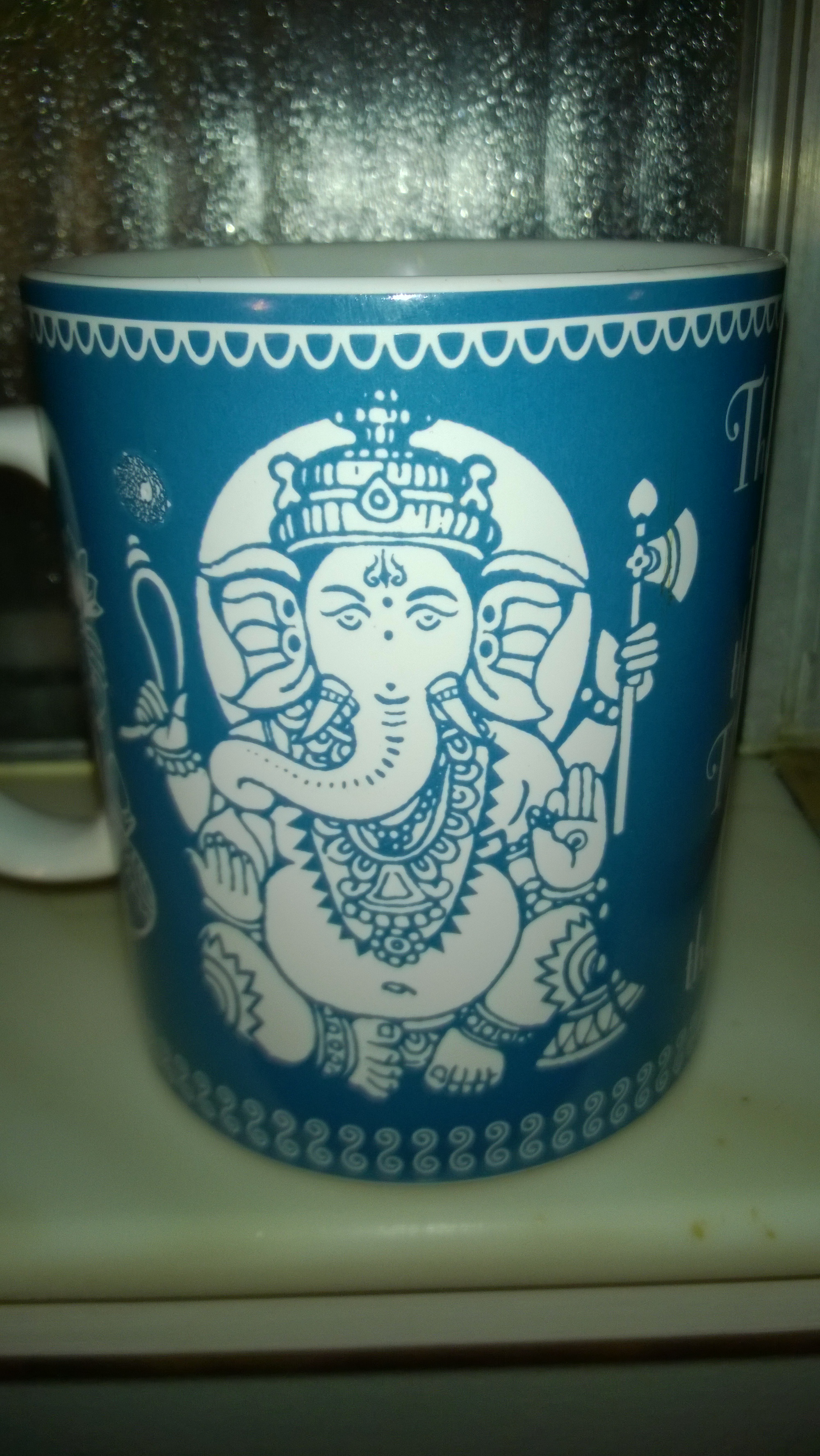
Bodhicitta, the perfect example of a way with heart, opens us to wonder at the universe and to compassionate action towards all. Like Ganesha on the cup, bodhicitta removes obstacles in our way, giving us a path forward, without it being a pre-constructed one; rather, we create the path with each engaged step of practice. This is a way that is in the heart and protects us from Kornfield’s identified failures of ambition, materialism and individual isolation.

WP_20141216_00_12_31_Pro

To those seeking a path with heart,

Gassho

Love, Rebounds, and Relationships: Part 1–Moving On?

Disclaimer: This is something I actually started writing quite some time ago (the date in my journal is a month ago to the day). This topic grew and unfolded in many different directions from the original inspiration as I started putting it on the page. Due to this prodigious growth, I’m going to break this up into pieces, trying to focus each post on different aspects of this topic that I want to discuss. The first piece is about rebounds, primarily, having recently gone through a breakup and seeing people’s ideas and reactions about moving on. Sometimes they are geared toward grabbing the next person who comes along. This will be discussed alongside a discussion of our conceptualizations of romantic love and all the hidden issues that lie in those unanalyzed concepts. I aim to present a more mindful approach to yourself and Love in these posts.


A common maxim proclaims that there is no better way to get over the last than by getting under the next. Yet, what is the draw of a rebound? Why is it both a sought remedy and a denigrated followup to a broken heart?

Heartbreak challenges our ideas of ourselves and our world. Suddenly, a shared companion in the adventures of life, in your perspective, and in your memories is gone. There’s a hole. This absence is almost palpable, like an aching scar after a piece of oneself has been removed. Everything–and I mean almost every moment–makes it ache. You yearn for the ache to subside, and the easiest way is to cover up that hole–that lack, that ache–with something else, or in this case, someone else.

Furthermore, this pain is the loss of an entire way of life, a path into a now lost future. Where there once was a “we”, there is now just an “I”. Now, you are left alone with a broken idea of partnership, with that of a feeling incomplete, again as though a part of your identity had been removed, as though part of your story had been cut off. Is this identity crisis and this idea of love/partnership so painful that we must rush to find that completion elsewhere, even if only temporarily, until the edge has worn off?

I think that there is something to be said for being present to the pain of this loss–facing it head on. Covering it over with someone else is a band-aid, a denial of the pain of this moment. Psychological research speaks of the five stages of grief: denial, bargaining, anger, depression, and acceptance. Moving on to someone else right away may seem like acceptance, a quickening of the grieving process, but it’s really a refusal to look back and feel. It’s a denial of the old loss through the replacement of a new gain. Perhaps, it’s no surprise that from my experience, rebounders act either as though their previous relationship never existed, or they are still tied up in knots about it and can’t stop talking about it if they start.

Under all of this discussed so far is the problem of identity (as I’ve previously pointed at our personal story in the experience). If you observe the way people talk about romantic love and how they seek it, it’s primarily about ego identity. A narrative of completion of one’s self in the Other lies at the core of so much talk about “Love” (here capitalized to emphasize our concept of it: Love as an idea, a placeholder of sorts while we investigate, and of course, we mean romantic love). We look for salvation, completion, rescue, and an ultimate, intimate connection–a holy communion– with the Other in Love. As such, Aristophanes’ depiction of Love as finding your other half to realize an original but now lost wholeness is so familiar. It’s human, all too human. From this familiar notion, Love is approached often as a communal “I” (We as one) or as another person who completes “me”, who fulfills many aspects of who “I am” and makes me whole. The continuation of the search and the desire for completion in the other is a bolstering of the story of “me”, the drama of ego. There’s a search here for certainty when life shows its uncertain, dynamic, unfolding nature–a sacred chaos of emergence. We seek an “I am” here in the arms of another, and this is completely understandable given the expression of the experience of loss that I have shared here. However, the confusion in this is that these experiences of pain and loss reflect on an underlying truth about my “self”: the dynamics of change are taken as a threat to my “self” as some set entity, when they are in fact, an expression of it–an unfolding, a time-being. The confusion is precisely around this idea of lacking something, no matter how much pain and desire for things to be otherwise may make it feel that way. The search for love as completion of myself with my “other half” is often denigrated, with the response: “I am already a whole person”. However, this duality of whole vs. incomplete merely continues the problem of ego. “I” am neither “whole” nor “incomplete” in their standard senses of needing or not needing more to be something. I already am sacred and luminous, neither “whole” in the sense of “perfect” or “incomplete” in the sense of “lacking something”. I am whole and perfect in the sense that I am precisely what I am in this moment, a particular configuration of conditions with the possibility of awareness and present, active compassion, yet this is always going to be pulled and covered over to some extent by my desire to not feel pain, to not suffer, to cover over that which I don’t want to face. As such, there is great value in standing present for the pain of losing a partner; it could be a moment for us to experience being awake to our lives as they are and acting from that open, tender place: a love which is not about my story, my self-bolstering, or my gratification–an active feeling and giving rather than the receptive filling of a lack. There’s no need for a rebound if you can be present to your own life as it is: not as you think it should be in your idealized concepts of yourself, Love, and what you “want”. Ultimately, this is about your relationship with yourself. Are you ready to look at that and question everything you take for granted? Are you ready to mindfully show up to your feelings and bring that into your next partnership, with whomever that may be? This is an invitation to actively embracing as I-You rather than the separation of I-It. You have the chance to gratefully feel the ebb and flow of your “self” with the beating of an open heart, but this requires the courage of staying present to those feelings and not running from them into an idea of completion and gratification: running into desire for pleasure rather than the love of your life, your fate, your world.

“We want to be perfect, but we just keep seeing our imperfections, and there is no room to get away from that, no exit, nowhere to run. That is when this sword turns into a flower. We stick with what we see, we feel what we feel, and from that we begin to connect with our own wisdom mind.

Without the maras, would the Buddha have awakened? Would he have attained enlightenment without them? Weren’t they his best friends ,since they showed him who he was and what was true? All the maras point the way to being completely awake and alive by letting go, by letting ourselves die moment after moment, at the end of each out-breath. When we wake up, we can live fully without seeking pleasure and avoiding pain, without re-creating ourselves when we fall apart. We can let ourselves feel our emotions as hot or cold, vibrating or smooth, instead of using our emotions to keep ourselves ignorant and dumb. We can give up on being perfect and experience each moment to its fullest. Trying to run away is never the answer to being a fully human being. Running away from the immediacy of our experience is like preferring death to life.

Looking at the arrows and swords, and how we react to them, we can always return to basic wisdom mind. Rather than trying to get rid of something or buying into a dualistic sense of being attacked, we take the opportunity to see how we close down when we’re squeezed. This is how we open our hearts. It is how we awaken our intelligence and connect with fundamental buddha nature.” – Pema Chödrön, “When Things Fall Apart: Heart Advice for Difficult Times”, p. 72.

It doesn’t need to be this way unless you keep playing a game that you are constantly trying to win.

Mundane Inspiration – The Words of House Martell

As I’ve struggled in recent months with the emotional upheavals that life bears in greater transitions, I’ve found solace and inspiration from myriad sources. One unlikely candidate that has been uplifting for me has come directly from the Song of Ice and Fire Series. Some of you may be familiar with this series of fantasy novels. Many would be more familiar with the TV show based on these books: “A Game of Thrones”. In any case, the various noble houses in the series each have their own family motto of sorts, their “words”. The rulers of the desert lands in the far south of the Seven Kingdoms, House Martell, have the words:

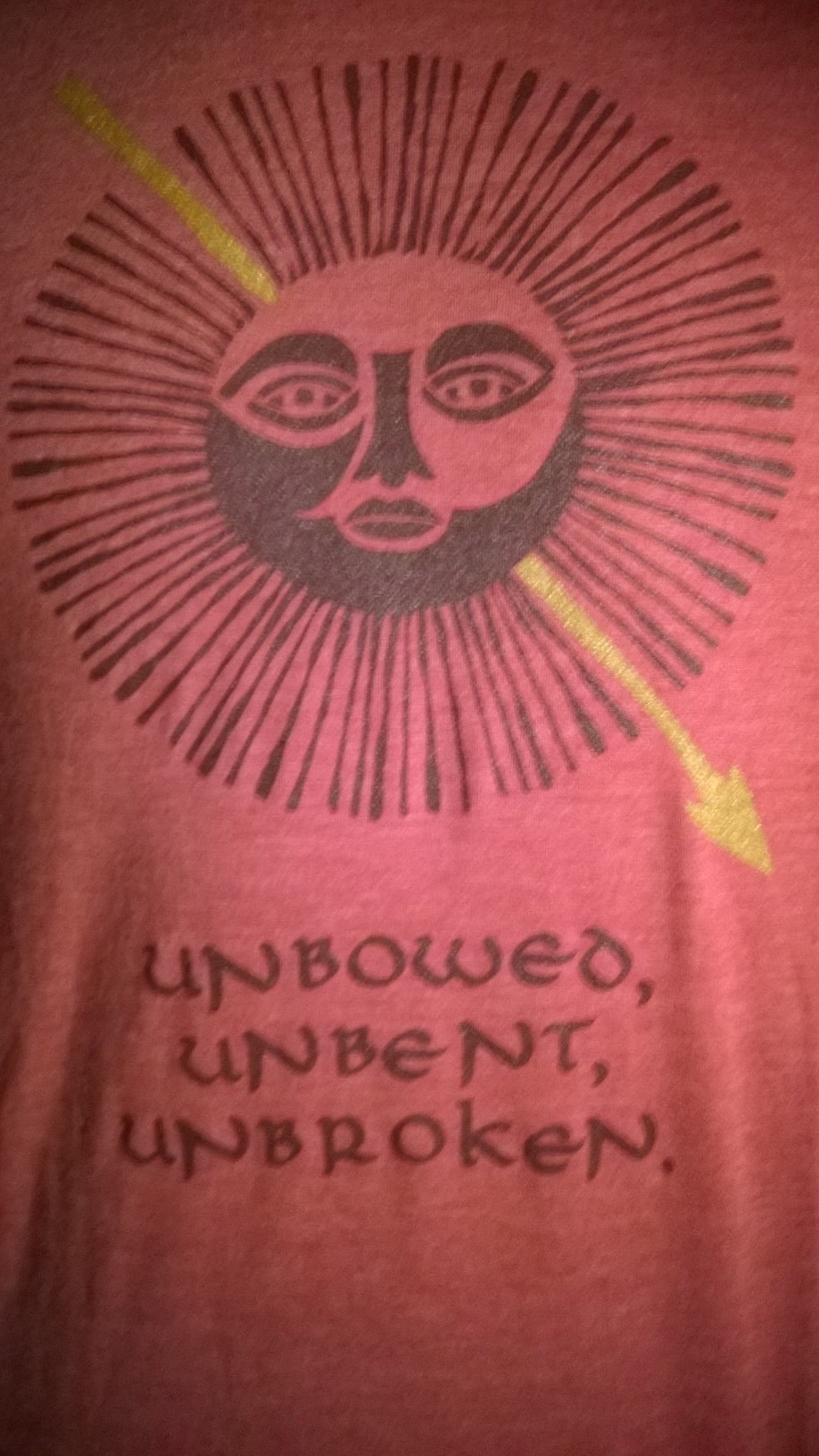
Unbowed, Unbent, Unbroken

WP_20141211_20_24_03_Pro

The Sunspear Sigil with House Martell’s Words

The words accompany the house’s sigil: The Sunspear. A symbol that radiates a determined strength and fullness. The sun shines out, and not only will he not be bowed, bent, or broken, he will overcome all obstacles with the sharp point of that radiant spear.

I do not offer this imagery and these words as some sort of call to violence or rage. Rather, if you are going through hard times, and I see so many going through their own heartbreaking transitions right now, you can resolve yourself to be unbowed, unbent, and unbroken. You are a warrior in the sense that you can discover your own strength, dignity, and basic goodness, no matter how difficult life may be.

Remember: you cannot control the events of the world, the myriad unfoldings of the universe, or the trials and tribulations of your fate. However, you can control how you react to them. So, stand tall. Shine. Resolve yourself to face them, not run away from them. Smile upon them with that glowing strength, and you may just find that you can bear so much more than you ever thought possible.

Previous Older Entries Next Newer Entries