One Empty Mind

One…
Sun shines through clouds
Birds sing in the wind

Empty…
Breeze blows around compassionate statue
Monks sweep, scrub, and smile

Mind…
All flows–just this moment
Not separate–myself, the mountain

Zen
Buddha Dharma
Everywhere, always–Just This

WP_20151018_15_31_37_Pro

WP_20151018_15_08_26_Panorama


May this help you experience the primordial emptiness of mind.

Gassho!

Compassion Can Save Your Life

Compassion can save your life
Deliverance from struggle and strife
No longer living on the edge of a knife
Compassion can save your life

Open eyes–that empathize
Open heart–that can impart
Open mind–judgments unwind
Openness–knowing emptiness

Karuna inspires–not about “me”
Holding wisdom’s hand–All that be
The Way–infinite, nothing outside
No longer separate–in peace “I” reside

Waking up is difficult.
It is realization that peace and happiness were not some distant accomplishment.
They were here all along.
The Buddha resides in the burning house.
The other shore is right here, right now.


May this inspire you to compassion and presence.

Gassho!

A Musing on “Wu Wei”

Here’s another trip through the musings of Morning Pages. Enjoy!


Anyway, there is a lot to be thankful for in this moment. I’m in a gorgeous part of the world. I have great coffee at hand as well as delicious Greek yogurt. I’m young. I’m smart, and I have the good fortune of being able to learn of the Dharma. There is no time to waste getting caught up in hormonal chaos. I could die at any moment. Practice is paramount.

That makes me think about wu wei. Most think of this as inaction or a bit more subtly, “doing without doing”. The thing is, it doesn’t mean “doing nothing”. It’s more like a rethinking of proper action. For the most part, we think of ourselves as Masters of the Universe, and by the power of Greyskull, anything that opposes our sense of the way things should be must be smote through “MY” action as agent who shapes the universe to “MY” will. The Tao Te Ching says multiple times that those things built by force and will come to an early end. They come to be from delusional thought–a cosmological navel gazing that puts undue importance on my place in the universe and overlooks how I am a part of it all–it’s a view that aspires for permanence, security and grandness. “I”, in truth, am just a momentary coming together of stardust, dancing and shining on this small orb in a backwater solar system. “My existence” lasts for what would be less than a heartbeat from the universe’s perspective.

Unlike this agent-centered push to dominate nature, wu wei is action that flows along with the universe’s unfolding. It is action, but action that correctly sees “my” place in the universe and acts along with the universe, rather than against it.

file7311247263819


May this help you see how to act in accordance with the Truth of the universe–wu wei.

Gassho!

1 Year–100

A turn…

I started this blog a year ago, and so much has been unfolding throughout the 12 months since. Also, I just posted the blog’s 100th post in the last few days, a good place to mark the end of this year’s journey.

I’m grateful for all of your comments and likes. I am thankful for your companionship on the Way–searching for wisdom and a way of expressing it to all sentient beings out there. May we continue to dance along the Way together, and may these writings be to the benefit of all who read them.

Deep Gassho!

Z

file3411299985701

Neither This Nor That

Me, myself, and mine
Are not the heart of the divine
“My” Truth? Do you comprehend
What this phrase would intend?
Between extremes–meaninglessness
Or metaphysical seriousness
We swing on conceptual dichotomy
Really invokes experiential lobotomy
Either/or, black or white?
Can All be measured in wrong or right?
Is value so readily inherent?
Is Truth just personally apparent?
Must we choose eternalism or nihilism?
Absolutism and relativism–a schism
De-cide–roots meaning to cut apart
Conceptual delimiting of ideological art
The Way walks through the abyss
The dividing line between–just this
Neither here nor there, this nor that
Wisdom lies not in the distinction I shat
Presence/Oblivion: two sides, same coin
These are not separate–nothing to join

file0001719187149


After a storm at sea the sailor heads for home and quiet harbor.
Tossed by indecision
we must return our unsettled mind to the center.
Tao is within us all.
With many voices it has but one beautiful song;
many aspects but only one essence.
Though we are not bound, we are always connected.

Buddhahood is meditation;
with constant attentiveness our mind travels far:
into the highest hills and all over the world.
Elusive, delicate–we see the cosmos is empty
as well as full.
Nothing beyond, Nothing in hand.
Beauty, spirit, Tao–all one.

–§1 in “Everyday Practice” from The Book of the Heart: Embracing the Tao by Loy Ching-Yuen

Without words, we understand no-mind;
without shape, we understand true nature.
With relaxed mind, we grasp the meaning of Tao;
with the boundless Way, we understand truth.

–§3 in “Everyday Practice” from The Book of the Heart: Embracing the Tao by Loy Ching-Yuen

May this help you see beyond dualism and the relativistic pat on the back that can come with your own Stories–that is “My Truth”.

Gassho!

The River of Life–on Existence and “Separation”

Here’s another set of Morning Pages philosophical thoughts. Enjoy!


Floating through–a bubble on the surface of a river. The fragility of it and the shining beauty–yet not separate from muck and refuse also floating by in the water. Separate? Does such a word make any deep sense? Of course the bubble is distinct from the banks of the river, but where does the bubble end and “the river” begin? Also, could one truly be without the other? You may say that the river could, but it would be a different river, and would either be without the banks? What is separation?

This image is a metaphor for life, and the last point stands to remind us that “my” life as separate, as independent, is equally implausible. The universe would not be the same without me in it, but we usually stop there and make this into some sort of grand creed of the ego–“My existence is of universal importance!!!” Thus do we beat our chests at the confusion and existential anguish of the questions: “Why am I here? What is the point of it all?” Thus do we cover over our fear of death and nonexistence, trying to overlook how that bubble could so easily pop and that we cannot begin to understand or conceive of what it would be like to dissolve from bubble into river–to have the “I” dissolve into whatever it may become when this body pops in its own way.

We must not stop with this roar at the uncertainties of our embodied, impermanent life. The other point was that I am not separate from the universe. The bubble would not be, if not for floating along on the water. Words deceive here. It is not the river, and yet it is the river. It flows differently than the water around it, but it is composed of the same water and shows us merely a different way that all the particulars of the river’s flow can manifest, albeit briefly, as one possible occurrence in the ever-changing flow of flux.

Bubbles floating on a river...

Bubbles floating on a river…

Here is the mystery. Here is Tao, shunyata, Source, or the divine spark. Here is what you should spend your time observing. The universe universes the universe, right here, right now–right everywhere, right always–and “I” am not a separate, “independent” observer. I am that unfolding splendor in one tiny, localized manifestation, clearly not the whole yet not separate from the whole. Such mystery cannot be adequately represented in words, only indicated, only shownLook.

May All be happy.
May All be healthy.
May All be at peace.
May All live with ease.


May this bring you insight and inspire you to look deeply at all you encounter.

Gassho!

A Visit–Nostalgia

A trip through a home from the past
Proof positive–nothing does last
The place–uncanny, both foreign and known
In these environs, many memories grown
Faces and voices flit through my head
Though called forth alive, long since dead
Recollections: so much pomp and circumstance
Also, niggling–the sweet comforts of romance
Nostalgia flashes under pale blue, fall sky
As all these trees and buildings pass by
Yet hazy ache is soon quelled
This story by details dispelled
Forgotten, repelled, and left aside
As self-righteousness and revisionism abide
Home you were, briefly and hard-won
In a moment, our greatest loves unspun
What was–cast as silly and delusion
This self-justification is the “wisdom” illusion
The Way goes on–perhaps with a return
Meanwhile, may you peacefully live and learn

portland-bridge-2-1545131-1600x1200

Thoughts and Letting Go–The Mind’s Kite

This is my first deep writing in a while. Yet again, it appears unexpectedly in the open space of Morning Pages. Enjoy!


Here we are… Another day. It’s great to be writing in this moment. As I slow down and attend to the process, I feel utterly awash with sensation. There is so much detail–sound, smell, light, touch, vibration–in every moment. Usually, though, we’ve shut much of it out as we narrow our vision/smell/hearing/etc. to some small set of attention. There’s nothing wrong with that. In fact, its’ somewhat necessary. There’s so much to experience that we can’t hold it all at once. It’s the same with our thoughts. A quiet moment of mindfulness reveals that they are a legion; however, in most moments, we’re running along with one in particular as though it were a huge kite yanking along a child on a windy day. The funny thing in each instance is our lack of awareness of the process and possibility in each. With sensation, we forget that there is so much that we are closing out in this moment, or maybe, we don’t forget as much as not even realize that’s happening. With the thoughts, the same: we don’t realize that we are holding onto that kite string and running along with them (the thoughts). Meditation can show us both that there is so much to be aware of in every moment, bodily, and so many thoughts flitting by, mentally. It can open us to our full unfolding, right here, right now. It also shows that those thoughts are not “me”. I don’t have to run along with them. I can just as readily let them go–that kite can just fly away. It is only in grasping to it that I give it the power to pull me here and there. I can just as readily watch it fly on the wind without feeling its pull. Whether that kite is in the shape of the most beautiful butterfly or the most terrifying dragon does not make it any more enduring, any more absolute. It’s just another passing moment, another gust of wind. In grabbing onto the string, I keep it flitting about in the broad, open expanse of my mind; otherwise, it will pass out of sight soon enough, and I have the opportunity to watch it soar by without mistaking that string and kite as an extension of myself–as an immutable truth that defines me.

ttronslien-2497

In this moment and in every “now”, “I” am a flux of all these sensations and thoughts, a huge amount of possibilities manifesting in reality. It’s one small fold of the universe universing itself; it’s an unfolding emergence; it’s a human becoming.

May All be happy.
May All be healthy.
May All be at peace.
May All live with ease.


May this help you let go of that kite, seeing the unfolding potential that is in every moment. May you find the liberation of not grasping onto thoughts and definitions, thereby taking the first steps out of the orbit of samsara.

Gassho!

Visit to the Tsubaki Grand Shrine

Recently, I went to the Tsubaki Grand Shrine–the 1st Shinto shrine built in North America (although moved from its original location in California to the current one in Washington State). It’s only about an hour drive from my place, surprisingly enough.

It’s located in some serene woods northeast of Everett, WA. It sits nestled amidst trees, alongside a soothing river. I can think of no better location for a religious shrine of a tradition that praises nature in all of her rhythms, cycles, blessings, changes, and unfoldings.

There were many altars, laced with traditions and rituals, speaking to the genuine Japanese heritage of this shrine–not some second-rate American attempt. For instance, there was a column with the animals of the Chinese zodiac carved around it, chasing each other endlessly through the ongoing years of the calendar.

Chinese Zodiac Column - Tsubaki Shrine

There was also a basin with long-handled wooden ladles for cleansing one’s hands and face before entering the nearby door to the shrine proper. The basin lay below an awning, keeping the water from being fouled by falling leaves, and a wise, kindly dragon stood above and behind it, his stony visage protecting from spiritual impurities.

A few steps away, a thick rope hung from another awning, attached to a large bell. This implement for announcing oneself at the temple entrance was above another basin–this one empty of water, but the open space was meant to collect offerings from visitors.
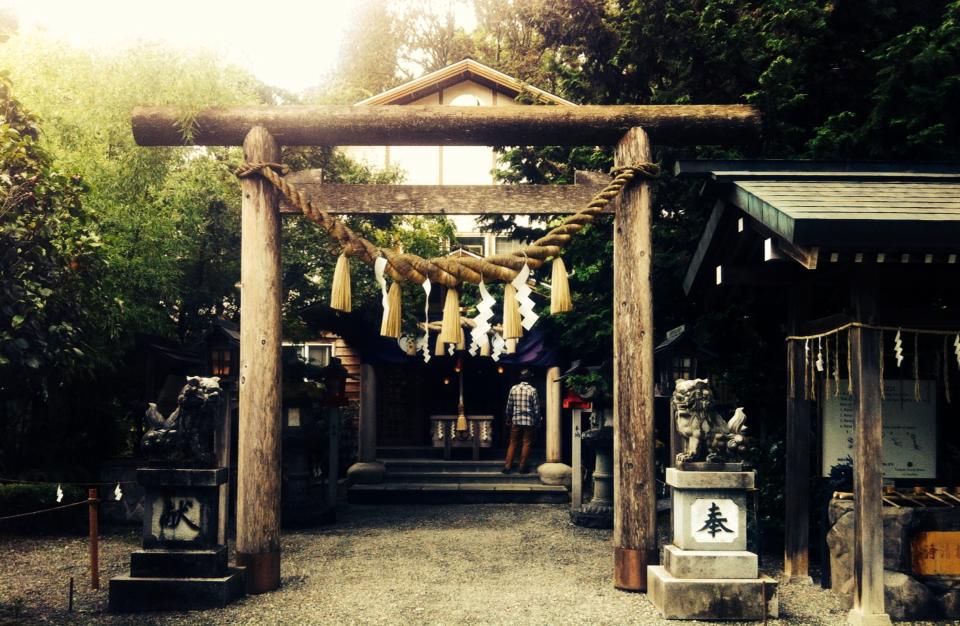
Tsubaki Shrine entrance

I’m standing at the entrance in the background, and the washbasin is in the foreground to the right. The description of the shop that follows is hidden behind the washbasin area.

To the right, a window displayed many small amulets and talismans that visitors can purchase for blessings in the year ahead.

My companion and I asked questions about the amulets, and the middle-aged, Japanese woman called out to her “sensei” to help us. She disappeared behind a partition and was soon replaced by a white-haired, Western man in his later 50s who answered our questions with gusto and greeted us to the shrine. He even let us inside to use the restroom despite the entrance having been cordoned off for the day already.

He pointed out a “portable shrine”–a large, golden relic atop wooden struts with colorful supports holding the shrine in place–and explained there are festivals which will require this. One is in Bellevue in September. We immediately agreed to go.

Here it is as well as the shrine’s reverend. This was found on the Northwest Public Radio’s site: nwpr.org.

After this, we walked outside and looked at the other altars for blessings and contemplation below the main shrine. There was a small enclosure, overgrown with moss and populated by some kami. Nearby, there was a board to hang small plaques with wishes for the kami to read and bless.
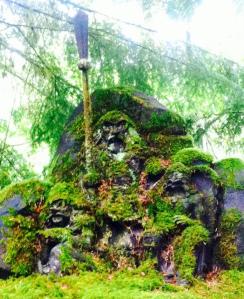
Guardians

Here are the guardians sitting atop a boulder in that small enclosure.

Further down the past was a large stone orb on a pedestal with instructions for a prayer that should be said three times while rubbing the orb. It is supposed to bring overall well-being to one’s life and relationships. This pedestal overlooked the peaceful course of the river below, which we walked down to and admired after each struggling to pronounce the Japanese prayer (written out for us poor gaijin in Romaji, so it was possible to phonetically sound out) three times. 🙂

Good Luck Prayer

Here I am saying the prayer and rubbing the orb.

Near the pedestal, there was a simple post with the wish that peace prevail on Earth written on it in numerous languages…

May Peace Prevail

The peaceful post with the river in the distance…

Finally, at the end of the path below the main shrine was a small shrine adorned with statues of mystical, white, Japanese foxes–those magical creatures of Japanese lore. This shrine had several of the iconic Japanese arches before it–in red and gold.

WP_20150815_16_30_41_Pro[1] WP_20150815_16_31_33_Pro[1] WP_20150815_16_32_31_Pro[1]

Just beyond the arches, before ending at the fox shrine, there was a large stone in the shape of what looked like the yin from a yin-yang symbol. A plaque explained its meaning as well as the tripartite Shinto symbol made of three of these swirling icons. The plaque said that Shinto beliefs hold that the entire universe down to the structure of subatomic particles is composed of spirals. Thus, the spiral is a symbol for revering the myriad and mysterious unfoldings of nature. I was awestruck by this simple yet profound praise of Nature in a quaint forest glade. Here was a simple pointer to the wonder of All rather than “my” mastery of it.

WP_20150815_16_30_02_Pro[1] WP_20150815_16_29_41_Pro[1] WP_20150815_16_28_41_Pro[1]


“I am sure everyone who visits the shrine is struck by the mysterious and undeniable beauty and the peaceful atmosphere that surrounds it. These are things I still notice everyday when I arrive. I find the earlier mornings at the shrine to be a true treasure because these are the times I can feel the world awakening around me. I love walking down the main path, listening to the birds and the river while seeing the morning sunlight shining through the trees. I can’t help but feel connected at these moments.

I’ve noticed while helping to maintain the shrine grounds it can often feel like you’re fighting an unwinnable battle against the forces of nature. You can pick up hundreds of leaves but more are constantly falling onto the ground, areas that have been cleared of weeds all of a sudden have weeds again a week later, and areas that have been raked soon need raking again. However it has dawned on me that maintaining the shrine grounds is not a struggle with nature but is instead an important part of the natural order of the shrine. Leaves fall and I pick them up; it’s part of the cycle. In a way it’s a balancing act between nature’s chaos and the human need for order. By clearing the shrine grounds, you get to be a part of the process.” — Teddy Rodriguez, a volunteer who helped maintain the shrine for some months–taken from the Shrine’s newsletter

May this adventure inspire you to see your engagement and interaction with nature. May it help you see your place within it, not different, not separate–but a piece of the whole; spirals all the way down.

Gassho!

Path of the Dharma: Dhammapada–Chapter 23: The Elephant

Note: I’m going to move forward in the book to this late chapter and then skip back to a couple earlier sections. Also, the passage below, although long, is not the complete chapter, rather about 2/3 of it. I chose this particular selection from it to emphasize one point of content, honing the Manjushri sword of wisdom.


Patiently I shall bear harsh words as the elephant bears arrows on the battlefield. People are often inconsiderate.

Only a trained elephant goes to the battlefield; only a trained elephant carries the king. Best among men are those who have trained the mind to endure harsh words patiently.

Mules are good animals when trained; even better are well-trained Sind horses and great elephants. Best among men is one with a well-trained mind.

No animal can take you to nirvana; only a well-trained mind can lead you to this untrodden land.

The elephant Dhanapalaka in heat will not eat at all when he is bound; he pines for his mate in the elephant grove.

Eating too much, sleeping too much, like an overfed hog, those too lazy to exert effort are born again and again.

Long ago my mind used to wander as it liked and do what it wanted. Now I can rule my mind as the mahout controls the elephant with his hooked staff.

Be vigilant; guard your mind against negative thoughts. Pull yourself out of bad ways as an elephant raises itself out of the mud. — Trans. Easwaran

455 (75)

The well-trained mind will take you along the path like the well-trained elephant carries the rider.

Something about the metaphor in this chapter struck me profoundly. The image of the well-trained elephant is very clear, and yet again, we have a comparison that distinguishes the path to nirvana from the other. In this first passage, the Buddha makes clear that the best quality to cultivate is a well-trained mind. This echoes the main message in the other sections we’ve discussed so far. He emphasizes here, however, that the only thing that will allow you passage to nirvana is a well-trained mind. The previous sections didn’t emphasize this destination.

Perhaps, we should take a moment here and question what exactly nirvana is. Otherwise, we run the risk of falling into undefined terms and elaborate concepts without understanding the intention of this message, rather falling prey to our own fancies and preconceptions. This task of considering nirvana may sound easy, but it isn’t and could be written about at much greater length. The word “nirvana” has a certain exotic and fantastical feel to it, at least from my perspective. I remember using it as a child to indicate having reached some ideal and unassailable state–a perfection of sorts that once attained never falls away. Such an understanding reiterates familiar metaphysical dichotomies of being fallen and transcending our state of lack to a completion in the ideal. The two phrases I just used indicate two familiar examples of this–Christianity (transcending fallen state–the lacking nature of sin–through the perfect grace of the ideal: God and Christ) and Western philosophy’s metaphysical systems in general from Plato onward (contrast of the lacking living world with the ideal one which is the Truth, the Real world behind the shadow one that we are in–appearance vs. essence). While there may be arguments for such an understanding of nirvana from passages in the Pali canon, it does not fit well with this section from the Dhammapada.

This passage makes clear that the path to nirvana is the path of the well-trained mind. The examples here show that the well-trained mind is not swayed away from the good, selfless presence in the world (as discussed in my first selection from the Dhammapada) by lust, laziness, etc. We’re shown through the metaphor of the trained elephant that the mind can be trained so that it does not wander about, and this, just this, is the path to nirvana. It’s not acquiring some special state (which wouldn’t fit with the Buddha’s emphasis on impermanence anyway) or going somewhere else outside the “ordinary” world (Where would such a place be anyway???). Rather, it’s being fully immersed in the world with our mind as it is underneath all the constant layers of distractions and compulsions.

We often think of nirvana as the result of enlightenment, highlighting the profound wisdom in this path/practice (to be enlightened is to have seen the Truth), but we could also cast it as liberation; that is another, if not equally emphasized, “attainment” (there’s really nothing to attain, more like something to lose) of Buddhist practice, and with that re-thinking, we can see that the path of the trained elephant is simply that–liberation from the myriad sufferings of a confused mind. This regal animal can bear us to the core of our own happiness, revealing our own basic goodness beneath the desire, aversion, and ignorance of our untrained mind.

eo0mAzay

Walking the path step by step…


In case we conclude that a capitalized Mind is something other than our usual one, Huang Po deflates all delusions about its transcendence.:

“Q: From all you have just said, Mind is the Buddha; but it is not clear was to what sort of mind is meant by this “Mind which is the Buddha.”
Huang Po: How many minds have you got?
Q: But is the Buddha the ordinary mind or the Enlightened mind?
Huang Po: Where on earth do you keep your “ordinary mind” and your “Enlightened mind”?”

A familiar implication is the Chan/Zen insistence that enlightenment is nothing more than realizing the true nature of the ordinary activities of one’s everyday mind. When Hui Hai was asked about his own practice, he replied: “When I’m hungry I eat; when tired I sleep.”

The Pali texts of early Buddhism do not emphasize “everyday mind” in the same way, for they often contrast the consciousness of an ordinary person (puthujjana) with the liberated mind of an awakened arahant. Yet there is the same focus on not-clinging, a notable example being in the “Book of the Six Sense Bases” in the Samyutta Nikaya. There the Buddha repeatedly teaches “The Dhamma for abandoning all.” He emphasizes that practitioners should develop dispassion toward the six senses and their objects (including the mind and mental phenomena) and abandon them, for that is the only way to end one’s suffering.

“Through dispassion [his mind] is liberated. When it is liberated there comes the knowledge: “It’s liberated.” He understands: “Destroyed is birth, the holy life has been lived, what had to be done has been done, there is no more for this state of being.””

Listening to this discourse, “the minds of the thousand bhikkus were liberated from the taints by nonclinging.” The absence of grasping is what liberates.

“Truly, is anything missing now?
Nirvana is right here, before our eyes.
This very place is the Lotus Land, this very body, the Buddha.”–Hakuin

Passage taken from David R. Loy’s A New Buddhist Path, pp. 50-51.

May this inspire you to train your mind and release the mind that grasps so that you too may achieve liberation–the well-trained mind will bear you on the path to nirvana.

Gassho!

Previous Older Entries Next Newer Entries