
This session returned to the experience I only got to the edge of exploring in my recording a couple nights ago and delved in deeply alongside some loving admiration of passages from Shunryu Suzuki’s “Zen Mind, Beginner’s Mind” and Dogen-zenji’s “Genjokoan”. I really tried to express some key ideas of non-attachment and sitting within calm presence, even in the heart of painful desires.
Philosophy Riffing | “It shouldn’t be this way” – Zen Practice, Living in the Burning House
19 Jul 2023 Leave a comment
in Philosophy Riffing Tags: Buddhism, Depression, Dogen, Practice, Samsara, Shunryu Suzuki, Wittgenstein, Zen
Philosophy Riffing | Emptiness/Form, Fixation/Liberation, Language/Life, Love/Loss, and Trauma/Understanding
14 Dec 2022 2 Comments
in Healing, Philosophy Riffing, Psychology Tags: Camus, Chöd, Gadamer, Heidegger, Hermeneutics, Love, Philosophy of language, Piaget, The Heart Sutra, Wittgenstein
This post went through a myriad of ideas and sources, from Buddhist nuns in the 1100s to Camus’ in the 1950s. I love where this one went and am grateful for anyone who walks along in these ideas and cares to comment or reach out for further conversation.
May this inspire many thoughts and your own healing.
Philosophy Riffing | I-You, Ethics as first philosophy, pursuing the Good, and Stoicism
02 Dec 2022 Leave a comment
in Ethics, Philosophy Riffing Tags: Buber, Buddhism, Epictetus, I-You, Marcus Aurelius, Stoicism, Wittgenstein
Recent reinvigoration of my interest in Stoicism inspired this somewhat meandering discussion of a meaningful, value-driven life with riffs on Buber, Wittgenstein, Buddhism, and most definitely Stoicism. May this inspire others despite its lack of clear organization.
Here’s the key book I mentioned late in the recording: How to Think Like a Roman Emperor by Donald Robertson .
Cross-Post: The Post-Rock Way – Love | Destiny | The Red Thread
29 Jan 2022 Leave a comment
in Buddhism, Love, Music, Philosophy Tags: Concepts, Dōgen, Myth, Philosophy of language, Stanley Cavell, Wittgenstein
This post was originally on my other blog about exploring spirituality and philosophy through post-rock music. I recently wrote a post on the best albums of 2021 in post-rock, so I recommend to check that out if you find the music in this post interesting. I had to write this post about one of my favorite post-rock songs with vocals. I hope you enjoy it as well.
One of the most moving post-rock discoveries for me last year was Akai Ito by we.own.the.sky..
This is one of the rare post-rock songs that has lyrics, and coming at the end of the album, the words make it even more powerful. Furthermore, the lyrics are short, simple, and moving, yet also somewhat cryptic:
The stars. They fall.
Lyrics – “Akai Ito” by we.own.the.sky
Like threads unfurl.
They guide me home.
Where I belong.
This is only repeated a few times, the final time being with a full chorus instead of a single voice.
Hearing this song immediately made me look up what “Akai Ito” means. It’s a reference to the Japanese version of the Chinese myth of the “red thread” a concept of love and destiny in which lovers are connected by a red thread of fate.
I don’t really believe in soulmates or some sort of destiny like that, but I can understand the pull of profound love and how powerful it can be. It truly is a sense of home and belonging, a seeming deep fit of shared connection that seems so meaningful and powerful that it feels like maybe greater forces are at play.
I’m not sure what to think of my own experience of this at this point in my life. I feel that I’ve lost that sense of belonging and home but feel the connection still, no matter what events have come forward. It’s hard, confusing, and sad. I’ve actually meant to write some Buddhist sutra inspired poetry on my other blog about this sense of heartbreak in such feelings of loss and coping with them. I’ll link here when/if I do.
That said, one thing I’m certain of is that the way to approach these surprising great feelings in life is to let them arise and wash over you, not clinging to the joy, but just sitting with it while you’re fortunate enough to experience it, and also not trying to cling to it when despairing that its impermanence makes it fade, wither, and disappear. All things are impermanent. The only way to maintain them is by effort by both parties and circumstances supporting that continued thriving. I’m reminded of a post I wrote about change and cultivating something ongoing regarding Taoism on my other blog, but more precisely to sitting with the joy and the sorrow without clinging, I always think of Dogen:
Therefore, flowers fall even though we love them; weeds grow even though we dislike them.
Dogen Genjokoan – as translated by Shohaku Okumura in Realizing Genjokoan: The Key to Dogen’s Shobogenzo
Furthermore, I’m reminded of some thoughts about love I’ve shared on my other blog, particularly here and in a podcast-esque recording about some experiences of love I’ve had. The key quote was from Stanley Cavell’s The Claim of Reason in which he’s talking about learning words as a child and that there are some concepts that are so huge that they do not express all they could take from us. In some regards, myth and song bridge that gap a bit – pulling us to grander feelings regarding these concepts, and when I hear this song, that’s what I feel – a more grandiose sense of love and connection, without ever mentioning either word.
But although I didn’t tell her, and she didn’t learn, either what the word “kitty” means or what a kitty is, if she keeps leaping and I keep looking and smiling, she will learn both. I have wanted to say: Kittens–what we call “kittens”–do not exist in her world yet, she has not acquired the forms of life which contain them. They do not exist in something like the way cities and mayors will not exist in her world until long after pumpkins and kittens do; or like the way God or love or responsibility or beauty do not exist in our world; we have not mastered, or we have forgotten, or we have distorted, or learned through fragmented models, the forms of life which could make utterances like “God exists” or “God is dead” or “I love you” or “I cannot do otherwise” or “Beauty is but the beginning of terror” bear all the weight they could carry, express all they could take from us. We do not know the meaning of the words. We look away and leap around.
Stanley Cavell – The Claim of Reason pp. 172-173
Heartbreak | Sitting with Suicidal Thoughts
12 Nov 2021 3 Comments
in Buddhism, Heartbreak Tags: Camus, Depression, Dukkha, Existentialism, Frankl, Meaning, Nietzsche, The Preliminaries, Tibetan Buddhism, Wittgenstein
I’ve kind of touched on the thoughts here in a recent post, but I thought they were important and weighty enough to address a bit more directly rather than abstractly. I’m hoping the vulnerability and sharing of process will support anyone else who needs it as finding the acceptance of friends and family has been crucial to continue sitting through these difficult feelings, whereas those who tell you you’re wrong, confused, or self-involved make it much more painful. I can only hope to give some companionship and feelings of being seen to those who need it.
I’ve honestly dealt with depression off an on throughout my adult life. It’s always around big changes and losses though – not the seemingly random nature of major depressive disorder, more the grief of the difficulties of a human life.
I’ve never really felt suicidal in depression, no matter how empty or meaningless life has felt. Not until this time. I’ve had the deep yearning to die regularly and escalating ideas of suicidal ideation since around mid-summer. It’s hard, and ultimately, it’s scary and tiring. Part of me has to struggle continuously not to sink into the abyss. Honestly, as someone deeply involved in existential psychology, I feel like it has to do with the famous quote: “He who has a Why to live for can bear almost any How” (Viktor Frankl, Man’s Search for Meaning). I’ve personally seen the withering away when a “Why” is lost. In many ways, this is precisely the problem of suicide that Camus lines out in his discussion of the absurd in The Myth of Sisyphus. Facing one’s existence and projects in life as meaningless is the ultimate existential angst. It’s facing the feeling that life wouldn’t matter if I wasn’t here. Rather than the Heideggerean state of being verfallen and covering over one’s death, it’s the inverse – staring life in the face and asking why you were even born at all while struggling to find any answer, as any you used to have have dissolved in your hands.
That’s all cerebral, but the experience is anything but – those are just philosophy riffs to explain the experience. The embodied experience is much more raw and crushing. I’ve thought numerous times how great it would be if I had the courage to jump out my window. I even had a sudden urge to stab myself with a knife recently, but ultimately, none of this has ever escalated to the point of having true plans, means, or intentions enough to where I felt I needed help, beyond some time to sit, cry, and be mindfully present for my feelings.
For me, it’s been all pulled forward by having attached to ideas of partnership and love – ideas that I didn’t fully realize were such a strong piece of my identity, desire, and meaning in life. Now, I’m just not so sure of those ideas, and ultimately, I don’t think the answer is to try to find them again with someone else, so it feels as though my life doesn’t really have something to aspire to, to build, to find meaning in.
Speaking of attachment – this is a klesha: clinging. Clinging to those ideas has caused such a traumatic crash of meaning and identity, and it doesn’t seem effective enough to take the existential, well, rather, Nietzschean, approach of building some new meaning/project/values, i.e. creating some new take on love or relationships. Instead, I’ve been inspired by the Buddhist ideas regarding attachment. I’ve tried to sit with the feelings of attachment and let them dissolve. Instead, I try to show up, connect with people, and provide my kindness and compassion for the struggles they go through, and ultimately, every time, it has led to gratitude and sometimes, even, growth in the engagement.
I feel that showing up to these hardest of feelings is like what I’ve posted about previously as a famous quote from Zen that before enlightenment you chop wood and carry water, while after enlightenment you chop wood and carry water. Facing the toughest moments of life is about mindfully sitting in them, realizing that it’s just more life. The world is as it was before. Your perception and emotional reactions are all over the place, but ultimately, the same billions of years of history are before this moment as in the past. The same world is there. It merely seems different because of that Wittgensteinian idea that the world of the sad person is different than that of the happy: i.e. your evaluations of it are different, but the aspects of living your life as a human being in your life and home are the same in the broader sense (this could very much be lined up with Stoic ideas as well, especially Epictetus).
Mindfully being present and being focused on showing compassion for others is a simple and yet deep shift in approaching the mystery of living in an existence that’s always greater and more mysterious than the meanings you find in your personal projects and interpretations. Being present and vulnerable in such a way offers the possibility of seeing life as precious, just as it is, just as painful and heartbreaking as it can be in its most samsaric of moments.
Which brings me to the greatest counter-perspective I can emphasize to that of the suicidal abyss: experiencing life as precious. I’ve recently been thinking of Atisha’s slogan practices from Tibetan Buddhism. The first slogan “First, train in the preliminaries” was key to facing my dad’s death a few years ago, and recent Buddhist classes I’ve been attending have been key to bringing these ideas back to the fore.
There are four “preliminaries”. I’ll attach a photo of a post-it note I wrote years ago with my own take of them to remember them by. It’s on my fridge. I took a picture of it before a recent trip because I was thinking about these suicidal thoughts and the counter effort I’ve been working on in seeing compassion and wisdom to pull me back into this more engaged mindset.
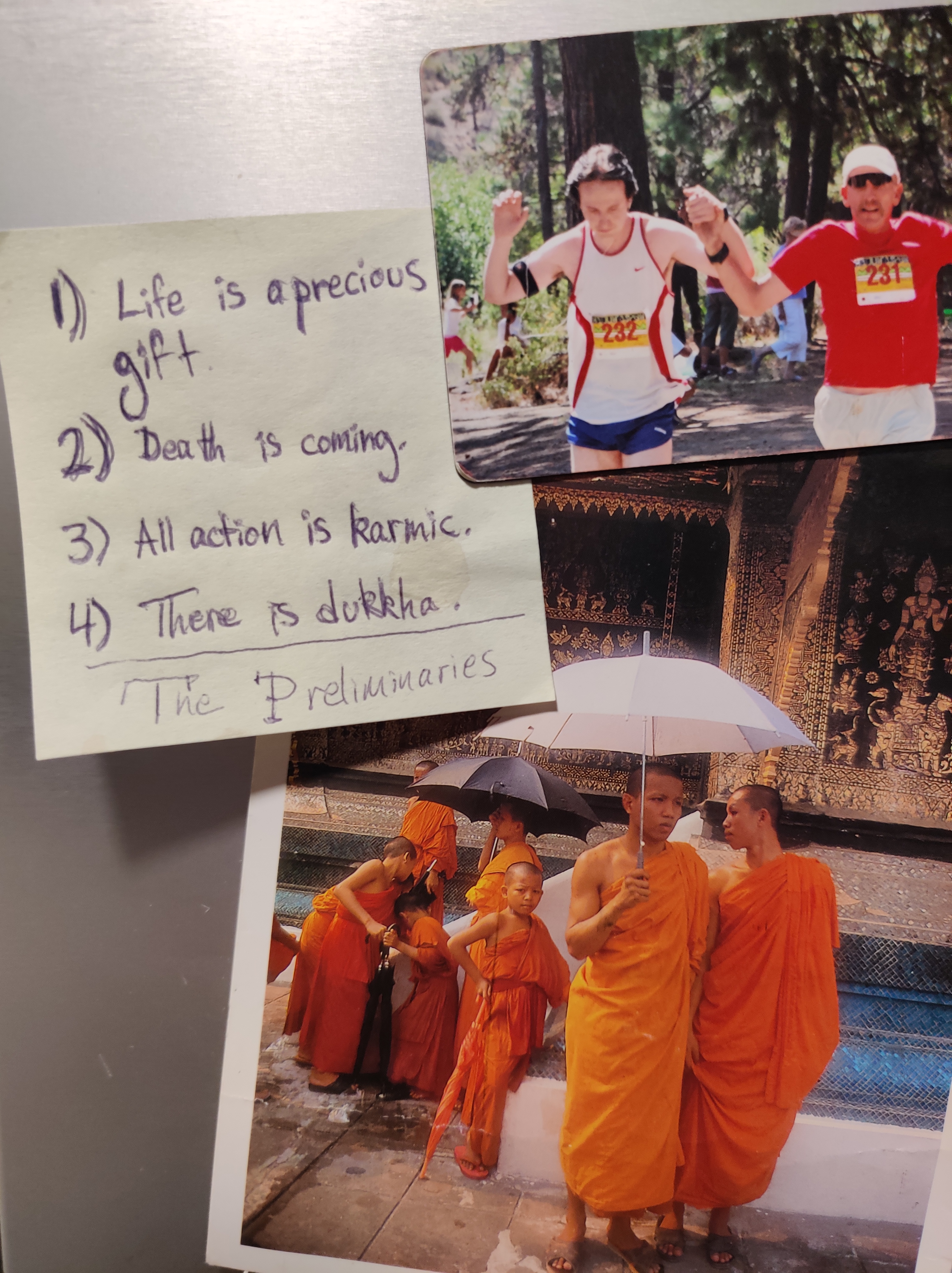
I’ll speak of slogan practice more thoroughly in the future (hopefully), but I’ll summarize these points here. Tibetan Buddhism emphasizes how rare and precious it is to be born as a human being in a time and place where you can learn the Buddha’s dharma – the truths and wisdom that offer you the possibility of breaking free from the painful reactions that make life so difficult. In a way, this summary of preciousness captures the point of the other 3 preliminaries as well as the Four Noble Truths in one go. A sentient life is one of the pain, disappointment, and suffering of dukkha. It’s one of standard patterns of action, walking through life with the same conditioned ways of re-acting (writing that way because we think of it as action, but it truly isn’t – reactivity is the most passive of ways of being. The only truly active freedom is in being able to sit with challenges and see your inclinations and choose differently in ways that do not continue the reactive patterns of suffering in your life). Waking up to a different way of being requires seeing the opportunity and wisdom that is available to you, embracing it with gratitude, and rethinking your actions based on the outcomes and results you bring to yourself through them (recognizing the 3rd preliminary that all action is karmic), working now to embrace that opportunity because you see your time is limited (recognizing the 2nd preliminary that death is coming), and finally, doing all of this out of the understanding that there is dukkha (the first of the Four Noble Truths which opens the whole Buddhist path before you).
When I think of the samsaric pain of loss and meaninglessness that I’m going through with all the suicidal thoughts attached to them, in other words, when thinking of the fact that there is dukkha, I remember another Buddhist passage I’ve brought up before, the poetic lines from Dogen’s Genjokoan: “Therefore flowers fall even though we love them; weeds grow even though we dislike them” (Shohaku Okumura, Realizing Genjokoan: The Key to Dogen’s Shobogenzo). Desire and aversion put us at odds with the changing circumstances of the impermanent world around us, but if we recognize those samsaric poisons within us, we can take pause and sit more patiently with the difficulties of life, allowing us to instead continue on with compassion for others and mindful presence for the moment at hand. We may no longer have the flowers of beauty, or we may need to contend with the weeds popping up, but we can be right in this moment, doing our best in it, and giving to all the others who are here struggling with their own pain at the changing circumstances they’re in.
May these words inspire and offer companionship to those who need them.
Gassho!
Philosophy Riffing | Liebe wird aus Mut gemacht – Love is made out of courage
14 Oct 2021 3 Comments
in Letting Go, Loss, Love, Narratives, Philosophy Riffing Tags: Buber, Compassion, Concepts, Courage, German, I-You, Nena, Nietzsche, Plato, Recording, Shambhala: The Sacred Path of the Warrior, Stanley Cavell - The Claim of Reason, Wittgenstein
Here is the second birthday creative gift post for myself. I’ve gotten responses from multiple people that they liked my posts of audio clips and wished I would do something more intentional or even more like a podcast. I attempted that last night with a general theme of “Liebe wird aus Mut gemacht” – “Love is made out of courage”. This almost hour-long first attempt at this kind of post is very much philosophy riffing and shared experience. I hope that people enjoy it as much as I enjoyed recording it.
NOTE: One detail I got wrong multiple times early in the recording – the dialogue I mention is Plato’s Phaedrus, not Phaedo. I tend to get those two dialogues’ titles mixed up in my mind, and it’s been years since I’ve read either.
Please give me any feedback on whether you enjoy this post or have themes you’d like me to explore in the future. Furthermore, let me know if you like the riffing style or would prefer something more structured! I’d love any feedback to consider whether to do more of this in the future and how best to go about it.
Previous post on Love and Language
Post from my other blog with some related analysis regarding experiences of love and language in relation to post-rock
Tarot – Understanding Yourself Through the Major Arcana: Moon
26 Jul 2021 4 Comments
in Spiritual Path, Tarot, Warrior's Path Tags: Courage, Illusion, Intuition, Resolve, The Shadow, Wittgenstein
I’ve been meaning to write about the meaning of particular tarot cards and what they can say about the spiritual and existential journey of life since a deep dive into the classic Japanese RPG Persona 4 Golden last year. Since then, I’ve been reading the tarot off and on, more frequently recently, for guidance through some tough times in life.
I think it would be useful to write about my experience with Major Arcana cards that have shown up strongly and repeatedly in my readings – explaining what they mean/have meant to me as I try to traverse the challenges of my life.
This time, I’ll write about the Moon card which has been a repeat pull in many spreads in the last few months.
The simplest way to summarize the Moon card is that it is a stage of the path that is a journey through darkness. It often is represented as a traversal of water between two pillars which represent some gate to beyond on the other side. The moon hangs above it all as the light through the darkness.
Often when people speak of this card, they focus on dealing with illusions. Picture this: you travel through the darkness with poor lighting. What you experience is skewed from the darkness of the night air. This is where perception is distorted into illusion, where imagination can fill in the gaps of what’s really there.
However, this card represents more than that. It also represents intuition. When you are forced to follow your own path through the darkness without your standard senses as being trustworthy, you have to trust your inner light, your intuition, to guide you. In some senses, this matches up well with the Hermit card.
Finally, the aspect I see discussed least: there is a danger to this journey. Going through the dark is no small task. If there are challenges in walking a trail in daylight (which there are), these are compounded in the darkness, and there are varieties of night creatures who can see and prey on you in the dark.
Ultimately, we could summarize all of these aspects by describing this as a journey that engages with the unconscious terrains of your life (water and moon as symbols) that you generally have covered over or are unaware of: a journey into your internal shadow lands or “Shadow work” as some might call it. In a very real sense, it’s a long dark night of the soul (although I don’t believe in souls). There is a danger of failure, loss, confusion, or a certain kind of self-destruction in traversing the darkness, but there’s also great transformation and wisdom to be gained in the journey and getting to the other side (a gate and threshold to traverse).

I feel that this card has come up for me time and again personally as I’ve had a lot of feelings and experiences thrown into doubt in recent months, and I’m even left questioning my concepts of romantic love and partnership. It’s a deeply existential struggle to truly look at such things and question precisely what they are and how you’ve valued them, possibly reevaluating who you are and who you will be in the world in the process. If defining relationships become a place of doubt and possible illusion, then you’re left with deep questions of what is real and who you are within that reality.
Thinking about this for this post reminded me of a hypothetical scenario in Wittgenstein’s “On Certainty” in which he discusses doubt through a thought experiment where he talks about a simple statement of “I’m living in England” but then imagines a slew of people coming in, telling him he is wrong, and offering proofs that that is not the case (§419-421). If this were thorough enough, your ground conviction in believing something to be the case would fall apart. This is the kind of illusion and doubt that one faces in the trials of the Moon, in my experience: the feelings and perspectives you’ve taken for granted without much analysis suddenly come deeply into question, and you are pushed to explore shadowy, unexplored realms within yourself.
To put it the most dramatically in terms of relationships, I felt resonance with a chunk of dialogue in a favorite show earlier today:
Liv: Why are you doing this?
Major: Doing what?
Liv: Making me doubt the only thing in my life that I was sure was real.
iZombie, S2: E4
This is a stage of journey that takes more resolve and courage than most any other. One of the only other ones that pops to mind is the resolve of patience for the Hanged Man, but this card differs, in that it’s a resolve to keep stepping forward with conviction, courage, and the willingness to face self-destruction for deep truth, unlike the call to resolutely accept and surrender to process with the Hanged Man. Regarding this, I would like to link a post on resolve from my other blog about post-rock. It fits well with the consideration of walking resolutely through the darkness.
Even though everything I’ve said here might have a dour ambience, I find few cards as empowering as the Moon card. There’s the real opportunity here for the fundamental investigation and hero’s journey to come through to great insight and growth. Being called to connect with intuition, face doubts, and throw your self-concept into danger are not things to shy away from. They are some of the greatest opportunities on the spiritual path and represent the greatest courage there is. This is the true vulnerability of the Warrior.
May this help others find their way through their own personal dark times.
Gassho!
On Memories
11 Jan 2016 Leave a comment
in Buddhism, Delusion, Historicity, Memory, Morning Pages, Perspective, Philosophy Tags: "The World is Made of Stories", David R. Loy, Hermeneutics, Interpretation, Wittgenstein
Here’s another philosophical entry from Morning Pages. This one jives on both hermeneutics (with some inspiration from my reading of the Tractatus by Wittgenstein as well) and Buddhism (at the end) with a final nod to some of the thoughts I encountered in David Loy’s The World is Made of Stories, a philosophical masterpiece of hermeneutics in its own rights. I hope that you enjoy and ponder your own experiences from this.
(The opening of the entry dealt with thinking back on an event from almost five years ago and memories of it.)
Trips into memory are so strange. I think that we can readily grab onto them too much. A memory is like a painting–an interpretation of a landscape and a moment of time. It’s a perspective–necessarily limited, and like a painting or a picture, the image itself fades with time, and our interaction with it now in the present is another interpretation. We see it from our current understanding, and it’s difficult to know/remember that our nostalgic reliving of a previous experience is an interpretation of an interpretation–not absolute, not complete. This is the beauty of it: our experience is artwork–a tapestry that is woven over and over again.

Free image found at morguefile.com, like many others on this blog
Although it is a truth (I experience what I do; that is true), it is not the Truth. It’s not a science or an in-depth recording of the “facts” (we might point out here that even these are interpretations, but more methodical, at least). Understanding this can allow us to be more compassionate to ourselves and others. It can allow us the clarity to see our place in the universe… How can we find enlightenment if we are unfamiliar with the nature of our delusion? We can’t if we grasp with certainty and dogma onto the legitimacy of our perspective, our experience, as the Truth. We have to be open to see our story-ing and to try to see beyond it to other perspectives. Sometimes, revisiting a memory gives us just enough of a jolt of our current story in the act of juxtaposition that we are pulled beyond in just a moment… It’s not always the case that we cling to memories without the realization of interpretation; sometimes, they’re a reminder of just that–we are built of stories, all of them interpretations, all the way down…
May this help you see your memories and your experience with insight and wisdom.
Gassho!
A Philosophical Knot: Un/conscious Agent
03 Dec 2015 Leave a comment
in Identity, Metaphysics, Morning Pages, Philosophical Knot, Philosophy, Psychology Tags: "I", Buddhism, Consciousness, Philosophy of language, The Unconscious, Wittgenstein
Here’s a rather philosophical set of Morning Pages. I’m capping it off with a quote from Wittgenstein to pull out one subtle allusion.
I hear the hum of vents as I sit here in the office this morning and focus. One astounding thing about meditating for me is the regular realization of how much of my experience passes by unnoticed. There is so much sound, smell, sight, sensation that goes by without my conscious processing of it. Perhaps the word “conscious” here leads us in troublesome philosophical directions. The problem with the term, as I stop now and really think about its usage, is that it is attached to the concept of a unified “I” that is the agent of consciousness.
However, if I drive for a while and suddenly realize that “I” wasn’t present for the last few minutes, does this mean that I “unconsciously” drove? This forces the familiar dichotomy of the unconscious as a secondary or, perhaps better said, primary agent behind the actions of the conscious agent. Philosophy then struggles with identity: trying to untangle the relationship between the two–are they separate? One conjoined and twisted Siamese twin?
Yet, we’ve presupposed a uniform whole in this agent (whether the conscious or unconscious one). We’ve presupposed an answer to the question of what/who “I” am in the analysis of an activity, thereby creating our own philosophical knot.
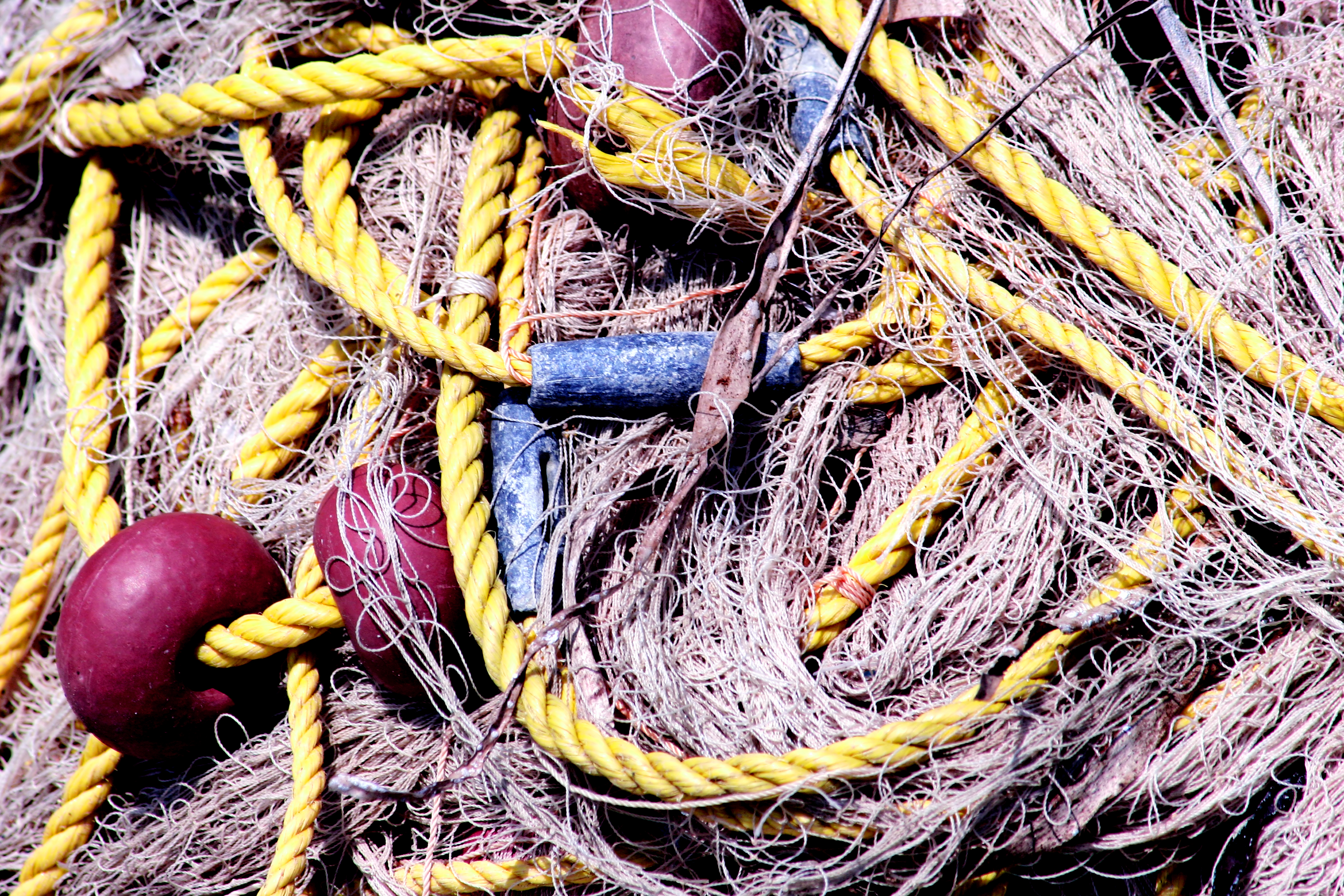
If “I” am a flux of several different multiplicities, assemblages, compilations, etc. coming together in this moment, “conscious” and “unconscious” become much more dynamic and engaged in the activity itself rather than unanalyzed concepts of agency and identity.
115. A picture held us captive. And we couldn’t get outside it, for it lay in our language, and language seemed only to repeat it to us inexorably.
118. Where does this investigation get its importance from, given that it seems only to destroy everything interesting: that is, all that is great and important? (As it were, all the buildings, leaving behind only bits of stone and rubble.) But what we are destroying are only houses of cards, and we are clearing up the ground of language on which they stood.
119. The results of philosophy are the discovery of some plain piece of nonsense and the bumps that the understanding has got by running up against the limits of language. They — these bumps — make us see the value of that discovery.
123. A philosophical problem has the form: “I don’t know my way about.”
203. Language is a labyrinth of paths. You approach from one side and know your way about; you approach the same place from another side and no longer know your way about.
309. What is your aim in philosophy? — To show the fly the way out of the fly-bottle.
–Selections from Wittgenstein’s Philosophical Investigations, trans. G.E.M. Anscombe, P.M.S. Hacker, and Joachim Schulte
I’m not trying to tear down “I” or “conscious” as meaningless. I do, however, hope to point toward how these words become laden with confusion and theory. My musings began on how many things are unexperienced in my experience: sounds and sensations simply do not register in the awareness of consciousness (whatever that may be), but some aspect of “me” is aware of them and acts upon them with skill, as per the driving example. The un/conscious “I” does not necessarily need some sort of soul in the driver’s seat, so to speak, a metaphysical subject who lies behind those actions and is aware of them or somehow pseudo-un-aware of them (and the Unconscious rises here as a problem because if it is the awareness in unawareness, the one who drives without being “conscious” as I, so to speak. Is it another soul? Another agent that shares this body?). “I” am some sort of combination of processes happening at once, a part of the world around me, acting and engaged in it. This is described perfectly well with “I drove to work, unaware”. It’s only in delving into those words, looking for some deeper meaning beyond the general meaning expressed in their usage that they become a knot of philosophical conundrums and issues of metaphysics.
The River of Life–on Existence and “Separation”
21 Sep 2015 Leave a comment
in Buddhism, Morning Pages, Non-dualistic thought Tags: "I", Ego, Life, Metaphor, Proper Insight, Separation, Shunyata, Tao, Unfolding, Wittgenstein
Here’s another set of Morning Pages philosophical thoughts. Enjoy!
Floating through–a bubble on the surface of a river. The fragility of it and the shining beauty–yet not separate from muck and refuse also floating by in the water. Separate? Does such a word make any deep sense? Of course the bubble is distinct from the banks of the river, but where does the bubble end and “the river” begin? Also, could one truly be without the other? You may say that the river could, but it would be a different river, and would either be without the banks? What is separation?
This image is a metaphor for life, and the last point stands to remind us that “my” life as separate, as independent, is equally implausible. The universe would not be the same without me in it, but we usually stop there and make this into some sort of grand creed of the ego–“My existence is of universal importance!!!” Thus do we beat our chests at the confusion and existential anguish of the questions: “Why am I here? What is the point of it all?” Thus do we cover over our fear of death and nonexistence, trying to overlook how that bubble could so easily pop and that we cannot begin to understand or conceive of what it would be like to dissolve from bubble into river–to have the “I” dissolve into whatever it may become when this body pops in its own way.
We must not stop with this roar at the uncertainties of our embodied, impermanent life. The other point was that I am not separate from the universe. The bubble would not be, if not for floating along on the water. Words deceive here. It is not the river, and yet it is the river. It flows differently than the water around it, but it is composed of the same water and shows us merely a different way that all the particulars of the river’s flow can manifest, albeit briefly, as one possible occurrence in the ever-changing flow of flux.

Bubbles floating on a river…
Here is the mystery. Here is Tao, shunyata, Source, or the divine spark. Here is what you should spend your time observing. The universe universes the universe, right here, right now–right everywhere, right always–and “I” am not a separate, “independent” observer. I am that unfolding splendor in one tiny, localized manifestation, clearly not the whole yet not separate from the whole. Such mystery cannot be adequately represented in words, only indicated, only shown. Look.
May All be happy.
May All be healthy.
May All be at peace.
May All live with ease.
May this bring you insight and inspire you to look deeply at all you encounter.
Gassho!

 On the Way
Recent Comments