
This session ended up being a journey into a lot of topics with quite a lot of musing and meandering through Buddhism, Taoism, Nietzsche, and Stoicism. May it provide benefit to those who listen to it.
Philosophy Riffing | Karma, Emotional Reactivity, Free Will, and Ressentiment
02 Dec 2021 Leave a comment
in Buddhism, Karma, Philosophy Riffing, Psychology Tags: Bruce Lee, Emotional Reactivity, Free Will, Marcus Aurelius, Nietzsche, Paramitas, Responsiveness, Stoicism, Taoism
Heartbreak | Sitting with Suicidal Thoughts
12 Nov 2021 3 Comments
in Buddhism, Heartbreak Tags: Camus, Depression, Dukkha, Existentialism, Frankl, Meaning, Nietzsche, The Preliminaries, Tibetan Buddhism, Wittgenstein
I’ve kind of touched on the thoughts here in a recent post, but I thought they were important and weighty enough to address a bit more directly rather than abstractly. I’m hoping the vulnerability and sharing of process will support anyone else who needs it as finding the acceptance of friends and family has been crucial to continue sitting through these difficult feelings, whereas those who tell you you’re wrong, confused, or self-involved make it much more painful. I can only hope to give some companionship and feelings of being seen to those who need it.
I’ve honestly dealt with depression off an on throughout my adult life. It’s always around big changes and losses though – not the seemingly random nature of major depressive disorder, more the grief of the difficulties of a human life.
I’ve never really felt suicidal in depression, no matter how empty or meaningless life has felt. Not until this time. I’ve had the deep yearning to die regularly and escalating ideas of suicidal ideation since around mid-summer. It’s hard, and ultimately, it’s scary and tiring. Part of me has to struggle continuously not to sink into the abyss. Honestly, as someone deeply involved in existential psychology, I feel like it has to do with the famous quote: “He who has a Why to live for can bear almost any How” (Viktor Frankl, Man’s Search for Meaning). I’ve personally seen the withering away when a “Why” is lost. In many ways, this is precisely the problem of suicide that Camus lines out in his discussion of the absurd in The Myth of Sisyphus. Facing one’s existence and projects in life as meaningless is the ultimate existential angst. It’s facing the feeling that life wouldn’t matter if I wasn’t here. Rather than the Heideggerean state of being verfallen and covering over one’s death, it’s the inverse – staring life in the face and asking why you were even born at all while struggling to find any answer, as any you used to have have dissolved in your hands.
That’s all cerebral, but the experience is anything but – those are just philosophy riffs to explain the experience. The embodied experience is much more raw and crushing. I’ve thought numerous times how great it would be if I had the courage to jump out my window. I even had a sudden urge to stab myself with a knife recently, but ultimately, none of this has ever escalated to the point of having true plans, means, or intentions enough to where I felt I needed help, beyond some time to sit, cry, and be mindfully present for my feelings.
For me, it’s been all pulled forward by having attached to ideas of partnership and love – ideas that I didn’t fully realize were such a strong piece of my identity, desire, and meaning in life. Now, I’m just not so sure of those ideas, and ultimately, I don’t think the answer is to try to find them again with someone else, so it feels as though my life doesn’t really have something to aspire to, to build, to find meaning in.
Speaking of attachment – this is a klesha: clinging. Clinging to those ideas has caused such a traumatic crash of meaning and identity, and it doesn’t seem effective enough to take the existential, well, rather, Nietzschean, approach of building some new meaning/project/values, i.e. creating some new take on love or relationships. Instead, I’ve been inspired by the Buddhist ideas regarding attachment. I’ve tried to sit with the feelings of attachment and let them dissolve. Instead, I try to show up, connect with people, and provide my kindness and compassion for the struggles they go through, and ultimately, every time, it has led to gratitude and sometimes, even, growth in the engagement.
I feel that showing up to these hardest of feelings is like what I’ve posted about previously as a famous quote from Zen that before enlightenment you chop wood and carry water, while after enlightenment you chop wood and carry water. Facing the toughest moments of life is about mindfully sitting in them, realizing that it’s just more life. The world is as it was before. Your perception and emotional reactions are all over the place, but ultimately, the same billions of years of history are before this moment as in the past. The same world is there. It merely seems different because of that Wittgensteinian idea that the world of the sad person is different than that of the happy: i.e. your evaluations of it are different, but the aspects of living your life as a human being in your life and home are the same in the broader sense (this could very much be lined up with Stoic ideas as well, especially Epictetus).
Mindfully being present and being focused on showing compassion for others is a simple and yet deep shift in approaching the mystery of living in an existence that’s always greater and more mysterious than the meanings you find in your personal projects and interpretations. Being present and vulnerable in such a way offers the possibility of seeing life as precious, just as it is, just as painful and heartbreaking as it can be in its most samsaric of moments.
Which brings me to the greatest counter-perspective I can emphasize to that of the suicidal abyss: experiencing life as precious. I’ve recently been thinking of Atisha’s slogan practices from Tibetan Buddhism. The first slogan “First, train in the preliminaries” was key to facing my dad’s death a few years ago, and recent Buddhist classes I’ve been attending have been key to bringing these ideas back to the fore.
There are four “preliminaries”. I’ll attach a photo of a post-it note I wrote years ago with my own take of them to remember them by. It’s on my fridge. I took a picture of it before a recent trip because I was thinking about these suicidal thoughts and the counter effort I’ve been working on in seeing compassion and wisdom to pull me back into this more engaged mindset.
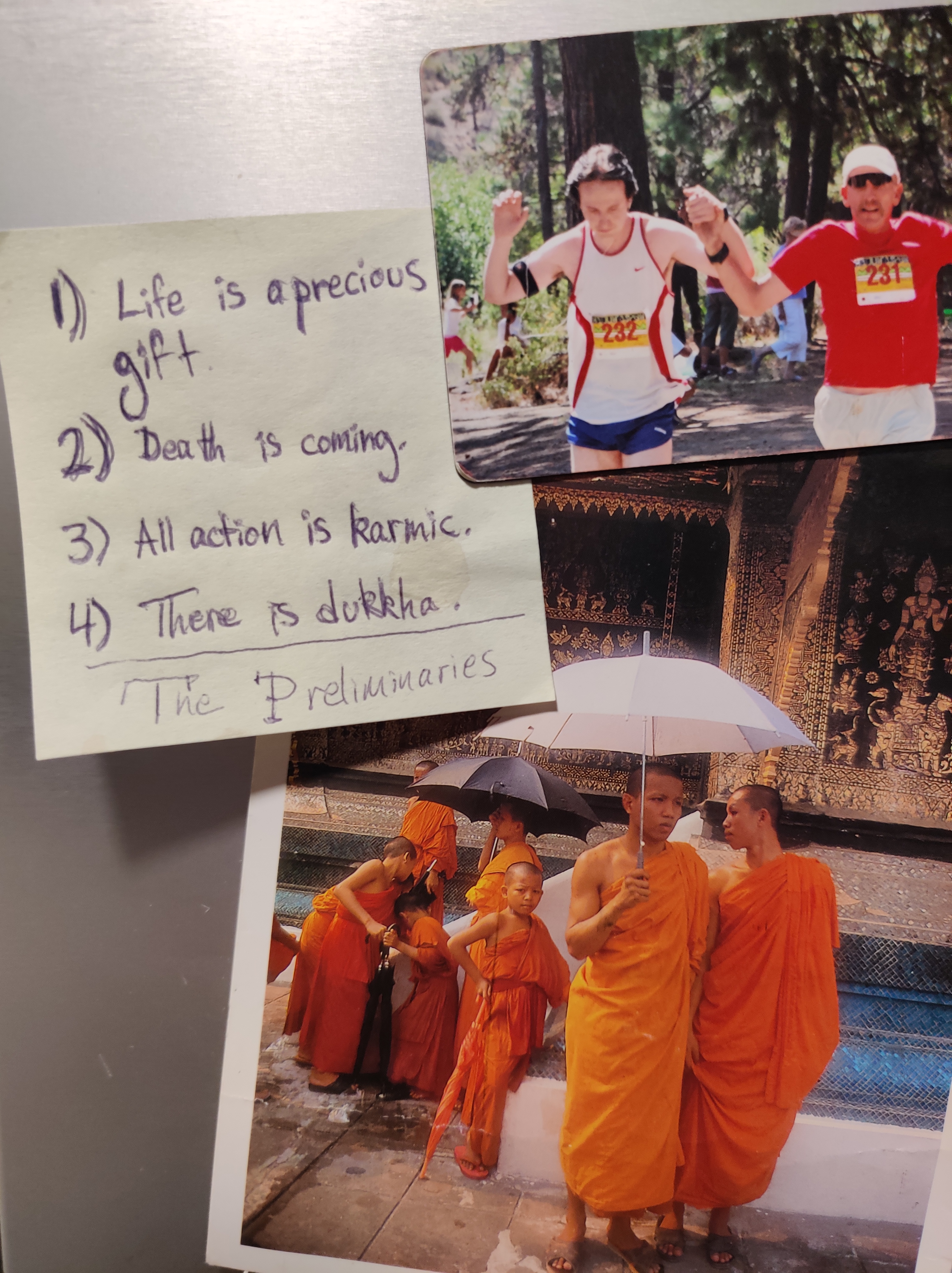
I’ll speak of slogan practice more thoroughly in the future (hopefully), but I’ll summarize these points here. Tibetan Buddhism emphasizes how rare and precious it is to be born as a human being in a time and place where you can learn the Buddha’s dharma – the truths and wisdom that offer you the possibility of breaking free from the painful reactions that make life so difficult. In a way, this summary of preciousness captures the point of the other 3 preliminaries as well as the Four Noble Truths in one go. A sentient life is one of the pain, disappointment, and suffering of dukkha. It’s one of standard patterns of action, walking through life with the same conditioned ways of re-acting (writing that way because we think of it as action, but it truly isn’t – reactivity is the most passive of ways of being. The only truly active freedom is in being able to sit with challenges and see your inclinations and choose differently in ways that do not continue the reactive patterns of suffering in your life). Waking up to a different way of being requires seeing the opportunity and wisdom that is available to you, embracing it with gratitude, and rethinking your actions based on the outcomes and results you bring to yourself through them (recognizing the 3rd preliminary that all action is karmic), working now to embrace that opportunity because you see your time is limited (recognizing the 2nd preliminary that death is coming), and finally, doing all of this out of the understanding that there is dukkha (the first of the Four Noble Truths which opens the whole Buddhist path before you).
When I think of the samsaric pain of loss and meaninglessness that I’m going through with all the suicidal thoughts attached to them, in other words, when thinking of the fact that there is dukkha, I remember another Buddhist passage I’ve brought up before, the poetic lines from Dogen’s Genjokoan: “Therefore flowers fall even though we love them; weeds grow even though we dislike them” (Shohaku Okumura, Realizing Genjokoan: The Key to Dogen’s Shobogenzo). Desire and aversion put us at odds with the changing circumstances of the impermanent world around us, but if we recognize those samsaric poisons within us, we can take pause and sit more patiently with the difficulties of life, allowing us to instead continue on with compassion for others and mindful presence for the moment at hand. We may no longer have the flowers of beauty, or we may need to contend with the weeds popping up, but we can be right in this moment, doing our best in it, and giving to all the others who are here struggling with their own pain at the changing circumstances they’re in.
May these words inspire and offer companionship to those who need them.
Gassho!
Heartbreak | Music | Songs for the Deep
29 Sep 2021 Leave a comment
in Buddhism, Heartbreak, Music Tags: Adele, Alanis Morissette, Dukkha, Four Noble Truths, Garbage, Gratitude, Heidegger, I Ching, Path, Resolve, Transmission Zero
I hadn’t planned to write more heartbreak posts, but ultimately, the journey through the abyss to safety (recent I Ching reading but also reminiscent of the Moon card) is a fraught one with new challenges and rapids along the way. For me, this is much more true than I’d like to admit. I’ve lost track of the number of times I’ve cried about her, thinking about how I’ll never see her skin and smile again, or reliving a moment I wish I could change to maybe make things end up differently. It hurts so bad some days, and I couldn’t tell you why those days are worse. Every day, I wish my heart would stop beating. It just hurts too damn much, and some days, like today, something breaks you into full on panicky hyperventilation and crying, and you can’t even really say what triggered that exact moment. However, even then, there are events that make you feel understood and seen.
I went to a concert last night – Garbage and Alanis Morissette. These two artists really brought this to mind because they both have songs about some difficult emotional experiences. Listening to them and seeing how popular they both are, even 20+ years later, made me think of previous heartbreak and the sense at that time that so many songs are about love lost and pain around it. There are certainly more songs about this experience than the opposite (not that there are none of those), and it made me realize that the experience of loss, grief, pain, and frustrated hopes is more common, impactful, and lasting than that of some deep joy realized, which is generally more fleeting and less deep.
If we think of this in spiritual terms, we’ll quickly arrive at the Buddha’s fundamental truth that upholds all of the Four Noble Truths – the first one: there is dukkha. There is a suffering in existing. It occurs on both great and mundane levels, and those great levels speak to our greatest desires (see the second noble truth) and the difficulties involved in them ending or not being fulfilled.
Our relationships with others are a fundamental. They are part of being in the world (riffing on Heidegger here but pulling in a Buddhist direction). We become entangled in the desire of being with, regularly. There is both some of the greatest beauty and the greatest suffering in this, as other humans reveal the depths of who we can be, what we can feel, and how we can flourish.
In any case, I wanted to pick a few songs from this experience alongside a couple others to really pull at the heartstrings regarding heartbreak and the pain in it. Music can give voice to the human experience in profound ways that make us feel seen. Perhaps this is cathartic in itself. I know that even in just driving to the concert, “You Oughta Know”, spoke to my more fiery feelings of being overlooked, unvalued, and cheated. I’ll just leave it as a reference here without linking it for better options that don’t delve into such anger, but even that can be valuable and worth expressing in its own way.
First, let’s go with Garbage’s “It’s All Over but the Crying”, which speaks to ending, loss, and the grief afterwards as well as the poor treatment and misperceptions of someone else. They didn’t play this at the concert, but I was really wishing they would have played something from “Bleed Like Me”.
Beyond that, Garbage played a newer song, “Even Though Our Love is Doomed”, at the concert that really spoke to me. The main refrain kept asking why we kill the things we love the most. I kept wondering the same, as my feeling time and again is that extraordinary was traded for ordinary in my situation. I can’t help but feel like I was told I was superlative repeatedly but then was not chosen because of more or less bullshit reasons that never really made sense and seemed historically revised and over-hyped over time. In the end, I have to wonder why we kill the things we love the most, and I’m sure I won’t be the only one who feels a resonance with that question. Furthermore, the song has a “even though” this killing is doomed, you still want the person anyway because you see the beauty of that love. I couldn’t understand that any deeper than I already do. As a friend pointed out today, that’s why I hurt so much now and feel dead – I loved that deeply that its passing is a grief to my core.
Between sets, songs played over the speakers, and an old fave came forth and reminded me precisely of the strength of crying out against not having been chosen, of the feeling of what it is to roll in the deep of the abyss. Adele’s song is a classic for a reason in this genre.
In a note more fitting with my usual musical journeys of late, I was walking home today, listening to my newest post-rock album release of focus, the fantastic Transmission Zero’s “Bridges”. Their song, “Still No Sign”, has this haunting feeling of floating through space, waiting for some signal and it never coming. That’s the feeling of waiting and not hearing anything, of feeling on edge with the hope that continues to cut rather than soothe, as every moment is that Buddhist play of dukkha and tanha arising together. I felt so haunted by this song that I stopped in opening my building’s door and just rested my head on it for a second to catch my breath and resolve. It’s simple but feels like a deep journey of waiting and yearning.
Finally, most importantly, I wanted to share a positive note. Alanis ended her set with “Thank U”, and it struck me hard, even though it was a song I never really liked before. The journey through pain, through the heartbreak, even in its angriest moments like some of her more memorable moments from “Jagged Little Pill”, is ultimately soothed in gratitude, in moments like telling the audience that she certainly recommends getting your heart trampled on to anyone. These are part of living with others and vulnerably putting our hearts out there. In the end, that’s how we become strong and how we give back grateful compassion. Every day, I feel like dying right now. I really wish my heart would stop sometimes, but ultimately, I also always paddle on past that abyss of deep waters, keeping my resolve to continue, do well, and give my kindness to others. It’s incredibly hard, but every time, I’m thankful for continuing, despite feeling unworthy and unfit for the challenge. I love the closing lines. I’m thankful for my own disillusionment, my facing nothingness, my sitting in silence, and the clarity of strength I find in myself every time I do that with vulnerable surrender and resolve rather than anger or self-involvement:
Thank you India
Thank you providence
Thank you disillusionment
Thank you nothingness
Thank you clarity
Thank you, thank you silence
Alanis Morissette – “Thank You”
May this help others feel both expression and some gratitude for continuing forward in heartbreak.
Gassho!
Heartbreak | Facing Death
16 Sep 2021 1 Comment
in Buddhism, Death, Heartbreak Tags: Bodhisattva, Camus, Compassion, David R. Loy, Love, Mahayana, Meaning, Nietzsche, Samsara, Viktor Frankl
I’ve been meaning to write this for a while, and although the intensity of the thoughts and feelings have ebbed and flowed, I feel like it’s important to return to, even if it’s mostly to focus my own mind and practice in the writing. Beyond that, however, I hope these words help others. The words are dedicated to them, with that intention.
In my last post, I said: “I’m left feeling like, to steal a poetic line from said person, in experiencing life right now, I’m watching the death of my concept and experience of love as I watch the death of a relationship.”
Honestly, death is on my mind a lot these days. I find myself muttering to myself, “I hate my life. I wish I could die.” It’s so by rote that it almost feels like a script, but there is still weight behind the self-talk. Deepest samsara – when clinging and desires aren’t met – hurts greatly. That’s why so many coping mechanisms revolve around escape and altered states. It feels nearly impossible to just sit with the full intensity of these painful feelings.
I find it haunting and thought-provoking even after years, that Camus opens his classic work of philosophy, “The Myth of Sisyphus”, with “There is but one truly serious philosophical problem, and that is suicide. Judging whether life is or is not worth living amounts to answering the fundamental question of philosophy.” Ultimately, it’s true – each and every one of us stamps the meaning on our own lives and has the ultimate say on whether it is worth living or not. Our approach to our lives is ultimately one that leans into mortality and affirms life as worth living… Or doesn’t. The same problem resonates, albeit somewhat differently, with Viktor Frankl’s famous “Man’s Search for Meaning”. He emphasizes that the root idea of his approach of logotherapy is that “He who has a why to live for can bear with almost any how” (supposedly a quote from Nietzsche, although it seems more like a rewording). The need for meaning is crucial in these existential approaches to the human condition. They are the key agency we have in making sense of our mortal lives and making them shine in the dark horizon of death (riffing on Heidegger and Foucault’s ideas of finitude in “The Order of Things”).
To return to the pain of deepest samsara, the meanings and identities we cling to the most, for me a future of partnership and family, are those that make life feel meaningless when they’re shredded to pieces (I actually wrote a masters paper on precisely this topic – the problem of the loss of meaning and the world becoming senseless after trauma). How do we face such scenarios? With Frankl, the loss of such meaning was a key indicator that others would succumb to the concentration camps. To Camus, it would mean falling into an overwhelmed despair in the face of the absurd, and if he truly is a follower of Nietzsche, would lead to nihilism – willing nothingness: choosing suicide.
In my darkest moments, that’s precisely how I feel – a pointlessness to my life, a wish for it to end, an overwhelming feeling like both myself and everything else doesn’t matter. The person at the core of my heartbreak recently reached out and told me she hoped I was finding peace in the end of our time together. That hurt so deeply. I wanted to scream. The only peace I feel is the peace of death: the death of meaning, and as I’ve described here, that is not any kind of peace that the living thrive in, quite the opposite.
Overall, however, I have long-developed self-care routines and the desire to do well for all sentient beings. These keep my strength focused beyond my own story, and they lead me to lean into compassion. For instance, I am kind to others I encounter, trying to be present and warm to them as genuine encounter. A contact at my local grocery store befriended me online recently, and I found that she has been in prison for a car accident and is just making her way back out into the world. Moments like that make my heart break and bring perspective to how much kindness and warmth needs to be cultivated and shared in this world. She thanked me for always being kind to her and spoke to others in her other job being rude. We all go through so much poor treatment and bad circumstances, even some bad karma from our own poorly made and poorly informed choices. We all deserve compassion. For the most part, that’s my North Star, when I’m not overly wrapped in my own story to see it.
I’m inspired by the path and the direction of the bodhisattva, aiming at a deeper engagement with reality. The new desire: working for the enlightenment of all sentient beings – a heroic and impossible task, that of wisdom and compassion. May that be my concern rather than samsaric worries about my own future.
I’m closing this off with three quotes that I hope will develop and connect these existentialist and Mahayana Buddhist themes.
I leave Sisyphus at the foot of the mountain! One always finds one’s burden again. But Sisyphus teaches the higher fidelity that negates the gods and raises rocks. He too concludes that all is well. This universe henceforth without a master seems to him neither sterile nor futile. Each atom of that stone, each mineral flake of that night-filled mountain, in itself forms a world. The struggle itself toward the heights is enough to fill a man’s heart. One must imagine Sisyphus happy.
Albert Camus – “The Myth of Sisyphus”, p. 123
When a Zen priest who has taken a sufferer under his care has reason to fear that he is not equal to his suffering, he will visit him repeatedly. Not with the intention of relieving him of distracting worries, but of reaching his inner self. He will try to make him face his suffering by bringing its full extent and magnitude to consciousness. He will help the sufferer to see that great suffering is not overcome by refusing to face it or by surrendering to it in despair. He will warn him of the danger of allowing himself to be solaced, and of waiting for time to heal. Salvation lies in giving full assent to his fate, serenely accepting what is laid upon him without asking why he should be singled out for so much suffering. Whoever is able to bear suffering in this way grows to the stature of his suffering, and he detaches himself from it by learning more and more to disregard the fact that it is his suffering.
This detachment paves the way to healing, and healing follows of itself the more sensitive one becomes to the suffering of others, and the more selflessly one shares their sufferings. This fellow suffering is quite different from the sentimental sympathy most of us indulge in, which, easily aroused and quickly dissipated, remains ineffective because it is not selfless enough. True compassion not bound to words forges the most intimate bond between human beings and all living creatures. The real meaning of suffering discloses itself only to him who has learned the art of compassion.
If the sufferer’s ears and eyes are opened by this clarification of his state of mind, he will mark that neither flight from reality nor denial of suffering can bring him detachment. And if, thrown back on himself, he shows that he is trying to become one with his fate, to assent to it so that it can fulfill its own law, then the priest will go on helping him. He will answer his questions, without offering anything more than suggestions and, of course, without preaching.
For there is something that seems to him very much more important than words. Gradually he will fall silent, and in the end will sit there wordless, for a long time, sunk deep in himself. And the strange thing is that this silence is not felt by the other person as indifference, as a desolate emptiness which disturbs rather than calms. It is as if this silence had more meaning than countless words could ever have. It is as if he were being drawn into a field of force from which fresh strength flows into him. He feels suffused with a strange confidence, even when his visitor has long since departed. And it may be that in these joyful hours, the resolve will be born to set out on the path that turns a wretched existence into a life of happiness.
Eugen Herrigel – “The Method of Zen”, pp. 124-125
We are reminded again of Dogen’s description of his own awakening: “I came to realize clearly that mind is no other than mountains and rivers and the great wide earth, the sun, and the moon and the stars.” According to one Mahayana account, the Buddha was enlightened when he looked up from his meditations and saw the morning star (Venus), whereupon he declared: “I am awakened together with the whole of the great earth and all of its beings.” It’s not that every living being became enlightened in the same way that he did at that moment, but that his own personal awakening was an achievement of the whole. Awakening, then, involves realizing that “I” am not inside my body, looking out through my eyes at a world that is separate from me. Rather, “I” am what the whole universe is doing, right here and now.
David R. Loy – “A New Buddhist Path”, pp. 86-87
May this provide solace to those feeling the abyss looking back into them after staring into it. May you find that you take a leap and a net appears.
Gassho!
Heartbreak | Loneliness
14 Sep 2021 Leave a comment
in Buddhism, Warrior's Path Tags: Clinging, Compassion, Heartbreak, Loneliness, Pema Chödrön, Samsara
I’ve been meaning to write this for a while, and although the intensity of the thoughts and feelings have ebbed and flowed, I feel like it’s important to return to, even if it’s mostly to focus my own mind and practice in the writing. Beyond that, however, I hope these words help others. The words are dedicated to them, with that intention.
I’ve recently been going through an on-again, off-again, dramatic semi-relationship with someone who has excited me to the possibility of a future together and made me feel more alive than any other romantic partner I’ve had. The only reason that really matters as backstory is that something in the progression of this connection and its long, slow, painful demise has made me really sit with my feelings regarding partnership and compatibility. I’m left feeling like, to steal a poetic line from said person, in experiencing life right now, I’m watching the death of my concept and experience of love as I watch the death of a relationship. I plan on writing more on that in a second post, but in this one, I want to focus on the related feeling of loneliness.
I’ve been lonely in relationships for pretty much all of my adult life. I wonder if this is normal. For me, I think it’s primarily because I’m a person with some particular and unique interests. It’s hard to share space and life with a person and feel like you’re not connected on many levels. Perhaps, it’s because of my ideals of partnership which I’ve written about on here before. I really seek a deep engagement with a partner, not just sharing of space and time. With that, I tend to throw in a lot of energy and support that doesn’t get matched, which leads to more feelings of disconnection and even resentment.
Loneliness when losing someone who meant so much to you, loneliness even during the slow fade of such a loss, is much more brutal. It’s like the sun went down and isn’t coming up again. In a way, it reminds me of my recent post on the tarot where I talked about three cards being about choosing love, not being disillusioned and not giving up hope. That was a positive, can-do interpretation. It could be just as much that in choosing this love, I was moving into an experience of disillusionment and despair. Now, I think about future relationships, and I see little to no likelihood that I’ll find someone else with the compatibility and partnership I seek. In a sense, such a spiritual friend is rare. I’ve thought about my experiences and the statistical demographics of who’s out there in the world, and in all likelihood, the frequent pulls of the Hermit card in the last few months are wise counsel for getting deeply in tune with myself, my own wisdom, and my own solitary path.

With feelings like this, most balk, and tell you you overreact, even though they don’t have a single real counterargument to a logical and experiential breakdown. I think we’re given way too many expectations of ending up with a partner with an Aristophanes’ story of another person somehow complimenting us out there, just waiting to be found. There’s simply no guarantee. Just as there’s no guarantee I will live past today. When faced with that, people tend to react really strongly to protect this groundwork, existential desire. A co-worker recently heard me out and said, “I agree with everything you just said, but it makes me sad because you don’t get a happy ending in this perspective.” This shows that, ultimately, the standard paradigm is a wishful thinking fallacy.
Sitting with loneliness is particularly hard because I feel out of place in a very physical sense. I live just a mile down the road from the person, and this neighborhood is new to me. I don’t feel fully at home here. Everything reminds me of her. Everything reminds me of how I’m facing a future of being alone, not having a family, not becoming a father. These are all things I held much more tightly than I thought. I have been trying to patiently sit and look at those feelings and fears arise with as much peace as I can muster, but the Buddha was right: the things we cling to are really what cause samsara. It’s incredibly difficult to not react to such feelings without squirming and running to the next.
However, I think that sitting with all of this offers one of the greatest opportunities for spiritual growth, even though I’m barely up to the task most days or fail on others. I wanted to write about my experience after reading a chapter in Pema Chödrön’s classing “When Things Fall Apart”. In sitting with ourselves in our most vulnerable, our most tender, we cultivate the warrior’s heart that opens us to more compassion for all beings. In many ways, this time has made me more patient and open to others, instead of less so. This kind of healing and growth leads to warmth to life, even in darkness.
Not wandering in the world of desire is another way of describing cool loneliness. Wandering in the world of desire involves looking for alternatives, seeking something to comfort us–food, drink, people. The word desire encompasses that addiction quality, the way we grab for something because we want to find a way to make things okay. … Not wandering in the world of desire is about relating directly with how things are. Loneliness is not a problem. Loneliness is nothing to be solved. The same is true for any other experience we might have.
…
Cool loneliness allows us to look honestly and without aggression at our own minds. We can gradually drop our ideals of who we think we ought to be, or who we think we want to be, or who we think other people think we want to be or ought to be. We give it up and just look directly with compassion and humor at who we are. Then loneliness is not threat and heartache, no punishment.
Cool loneliness doesn’t provide any resolution or give us ground under our feet. It challenges us to step into a world of no reference point without polarizing or solidifying. This is called the middle way, or the sacred path of the warrior.
When you wake up in the morning and out of nowhere comes the heartache of alienation and loneliness, could you use that as a golden opportunity? Rather than persecuting yourself or feeling that something terribly wrong is happening, right there in the moment of sadness and longing, could you relax and touch the limitless space of the human heart? The next time you get a chance, experiment with this.
Pema Chödrön, “When Things Fall Apart”, p. 65-66
May these words help others sit with their most difficult experiences of feeling lonely and spur them towards compassion and wisdom.
Gassho!
Philosophy Riffing | Valuing Yourself and Sitting with Being Alone
15 Aug 2021 Leave a comment
in Buddhism, Philosophy, Spiritual Path Tags: Acceptance, Alone, Ancient Philosophy, Anxiety, Foucault, Meditation, Pierre Hadot, Self, Zen
I recently was trying to explain my thoughts to a friend in audio clips regarding preparing for a future of potentially ending up alone rather than with a partner and how one should spiritually approach sitting with oneself. I thought the audio clip was me at my best in terms of pulling together a variety of ideas from different sources and tying them together into something meaningful, so I wanted to share. It’s about 9 minutes long, so only jump in if you’re interested.
Morning Pages | Clinging in Emptiness
11 Aug 2021 Leave a comment
in Buddhism, Morning Pages, Stoicism Tags: Clinging, Emptiness, Slogan Practice
I wrote this passage in Morning Pages a few days ago – a practice I’ve been trying to work on again as a means of self-care and continued spiritual development. Personally, this passage really felt like a deep expression of the heartbreak I’m currently going through, but at the same time, it riffs hard on Marcus Aurelius and Buddhism. As such, especially after reading it again and finding it much more cerebral and poetic than the emotional mess I thought it was when I was writing it, I share it here.
Here “I” am. I’m not sure why I write that in this moment, but it feels weighty. Perhaps more accurately, it feels light. I have the slogan in mind to regard all dharmas as dreams (#2) [note: this is a reference to the Tibetan slogan practices of Atisha – a path and practice I’ve been meaning to dig into again. #1 and #2 both helped me through my dad’s passing a few years back]. That includes me. I’m not the same as yesterday, a week before, or 5 years ago as I just saw in pictures. What can I take from this in this moment? Well, it clearly indicates, at the least, that the worries I have now will change. They may grow. They may wither. They may be fully replaced. Also, my body will change – perhaps for the better with more exercise (and a better diet), but mostly, I will continue to fall apart.
What is there to cling on to when all is emptiness? Why am I clinging so hard to a particular outcome? And yet… It’s still worth hoping for. I’m grateful for this moment.
May this give you pause to see the flux of change that is emptiness – the lack of inherent essence to all that is. All dharmas are dreams. However, may it also give you pause to consider what you hold dear and why. I plan on writing more on adapting through change in the next post.
Gassho!
Walking along the Dhammapada — Chapter 17: Anger
07 Jul 2021 Leave a comment
in Buddhism, The Dhammapada Tags: Anger, Mindfulness, Reactivity, Skillful action, The Fire Sermon
I’m taking another journey through the Buddha’s lessons on the path of the Dharma (one way you could translate the title Dhammapada). A few years ago, I wrote posts on a handful of chapters, but I didn’t go over every chapter. This time, I’m challenging myself to post on every chapter and share them here.
The key lesson to take away from this chapter that speaks to the greater spiritual path of Buddhism and The Dhammapada is that of self-control vs. reactivity. A wise, awakened one is liberated from the pain of as the Buddha puts it in the Fire Sermon the burning of the senses, passion, aversion, and ignorance. In other words, liberation is the extinguishing of clinging. This allows one to control one’s actions and act skillfully rather than being pulled along by our desirous and aversive reactions. This is the difference that’s listed in early lines:
Give up anger, give up conceit,
Pass beyond every fetter.
There is no suffering for one who possesses nothing,
Who doesn’t cling to body-and-mind.The one who keeps anger in check as it arises,
The Dhammapada, 221-222, trans. Fronsdal
As one would a careening chariot,
I call a charioteer.
Others are merely rein-holders.
In other words, you can become liberated by observing yourself through mindfulness, letting go of reactions, acting well, and thereby becoming one who drives the chariot, rather than just being pulled along by the horses.
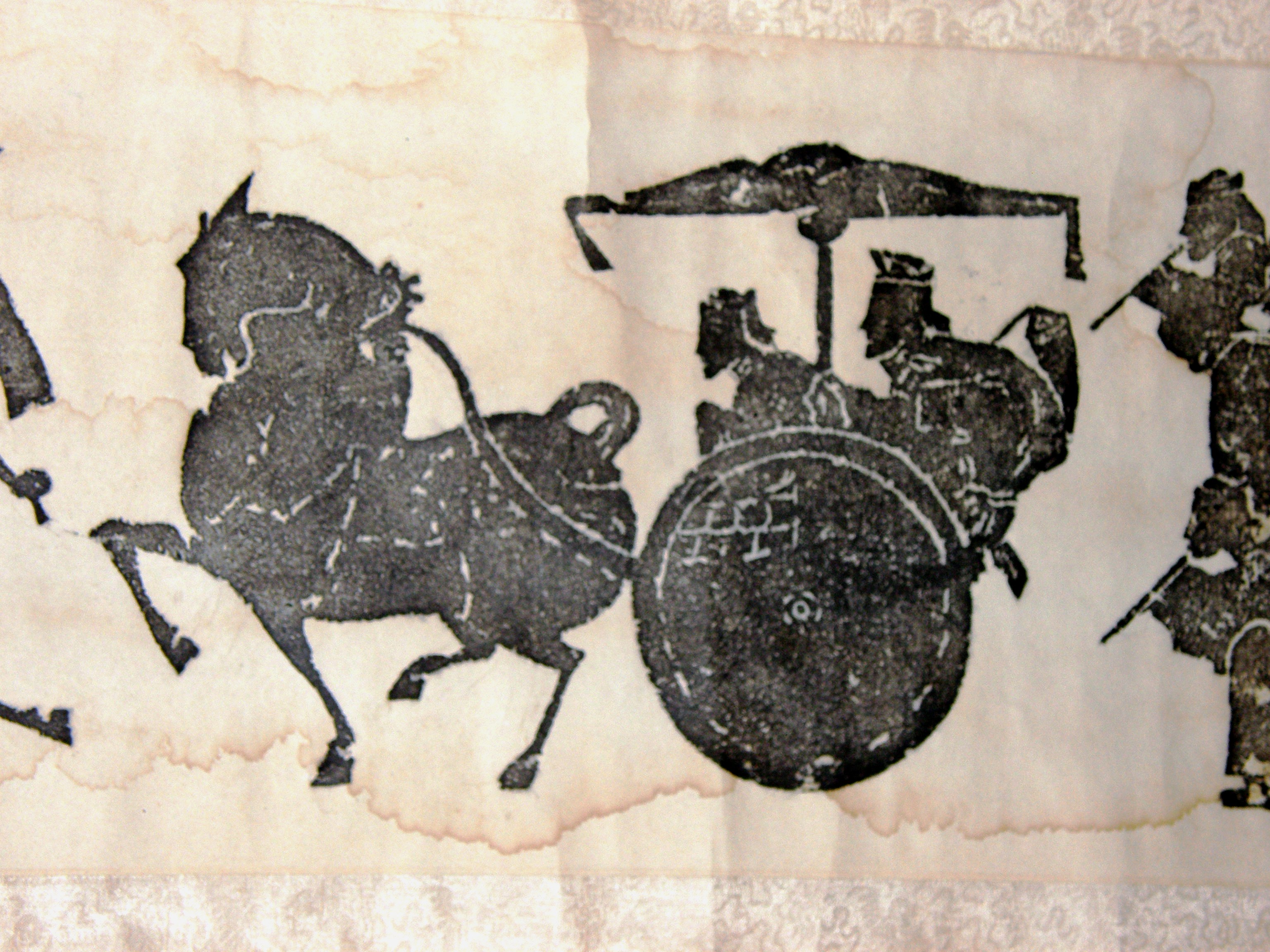
This can be summarized in a term that came up in my other translation many times: “well-controlled”. That’s the aim. Ultimately, that control is liberation. It comes from wisdom, insight, and mindful engagement. Otherwise, we are just pulled along reactively by our impressions and reactions.
The only way beyond a reactive, conditioned, samsaric pull is to be ever wakeful, holding anger in check in body, speech, and mind. Liberation is and comes through holding the reactivity of conditioning in mind and then letting it go. It’s a seeing, releasing, and doing differently. Thus does one choose and thereby drive the chariot.
May this inspire effort to gain control of skillful action rather than mindless reaction.
Gassho!
Walking along the Dhammapada — Chapter 16: The Dear/Affection
12 May 2021 Leave a comment
in Buddhism, The Dhammapada Tags: Attachment, Craving, Four Noble Truths, Karma, Practice, Suffering
I’m taking another journey through the Buddha’s lessons on the path of the Dharma (one way you could translate the title Dhammapada). A few years ago, I wrote posts on a handful of chapters, but I didn’t go over every chapter. This time, I’m challenging myself to post on every chapter and share them here.
I’ll be honest – I find this chapter difficult. It’s difficult precisely because of questions I’m currently wrestling with in my own personal development. They’re also questions related to ongoing queries I have for Buddhism around the life of a householder vs. that of a monk. How does one handle the issue of attachment in the middle of a standard, nonmonastic life? It’s a problem in terms of finding balance and a Middle Way through the tangles of craving and clinging. The best I can come up with is seeing the attachments we have and letting them be without grabbing onto them with clinging and craving, but that is incredibly difficult to do, and that’s precisely why one is pressed to go into the freedom of a monastic life. This chapter has a very strong tone that doesn’t help me with these considerations at all, and like much of the oldest Buddhist teachings, it feels like one is only able to find liberation by leaving the life of the householder behind and severing all attachments.
This may all sound like some kind of philosophical knots over a non-issue, but one description of the founding of the practices of tantra in Buddhism precisely highlighted this issue (and unfortunately, it’s been years, so I can’t remember where I read it now). It was the legend of a king who asked the Buddha for practices to find enlightenment while still holding onto his sensual life, basically (surely a legend because tantra is one of those practices from other Asian spiritual traditions Hinduism/Bön that were fused with Buddhism as it grew and travelled).
In any case, let’s focus on one main passage here. This whole chapter really emphasizes that craving/clinging in its various guises keep one rooted in samsaric suffering. This fits with the Four Noble Truths. There is suffering. Suffering arises from tanha (craving/clinging). One can be liberated from suffering by ceasing the bond of tanha. There then is a path forward to realize this goal. This chapter emphasizes that aspect of tanha – we crave that which we desire. We crave for that which we don’t desire to not happen. In fact, whatever else doesn’t fit the desired or undesired is so separate from our affected awareness, that we just ignore it. These are the three poisons: desire, aversion, and ignorance. We can see in passages like this chapter that clinging/craving drives all three on a continuum of sorts. Think of it like a number line where – craving = aversion, 0 = ignorance, and + craving = desire. It’s worth mentioning here that the titles in my two translations point to this as well: “The Dear” – we cling to that which we hold dear; and “Affection” – affect, our emotional movements that pull us hither and yon in samsara, are driven by the clinging in the 3 poisons. There are several lines that point out these dynamics and then accentuate different versions of affection where it is at play and that such things should be avoided. The overall summary is captured in the final emphasis:
Craving gives rise to grief;
The Dhammapada, 216, trans. Fronsdal
Craving gives rise to fear.
For someone released from craving
There is no grief;
And from where would come fear?
In terms of my own struggles, I’m left thinking of these considerations, and I think the path is truly that of sitting in the midst of the swirl of affection, whatever arises, and seeing how there is the pull of desire and aversion as well as the lack of interest in ignorance. We can watch what comes up within our mind and try to respond skillfully rather than getting hooked into craving and the karma that arises from acting within it. What this means for myself in terms of relationships, my own stories, and an engaged life, is an ongoing investigation.
In relation to that little idea of karma, I love the closing lines in this second translation, where good deeds are presented as analogous to a seeker’s family who celebrate his return home into Nibbana. As such, we have yet again an emphasis on acting well from the stance of nonattachment at the end of this chapter admonishing the seeker to not cling.
When, after a long absence, a man safely returns home from afar, his relatives, friends, and well-wishers welcome him home on arrival.
As relatives welcome a dear one on arrival, even so his own good deeds will welcome the doer of good who has gone from this world to the next.
The Dhammapada, 219-220, trans. Buddharakkhita
May this bring others to recognize the role of clinging in samsara and get them to investigate its role in their lives.
Gassho!

 On the Way
Recent Comments