Heartbreak Wisdom Journal–Entry 7: Letting Go of the Person You Used to Be (Part 1)

Clarification: I’m splitting this piece into two parts. The first is my own personal experience of late, and the second is a related long quote that goes well with this, but I feel it best to let them both stand on their own, yet connected and in a harmonic resonance with each other.


Last weekend, I went down to the city I used to live in with my ex. I stayed with mutual friends–the first time seeing them in months. It was eye-opening. After all this time and change, I’ve still been carrying some ideas that this home has some elements that are the same, but like me, really, so much has shifted. I went, in part, to feel this connection again and to weigh the opportunity of returning there. It was odd, unhemlich really: some things still felt like the home I miss and love–homey=heimlich, but there was an overarching foreignness alongside this familiarity–unhomey=unheimlich: that bizarre feeling when the familiar is unfamiliar. The saddest part was how distant others were when I saw those other connections beyond the friends I stayed with. All of this made me realize that if I go back, it will have to be completely on my own steam and without expecting the familiar to be there. As sad as that may be, seeing things clearly, especially even the most subtle layers of desire and hope–unconscious ones, can be liberating. Seeing clearly what you are holding onto can gently open the hand, letting those things fall away.

The hardest thing was that I almost saw her. Even just hearing her voice from a distance brought up all the little idiosyncrasies about her that I still miss. I lost a partner and a best friend so many months ago with this breakup, and it is very often, still, that I hear her voice in my head, saying certain things just that particular way that only she would say them, or I can almost hear and see her responding to the goofiness that I regularly bring into the world.

Yet, the gusto of her voice, also recalled all those bizarre relationship-ending conversations, galvanized with that sentiment of self-righteousness, as though the point of this life-changing decision were distinguishing right and wrong. That voice, those eyes, that cold feeling of being disconnected from reality with overlays of denial… I’m glad that I chose not to go say hello. I don’t see any benefit in facing that now, if any of it remains at all. If that is the case, certainly she wouldn’t be interested either. She wanted my presence cut from her life, wanted me dead in a certain sense, and she’s never reached out again afterward. She could just as readily have walked down to say hello to me as well; the decision did not have to be made by me, and clearly, she didn’t want to. That’s fine. Ultimately, one of the largest parts of moving on in the kind of situation I’m in is accepting the choice of a person you love to not love you anymore. In a certain sense, it’s dying with grace. It’s letting go of the person you used to be.

I came back home to my life in the Seattle area, after this whirlwind trip, and I began the work week again. It was a bit jarring making this transition… For the week previous to the trip, I had been doing a Healing Bootcamp of sorts, described in The Wisdom of a Broken Heart, but I didn’t finish the closing of the last day due to leaving on my trip to see my friends and my old home. The middle of the relief program requires a journalling of the beginning, middle, and end of the relationship–piece by piece, and then, you write down points of gratitude for each of these stages and offer them upon your altar. At the end of the program, you perform loving-kindness meditation for your ex and burn the offered gratitude while stating that for now this relationship is over, and you are a better person for having experienced it.
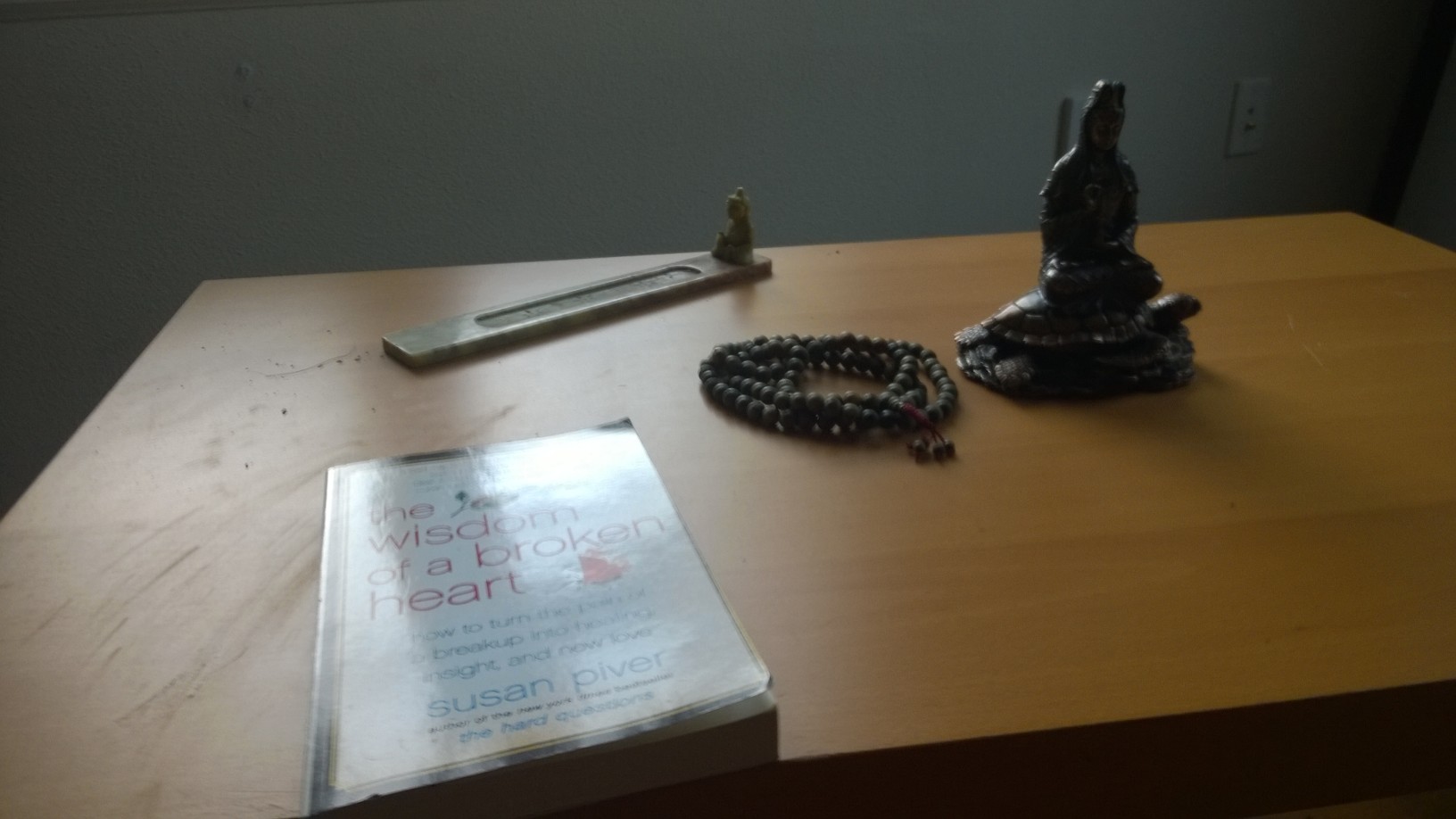
WP_20150419_15_21_52_Pro

A simple altar that I set up for this recovery program — sans the written offerings described in this post

After returning from a trip of letting go, I belatedly did this final ritual–opening my heart with loving-kindness and burning the past with a cleansing fire. I stood on the bricks in the backyard, lighting each piece and feeling the warmth of the fire sharing my joy at the gifts I’ve been given (and was offering as gift over to the flames) but also burning them away–past and gone. Unlike a rebound or more aggressively “moving on”, this whole process was so kind, loving, gentle, yet affirming. It has been a completely mindful way of growing through heartbreak with acceptance, even gratitude, for pain and change. It’s not a denial of the past or the present in the slightest. On the contrary, it’s showing up for it: taking the path of the spiritual warrior–knowing that even this, maybe even especially this, is an opportunity for practice.

I still have a lot of healing to go, so there may still be several other entries in the Heartbreak Wisdom Journal, but this experience was definitely a turning point, and I feel some liberation from showing up to the person I used to be and tenderly, yet bravely, letting go of him.


Here is what I had to say about the ritual in my Morning Pages earlier this week:

I spoke to each note, reading them all aloud and emphasizing how wonderful each point of gratitude was but emphasizing also, like everything, these pass too. These moments were gone. The points of gratitude–the experiences–have shaped me. Their karmic consequences have begun blooming, yet, their cause, and the connection associated with them, has been severed and crushed. Now, it has also been burned. The fire was beautiful–flickering flames lapped at my words of gratitude, embracing them and celebrating them with the burning joy they deserved. Now, those words are dissipated, spread on the wind. Who knows what comes next? Not I.
This has given me some small amount of emotional clearance, yet there is much more healing to come.

May this help you find your own ability to let go of the person you used to be.
Gassho!


Previous Heartbreak Wisdom Journal Entry– Entry 6: Forgiveness
Next Heartbreak Wisdom Journal Entry– Entry 7: Letting Go of the Person You Used to Be (Part 2)

Tao a Day – Verse 63: Doing without Doing

Let’s approach this verse in two pieces. We’ll compare the Red Pine and Jonathan Star translations for each piece in that order:

Act without acting
work without working
understand without understanding
great or small[,] many or few
repay each wrong with virtue
– Trans. Red Pine

Act without acting
Give without giving
Taste without tasting

Tao alone becomes all things great and all things small
It is the One in many
It is the many in One

Let Tao become all your actions
then your wants will become your treasure
your injury will become your blessing.
– Trans. Jonathan Star


It’s always interesting to see how different translations of this classic have been approached, and the power of Red Pine’s translation is to get it down to one without artistic interpretation: a simple, bare-bones, as close to the original as possible translation without embellishment. The quote from his translation here boils this down; act without acting in all instances and with everyone, no matter how they treat you. Do this by repaying wrong with virtue. However, what are we to make of the very enigmatic opening lines? Luckily, his book also has chosen commentary from Chinese masters throughout the ages. I found these two bits of commentary quite helpful. Ho-Shang Kung, a Taoist master from around 100 B.C., says: “To act without acting means to do only what is natural. To work without working means to avoid trouble by preparing in advance. To understand without understanding means to understand the meaning of the Tao through meditation.” Sung Ch’ang-Hsing, a seventh patriarch of the Dragon Gate and Taoist master from the 1700s, says: “To act without acting, to work without working, to understand without understanding is to conform with what is natural and not to impose oneself on others. Though others treat sages wrongly, the wrong is theirs and not the sages’. Sages respond with the virtue within their hearts. Utterly empty and detached, they thus influence others to trust in doing nothing.”  These two pieces of commentary make this short section shine. It fits well with my previous discussion of Verse 8 (What I called: “In Accordance with Nature”), and it also fits with a previous post (in terms of doing what is natural and not imposing oneself on others and the world): Control and Letting Go. The doing without doing, wu wei, is acting in appropriate resonance with the nature of things–situations as they present themselves. It is not about imposing your own will on the world and making it conform to you. The Sage does not see such a separation, and the Tao Te Ching speaks in passage after passage about how that which is gained by force does not last very long: it comes to an early death. Hence, the way to live forever (or live longer and at peace) is to develop the virtue, Te, which goes along with the emanations of the 10,000 things (one aspect of Tao). Acting through force and reactive vengeance is not only ego-centered, it does not embrace Tao. It embraces “me”. That’s all. Acting in that very standard sense of pursuing your own motivations to make the world the way you want it to be, to form it in your own image as some creator-God-wannabe, is not virtuous, not wise, and not seeing the universe and its mysterious origins for what they are. We could look to the comments on Verse 26. Jonathan Star’s translation says pretty much the same thing as everything I just explicated but in a more succinct and poetic manner. As he closes, letting Tao become all of your actions is to act without the intention of promoting yourself. Instead, it is to act in accordance with Tao, the ever unfolding beauty of All, and by so doing, you act without acting. It’s not about complete inaction. It’s about acting through Tao rather than through your “self”.


Here is the second passage from the verse:

Plan for the hard while it’s easy
deal with the great while it’s small
the world’s hardest task begins easy
the world’s greatest goal begins small
sages therefore never act great
they thus achieve great goals
who quickly agrees is seldom trusted
who thinks things easy finds them hard
sages therefore think everything hard
and thus find nothing hard
– Trans. Red Pine

Take on difficulties while they are still easy
Do great things while they are still small
Step by step the world’s burden is lifted
Piece by piece the world’s treasure is amassed

So the Sage stays with his daily task
and accomplishes the greatest thing
Beware of those who promise a quick and easy way
for much ease brings many difficulties

Follow your path to the end
Accept difficulty as an opportunity
This is the sure way to end up
with no difficulties at all.
-Trans. Jonathan Star


Let’s take one more piece of commentary to handle these lines. Te-Ch’ing says (again from Red Pine’s book): “When I entered the mountains to cultivate the Way, at first it was very hard. But once I learned how to use my mind, it became very easy. What the world considers hard, the sage considers easy. What the world considers easy, the sage considers hard.” Controlling the mind in Buddhism is mindfulness. This is showing up to each moment just as it is without concept. Taoism’s stories of insight are meant to produce the same result: non-conceptual understanding. We might understand the Sage here as the mindful one of Tao’s unfolding with each moment. A task, no matter how large, is always right now. For instance, the next verse is the one with the famous line “A journey of a thousand miles begins with a single step.” The thing is: it begins with a single step, it continues with a single step, and it ends with a single step. The task is always the small, easy task of just one step. The Sage approaches doing by not looking at the goal which sees the task in its entirety: huge, hard, insurmountable. Rather, he sees it as this small, single step in this moment. Each moment of doing is a step. Again and again. Yet, the Sage sees it just as the step of this moment, not all the steps that lie ahead. The Sage recognizes the greatness of the task, but he is not daunted, as he approaches it in accordance with the task and with flexibility in each and every step, moment by moment: just this. Through such a mindful engagement with the present action that is in accordance with nature, the Sage will surely accomplish the greatest of things.

May this help you achieve the greatest things without acting.
Gassho!

yin-yang-382328_640

The Eternally Wondrous

It’s so easy to get wrapped up in annoyance, sadness, the frustration of desires, anger, and worry. On one level, we are a bundle of wants, always already ahead of ourselves, reaching toward the next moment of climax in gratification

A few minutes of meditation can be so profound because of this. You breathe, and the Now unfolds. For a moment, plans and memories fall silent, and there is merely presence – the ten thousand things. All is.

Such moments show that the wondrous is in each and every instant – right at hand, overlooked in our gazing backward or running ahead.

The miracle is not in the completion of desire; it is in the Becoming of the Universe – right everywhere, right always.

Worry

Why do you worry?

Heaviness holds down your heart while you prepare to run or fight, feeling trapped and powerless.

But what causes such distress? A goal? A possession? A lover? Money? Success?

How many millions of moments have passed in your life without these objects of your concern? Did these moments not merely march on from one to the next, fluctuating as the ebb and flow of time, whether you watched them with serenity or while riddled with anxiety?

How many billions of lives have been caught and fraught with these feelings? Yet these billions are now gone, nameless, dust on the earth, soil for the plants. How many eons and multitudes will follow you yet after this moment?

You are a falling star, burning brightly for a few moments in the becoming of the Universe. Do not worry about how to become a harder or bigger rock or how to fly instead of fall. Embrace your existence and shine.

Show Me Practice

“Show me one thing that you didn’t learn from your books.” Better said, show me how these ideas impact a life. Show me how they are concretely experienced and practiced.

Even the barest knowledge of facts must change you and the world in which you live. In learning of photosynthesis, a new world of interaction opens where physics, chemistry, and biology intertwine—a new realization of the intimacy of *natura*, the chiasm of a vibrant unfolding.

Now you see life differently. Your understanding changes – you and the world change. Yet this wonder is so easy to lose and so hard to gain. With your elaborate systems and beautiful arguments, how do you see the world differently, and how do you continue to be in wonder of it, to have gratitude for every moment of it, and to find meaning in it? Or are you lost in a haze of Ideas? Are your ideas lived through concrete experiences, or are your experiences lived through abstract ideas? Wake up.

Walking the Path

Keep your eyes open. With each step, the world moves. Knowing that the road leads to Rome, even knowing what Rome will look like when you get there, is not the same as the journey. Knowing that there are dangers everywhere, even knowing that you are strong enough to overcome them, is not the same as traveling without fear. Each step is all there is, neither good nor bad. Before and after fuse into the repetition of difference.

Next Newer Entries