The Way is in the Heart

WP_20141216_00_11_26_Pro

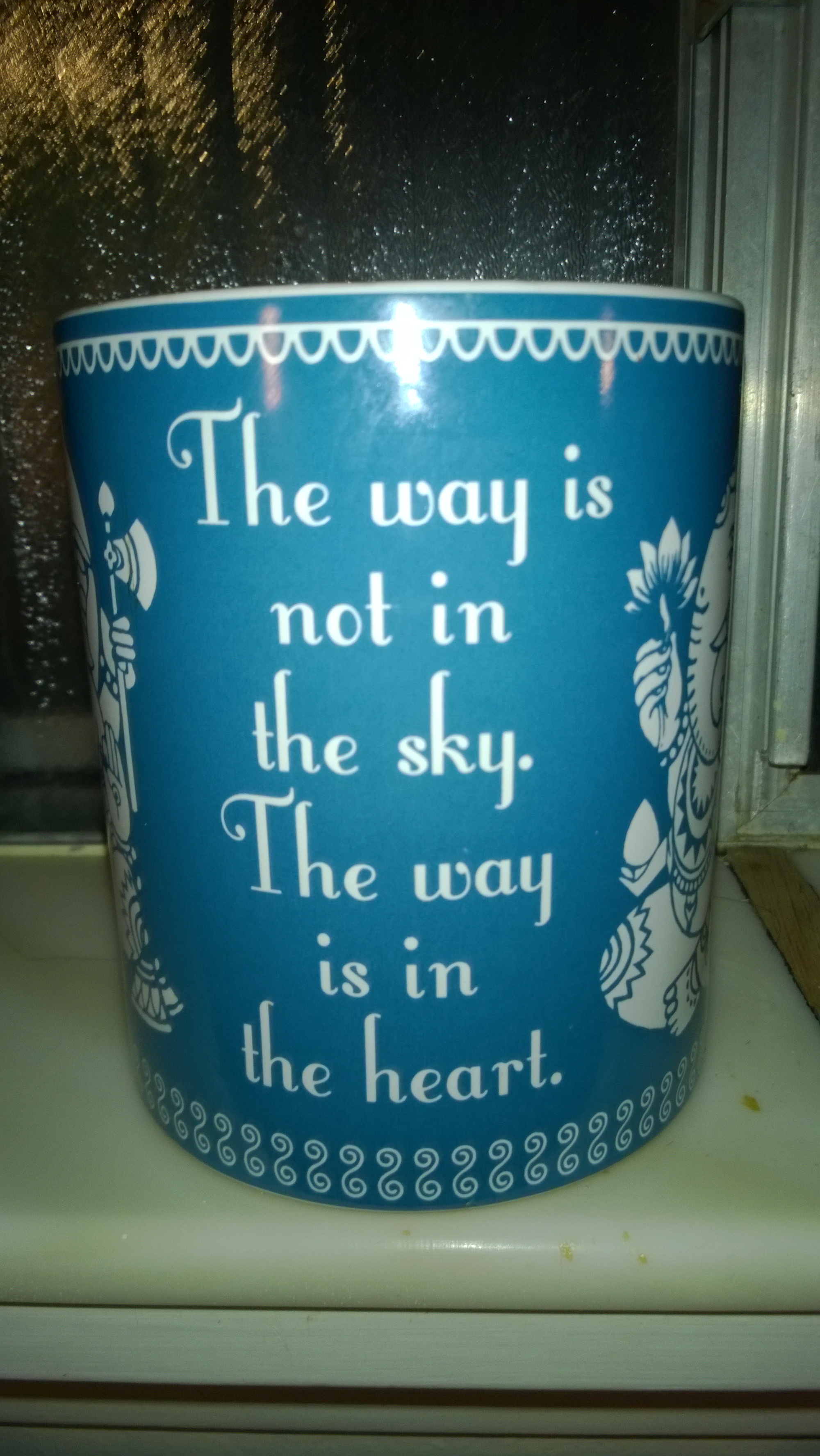
This simple mug, found at a local Ross for a few dollars, has a profound message. The way of an engaged and authentic human life is not to be found in the abstract ideals of dogma and speculations about eternal metaphysical systems. Rather, it is to be found in the concrete embodiment of this body, in the compassionate beat of your heart.

The opening of Jack Kornfield’s book, “A Path with Heart: A Guide Through the Perils and Promises of Spiritual Life”, expresses this lesson deftly:

In undertaking a spiritual life, what matters is simple: We must make certain that our path is connected with our heart. Many other visions are offered to us in the modern spiritual marketplace. Great spiritual traditions offer stories of enlightenment, bliss, knowledge, divine ecstasy, and the highest possibilities of the human spirit. Out of the broad range of teachings available to us in the West, often we are first attracted to these glamorous and most extraordinary aspects. While the promise of attaining such states can come true, and while these states do represent the teachings, in one sense, they are also one of the advertising techniques of the spiritual trade. They are not the goal of spiritual life. In the end, spiritual life is not a process of seeking or gaining some extraordinary condition or special powers. In fact, such seeking can take us away from ourselves. If we are not careful, we can easily find the great failures of our modern society–its ambition, materialism, and individual isolation–repeated in our spiritual life.

Of course, we are individuals, bodies with extremely sensitive nerves which intimately map all the pains and pleasures that the world offers us. We seek out the positive sensations that these senses perceive, and as such, of course we desire these higher goods, ultimate “goods” or the purest pleasures one might say, promised in spiritual pursuits. This is what gets us started. Otherwise, why would we begin? In any path, even if advanced, there will be some small shadow of that egoistic motivation. That’s why Dōgen, one of the greatest Zen ancestors, says: “Those who greatly realize delusion are buddhas. Those who are greatly deluded in realization are living beings” (Genjōkōan in the Shōbōgenzō). To put this as simply as I can, as embodied individuals with a limited perspective, we struggle to realize the greater picture of a huge, interconnected, flowing universe of which we are part (in fact, not “part” per se as this can imply separation–there is no separation). We create elaborate stories of “Me” and accumulate myriad possessions as “Mine”. One particularly cutting and separative term I’ve experienced many times of this type is “My Truth”. This individualizes and upholds the ego’s limited perception above all else, thereby glorifying the Self as spiritual ideal (what Chögyam Trungpa would call “spiritual materialism“) and misunderstanding the concept of truth as well (for example, while a schizophrenic’s experience of a hallucination is true insofar as we can believe that he or she experiences it, it is not true in the same sense as “Water freezes at 32°F.”). From our limited perspective, we can aspire to greater understanding, insight, and experience. This is why buddhas greatly realize delusion–out of their self-centered motivation, they begin practice. They are also living beings (a buddha is clearly a living being!), still feeling some sense of separation and individuality even when realizing the greater truth that all is one. Hence, they are greatly deluded in realization.

The danger here for Dōgen is as Kornfield mentioned. A path without heart can mean: “Furthermore, there are those … who are deluded within delusion.” Those are the practitioners of spirit who get trapped in their pictures of the world, their fabrications, and their value systems. They fall into their own fantasies of being heroes or heroines. Rather than compassionately and vulnerably opening their hearts to the universe, this is selfishly putting on armor to protect their ego, their persona, their “story”–it’s a security blanket.


I’ve said that a way with heart is embodied rather than abstract and openly vulnerable and compassionate rather than egoistic and self-protective. The Buddhist idea of bodhicitta is the perfect expression of this. It translates to “awakened heart” or “noble heart”. However, citta in Sanskrit means both mind and heart in English. They don’t have quite as clear of a distinction as we do in the English language. However, this is apt – the heart (poetically meant) has an understanding–a very visceral and experiential one that grounds more than the airy concepts of the mind (from our Western understanding of “mind”). The heart pumps life throughout our entire body day in and day out for our entire lives–taking the air and nutrients from the world and circulating it through our entire bodies, making that external stuff into our bodies and taking the waste of our bodies to be returned to the world. Last, but perhaps most importantly, the heart is the symbolic organ of compassion–with phrases like “opening your heart” or “have a little heart”. The heart chakra is a perfect example of this in the Indian energetic system of the chakras–the point of connection, compassionate connection rather than individuated separation, with all life and existence. It is the symbolic seat of being open to and aware of the sacredness and wonder of everything rather than the self-centered idea of “My Truth”. In fact, in some of my reading about the heart chakra, I’ve read that developing and focusing on the energy of this green, open chakra can be the most fundamentally beneficial energy healing practice, and this position resonates well with the symbol of Yin-Yang (actually called Tai Chi, meaning supreme ultimate or universal harmony) in the Chinese energy practices of Qi Gong and Tai Chi. My point is that bodhicitta, “the awakened heart”, is the open, tender connection of the spiritual practitioner to the universe. It’s the compassionate engagement that brings a gentle support of all people–recognizing their confusion, pain, and human ways, ways needing compassion and guidance without the self-certain way of dogma (which is basically rigid opinion) or the sterile and abstractly disembodied ideals of some belief systems.

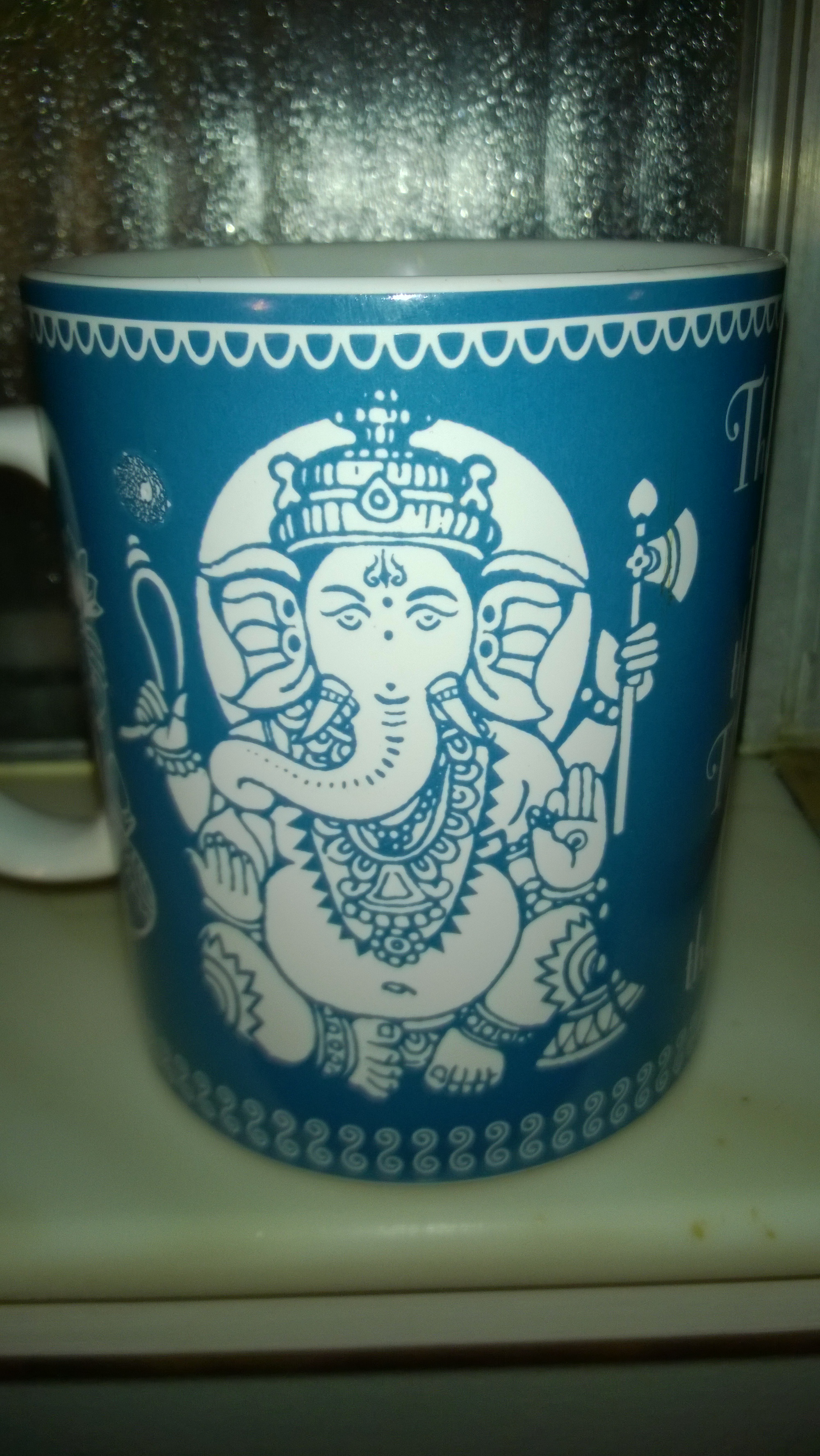
Bodhicitta, the perfect example of a way with heart, opens us to wonder at the universe and to compassionate action towards all. Like Ganesha on the cup, bodhicitta removes obstacles in our way, giving us a path forward, without it being a pre-constructed one; rather, we create the path with each engaged step of practice. This is a way that is in the heart and protects us from Kornfield’s identified failures of ambition, materialism and individual isolation.
WP_20141216_00_12_31_Pro

To those seeking a path with heart,

Gassho

Water’s Flux

Indigo waters gently stir
Under a night sky, black as emptiness
Foggy lights behind – the only luminescence
Ripples gently skim the surface,
Lapping at the dock’s beams
Lip, lup, lap, lup…

The water shimmers as it moves
Undulations in dim, pale light
A glittering, indigo, velvet flow
With each lap, the lake changes,
Water moves, dirt and particles shift
With every moment, fluctuation

The lake remains, but
It is imperceptibly different
I meditate – looking on the splendor
Of flux, of impermanence
As each ripple rolls toward me
Breathing in and out
Changing microscopically
With the lake
The “I” that appears the same
Just as the lake seems constant

Love, Rebounds, and Relationships: Part 1–Moving On?

Disclaimer: This is something I actually started writing quite some time ago (the date in my journal is a month ago to the day). This topic grew and unfolded in many different directions from the original inspiration as I started putting it on the page. Due to this prodigious growth, I’m going to break this up into pieces, trying to focus each post on different aspects of this topic that I want to discuss. The first piece is about rebounds, primarily, having recently gone through a breakup and seeing people’s ideas and reactions about moving on. Sometimes they are geared toward grabbing the next person who comes along. This will be discussed alongside a discussion of our conceptualizations of romantic love and all the hidden issues that lie in those unanalyzed concepts. I aim to present a more mindful approach to yourself and Love in these posts.


A common maxim proclaims that there is no better way to get over the last than by getting under the next. Yet, what is the draw of a rebound? Why is it both a sought remedy and a denigrated followup to a broken heart?

Heartbreak challenges our ideas of ourselves and our world. Suddenly, a shared companion in the adventures of life, in your perspective, and in your memories is gone. There’s a hole. This absence is almost palpable, like an aching scar after a piece of oneself has been removed. Everything–and I mean almost every moment–makes it ache. You yearn for the ache to subside, and the easiest way is to cover up that hole–that lack, that ache–with something else, or in this case, someone else.

Furthermore, this pain is the loss of an entire way of life, a path into a now lost future. Where there once was a “we”, there is now just an “I”. Now, you are left alone with a broken idea of partnership, with that of a feeling incomplete, again as though a part of your identity had been removed, as though part of your story had been cut off. Is this identity crisis and this idea of love/partnership so painful that we must rush to find that completion elsewhere, even if only temporarily, until the edge has worn off?

I think that there is something to be said for being present to the pain of this loss–facing it head on. Covering it over with someone else is a band-aid, a denial of the pain of this moment. Psychological research speaks of the five stages of grief: denial, bargaining, anger, depression, and acceptance. Moving on to someone else right away may seem like acceptance, a quickening of the grieving process, but it’s really a refusal to look back and feel. It’s a denial of the old loss through the replacement of a new gain. Perhaps, it’s no surprise that from my experience, rebounders act either as though their previous relationship never existed, or they are still tied up in knots about it and can’t stop talking about it if they start.

Under all of this discussed so far is the problem of identity (as I’ve previously pointed at our personal story in the experience). If you observe the way people talk about romantic love and how they seek it, it’s primarily about ego identity. A narrative of completion of one’s self in the Other lies at the core of so much talk about “Love” (here capitalized to emphasize our concept of it: Love as an idea, a placeholder of sorts while we investigate, and of course, we mean romantic love). We look for salvation, completion, rescue, and an ultimate, intimate connection–a holy communion– with the Other in Love. As such, Aristophanes’ depiction of Love as finding your other half to realize an original but now lost wholeness is so familiar. It’s human, all too human. From this familiar notion, Love is approached often as a communal “I” (We as one) or as another person who completes “me”, who fulfills many aspects of who “I am” and makes me whole. The continuation of the search and the desire for completion in the other is a bolstering of the story of “me”, the drama of ego. There’s a search here for certainty when life shows its uncertain, dynamic, unfolding nature–a sacred chaos of emergence. We seek an “I am” here in the arms of another, and this is completely understandable given the expression of the experience of loss that I have shared here. However, the confusion in this is that these experiences of pain and loss reflect on an underlying truth about my “self”: the dynamics of change are taken as a threat to my “self” as some set entity, when they are in fact, an expression of it–an unfolding, a time-being. The confusion is precisely around this idea of lacking something, no matter how much pain and desire for things to be otherwise may make it feel that way. The search for love as completion of myself with my “other half” is often denigrated, with the response: “I am already a whole person”. However, this duality of whole vs. incomplete merely continues the problem of ego. “I” am neither “whole” nor “incomplete” in their standard senses of needing or not needing more to be something. I already am sacred and luminous, neither “whole” in the sense of “perfect” or “incomplete” in the sense of “lacking something”. I am whole and perfect in the sense that I am precisely what I am in this moment, a particular configuration of conditions with the possibility of awareness and present, active compassion, yet this is always going to be pulled and covered over to some extent by my desire to not feel pain, to not suffer, to cover over that which I don’t want to face. As such, there is great value in standing present for the pain of losing a partner; it could be a moment for us to experience being awake to our lives as they are and acting from that open, tender place: a love which is not about my story, my self-bolstering, or my gratification–an active feeling and giving rather than the receptive filling of a lack. There’s no need for a rebound if you can be present to your own life as it is: not as you think it should be in your idealized concepts of yourself, Love, and what you “want”. Ultimately, this is about your relationship with yourself. Are you ready to look at that and question everything you take for granted? Are you ready to mindfully show up to your feelings and bring that into your next partnership, with whomever that may be? This is an invitation to actively embracing as I-You rather than the separation of I-It. You have the chance to gratefully feel the ebb and flow of your “self” with the beating of an open heart, but this requires the courage of staying present to those feelings and not running from them into an idea of completion and gratification: running into desire for pleasure rather than the love of your life, your fate, your world.

“We want to be perfect, but we just keep seeing our imperfections, and there is no room to get away from that, no exit, nowhere to run. That is when this sword turns into a flower. We stick with what we see, we feel what we feel, and from that we begin to connect with our own wisdom mind.

Without the maras, would the Buddha have awakened? Would he have attained enlightenment without them? Weren’t they his best friends ,since they showed him who he was and what was true? All the maras point the way to being completely awake and alive by letting go, by letting ourselves die moment after moment, at the end of each out-breath. When we wake up, we can live fully without seeking pleasure and avoiding pain, without re-creating ourselves when we fall apart. We can let ourselves feel our emotions as hot or cold, vibrating or smooth, instead of using our emotions to keep ourselves ignorant and dumb. We can give up on being perfect and experience each moment to its fullest. Trying to run away is never the answer to being a fully human being. Running away from the immediacy of our experience is like preferring death to life.

Looking at the arrows and swords, and how we react to them, we can always return to basic wisdom mind. Rather than trying to get rid of something or buying into a dualistic sense of being attacked, we take the opportunity to see how we close down when we’re squeezed. This is how we open our hearts. It is how we awaken our intelligence and connect with fundamental buddha nature.” – Pema Chödrön, “When Things Fall Apart: Heart Advice for Difficult Times”, p. 72.

It doesn’t need to be this way unless you keep playing a game that you are constantly trying to win.

Mundane Inspiration – The Words of House Martell

As I’ve struggled in recent months with the emotional upheavals that life bears in greater transitions, I’ve found solace and inspiration from myriad sources. One unlikely candidate that has been uplifting for me has come directly from the Song of Ice and Fire Series. Some of you may be familiar with this series of fantasy novels. Many would be more familiar with the TV show based on these books: “A Game of Thrones”. In any case, the various noble houses in the series each have their own family motto of sorts, their “words”. The rulers of the desert lands in the far south of the Seven Kingdoms, House Martell, have the words:

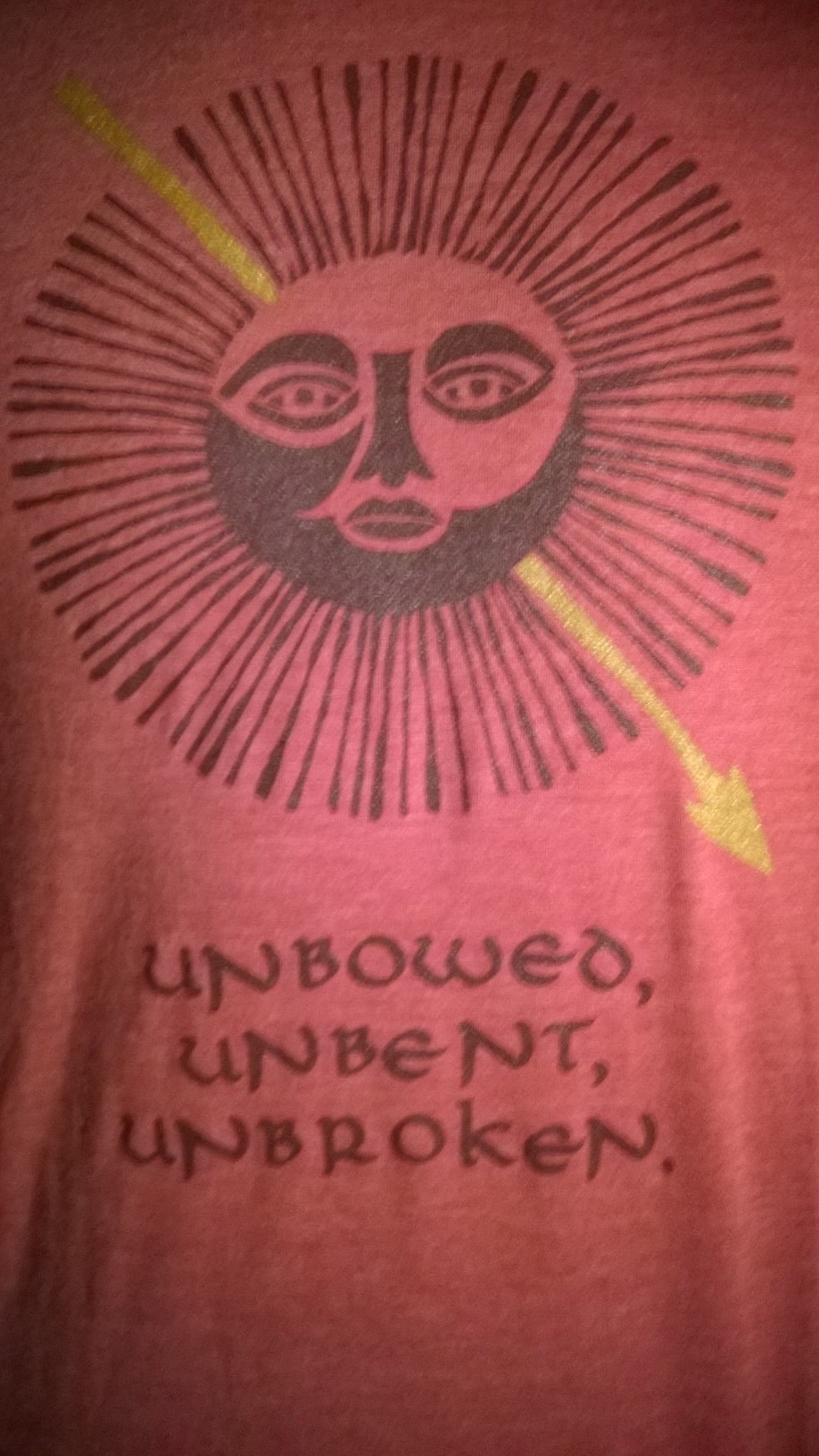
Unbowed, Unbent, Unbroken

WP_20141211_20_24_03_Pro

The Sunspear Sigil with House Martell’s Words

The words accompany the house’s sigil: The Sunspear. A symbol that radiates a determined strength and fullness. The sun shines out, and not only will he not be bowed, bent, or broken, he will overcome all obstacles with the sharp point of that radiant spear.

I do not offer this imagery and these words as some sort of call to violence or rage. Rather, if you are going through hard times, and I see so many going through their own heartbreaking transitions right now, you can resolve yourself to be unbowed, unbent, and unbroken. You are a warrior in the sense that you can discover your own strength, dignity, and basic goodness, no matter how difficult life may be.

Remember: you cannot control the events of the world, the myriad unfoldings of the universe, or the trials and tribulations of your fate. However, you can control how you react to them. So, stand tall. Shine. Resolve yourself to face them, not run away from them. Smile upon them with that glowing strength, and you may just find that you can bear so much more than you ever thought possible.

Murderous Zeal – Letting Go

Disclaimer: This post is much more personally revealing than most posts I write. This will not be quite as didactic, rather processing with the intent of expressing what I need to express but cannot share with the person with whom I wish to express it. Some of you may know me enough to know who that is, and to those, I say that this is not meant to judge or cast aspersions to that person’s character, a person I love with all my heart. Instead, this is trying to put into words what I have experienced, the pure, raw pain of it, and the folly I see in what has happened. Disagreeing with another’s choices and trying to accurately describe them as they are, to call a spade a spade, so to speak, does not mean that you belittle them or that you necessarily even think poorly of them (judgment can mean both identification as well as moral judgment; judgment here is meant as the first of these two). Believe me, that’s part of the depth of my pain expressed here. So, those of you who know, either don’t read this, and let my expression be, or see what I have to say about what I’ve felt and how I’m moving forward. Expressing this here is therapeutic for me. This is not meant to cause any stir; that person will likely never see it, and I wouldn’t publish it here if I thought that that person would. So either let this be, or read it to share my expression without any more motive than that.


You took the ideology of relationships from a friend, a maxim we would have previously scoffed at, and you embraced it as creed and animating principle. “If we were together again, it would have to be completely different.” Thus armed, like one of the furies, you killed “us” with a murderous zeal that I’ve never previously seen — lashing out in fear and pain, you held dear the despairing mantra: “This must die.” Yet, must it have? You never stopped. You never questioned. You held on with certainty, out of pain, unwilling to see how things could already be different. You instead repeated fatalistic stories of how they could never change without this melodramatic action.

Stumbling forward, revising what you said from one conversation to the next, galvanizing your certainty as having been one clear idea that you held all along — not merely a reactive lash of pain which grew into a clearer purpose with time — you stand, superior, self-righteous, cold, and cruel. I’m cast as naive, weak, and pathetic, so worthy of the death you dole out. Yet, our conversations reveal that your position has not been clear throughout beyond the reaction of pain, and your words come again to stubborn, self-righteous contradictions, and after knowing you for years, it all shines as an inauthentic escape from that which you can’t face. The hardest has ultimately been the empty promise of friendship, the last thing to die after love and family: the third and final death. I’m no more than an acquaintance now. Best of luck with your coping with this pain, with your soothing escape from it. May your pain and resentment have been quenched. I fear deeply that you will feel them again in your next deeply intimate connection, as I am not the source of your emotional reactivity. My greatest hope is merely that you can be real about this at some point, for your own growth.

I’ve been working on letting go of my pain in regards to this for some time. It’s been hard. It’s been painful (ironically, letting go of pain is painful). I’ve lost more than I can put into words, and that clings to me like an old skin that I can’t slough off — so close to a fresh rebirth if I could only peel off an essential layer of who I have been. Strangely, a few sentences in a popular psychology magazine have helped me find acceptance in ways that so many wise words from friends have been unable to do (more due to my own difficulties than any ineffectiveness of theirs; sometimes, only the right words stick — one key opens a door): “To let go of a past injustice that preoccupies us, we must relinquish our natural burning hope for equity. or at least for exposing to the world the wrongdoer — your brother, your crooked business partner, your vicious former friend — for who and what he is. Dimming that eternal flame of rage is effortful. The bad guy won. It happens.” (Psychology Today, Jan. 5th 2015, p. 56)  Indeed, it does happen, and so many of the things we need to let go of are not done by “bad guys” at all, my case included. We are people. We make selfish, myopic, or childish choices sometimes. That’s how it goes, and perhaps, the first step to letting go in cases like mine is accepting that — accepting that someone you love deeply can throw you aside, can lose sight of you, but it’s not really about you. They’ve done something “bad”, but it’s not something you should take personally, no matter how deeply that cut may go into your heart. The Stoics would remind us that there are things that are up to us, and there are things that aren’t. Only the first deserve our concern, and the only part of this situation that is up to us is our reaction to it, so let’s not make the other person’s decision — that part of existence that is up to him or her — about us. It isn’t. It’s about them. Let it be, and wish them well from a place of strength and dignity, as hard as that might be, because it still hurts…

In line with what I just said, I’ve also been inspired by a book by Chögyam Trungpa entitled “Shambhala: The Sacred Path of the Warrior”. In one passage, he states:

As human beings, we are basically awake and we can understand reality. We are not enslaved by our lives; we are free. Being free, in this case, means simply that we have a body and a mind, and we can uplift ourselves in order to work with reality in a dignified and humorous way. If we begin to perk up, we will find that the whole universe — including the seasons, the snowfall, the ice,and the mud — is also powerfully working with us. Life is a humorous situation, but it is not mocking us. We find that, after all, we can handle our world; we can handle our universe properly and fully in an uplifted fashion. The discovery of basic goodness is not a religious experience, particularly. Rather, it is the realization that we can directly experience and work with reality, the real world that we are in. Experiencing the basic goodness of our lives makes us feel that we are intelligent and decent people and that the world is not a threat. When we feel that our lives are genuine and good, we do not have to deceive ourselves or other people. We can see our shortcomings without feeling guilty or inadequate, and at the same time, we can see our potential for extending goodness to others. We can tell the truth straightforwardly and be absolutely open, but steadfast at the same time. The essence of warriorship, or the essence of human bravery, is refusing to give up on anyone or anything. (pp. 16-17)

Here, warriorship is not meant in terms of violence and war, rather courageous action in life’s difficulties with wisdom and dignity. In letting go, I think there’s nothing greater to aspire to than the courageous realization of our freedom to be upright and dignified, to walk forward with intention of loving-kindness for the world, when every signal and resonant vibration of pain tells us to stop, turn back, give up, and be jaded. This simple way of seeing the world for the beauty that it is may just be the hardest thing to do, especially in times of severe pain, but this is precisely the choice that is up to us, and it is more important in these times than in any other. Has my pain fully subsided? Of course not. However, I can choose to see it, to embrace my situation with courage and dignity. Most importantly, I can choose to love myself in all of this. What better thing to share than that, and how better to share it than being a sacred warrior?

I hope that someone out there reads through this long post and finds some point of inspiration for his or her own journeys. If you make it to these words, know that you are not alone, dear friend.

Gassho.

Bad Faith

We are masters of our own deception.

Aware of what lies before us, we can so readily turn our eyes away, refusing to see it, refusing to take agency, while distracting ourselves from the fact that this is just what we are doing. This self-deception, self-distraction, can be done in so many ways. You see it in the dreamy confusion of “denial” – a psychological cocoon, insulating from the tragic situation the person wishes not to acknowledge. You see it in elaborate narratives, newly built, those which recast entire histories with the most radical revision of a revolutionary, changing ourselves into victims of horrible fate or victors over that same horrible fate, which was once perceived as anything but…

Be careful with the stories you tell yourself. Be courageous enough to show up and face your life just as it is.

Self-deception

Gratitude and Affirmation During Times of Loss and Pain

In recent weeks, I’ve received aspersions to my character, questioning of my intelligence, and other undeserved negativity. I’m a radiant, awesome, deep, heartfelt, kind, and insightful being, always pushing myself to improve, learn, love, and grow. I’m working through all this and trying to move beyond, despite all the loss that circles through my life.

I feel that this is an opportunity to affirm and express my gratitude:
I’m grateful for seeing that we all are lost from time to time but that the way out is to admit it and work through with humility and vulnerability, to reach out to any involved and those you hold dear. Self-righteous proclamations and stubborn intention just continue a lost path. I feel the call here of Socrates saying that he is wise for knowing that he knows nothing – question what you know. Don’t assert it. Being reminded of this is one of the greatest lessons.
I’m grateful for friends and being reminded that they are those who challenge you to be virtuous, i.e. live up to your excellence (à la Aristotle). They are willing to point out the things about yourself that you aren’t willing to hear and love you in spite of yourself sometimes (as we all sometimes struggle and act poorly). They do so much more than just support you. They are partners in your life’s changes. As such, they keep you honest and authentic to yourself and your path. If you are not open to their criticism, your friendship is not as empowering and vibrant as it could be.
I’m grateful to be reminded that you should not make decisions out of fear and pain. Even when life throws you hard challenges, choose from a place of love, hope, faith, and intention for what you want to work toward. Do not choose from a place of fear, desire to numb pain, and what you want to run away from. Choose hope, not despair.
I’m grateful for all the self-care routines I have developed over the years. Loving others and the world starts with taking care of yourself.
I’m grateful for my personal strength. It’s amazing what you can make it through if you’re willing to face it.
I’m grateful for my health, my heart, and my short time in this mysterious and beautiful existence. It’s really difficult to affirm our lives at times, given the struggles we undergo. It’s so easy to want to escape it all, but in the end, I choose to stand tall and proud, and like Sisyphus, I aim to affirm my lot and love my fate.

Be Well!

Gassho!

I couldn’t have said it better myself.

Heartbreak

I recently had a tarot reading to get insight into my life outside of the perspectives of friends and family, beyond the spheres of people who already know me. My reader, a middle-aged black woman with thick dreds, was an interesting voice to hear amid the many others in my life. She did several spreads to see where I am at and how to overcome my current difficulties. I initially was pretty quiet and vague, but as what she was saying touched on several layers that she didn’t know about/talk about, I opened up to her.

Her initial message, and it remained the most stressed throughout, was about my job and how to regain some personal autonomy in relationship to career. She said something about it that really struck me: I’m heartbroken about my job. She clarified that heartbreak can occur in more than just our romantic lives, and many never even think about heartbreak with a job.

As she spoke, and more so after the reading, I realized how heartbroken I am right now. I have heartbreak related to love, job, home, family, and friends. Everything seems to float without stability, path forward, or clarity for the greater flow of my life. So many things I love have been cut out of my existence, have been dramatically altered, or have consistently done me ill while claiming to do me well. How do you move forward through such miasma? I have by the only way I know how: nurturing myself. Hence, I have been writing so much, meditating, and exercising. I have been talking things out with friends, and I’ve even been developing my intuition more by using the I Ching and tarot as oracles to broaden my perspectives about my life. Finally, beyond my usual self-care in times of difficulty, I’ve tried to improve my situation. If I’m heartbroken, particularly about my job, let me remedy that.

A few weeks ago, I did a meditation. Although not intended, it too was about heartbreak. I sat on the floor and breathed deeply with my hands over my heart in the shape of a triangle. I felt the energy pulse out of these three sides, throbbing out and reaching into the world around me. After some time, I put my hands down and asked myself: “If my heart were planted, what would it grow into?” I saw a vibrant blue flower open up, both beautiful and melancholy, filling my chest. When it opened, a personal object (I’m not willing to share this detail here) was dark and lifeless in the flower’s center. It felt like the culmination of a sad message, emphasizing my separation and loss of love, indicating the death of a deep connection. Then, the object shattered and bright, spiky, red petals burst forth, making the flower vibrant and hopeful. However, this did not seem like an erasure of the old, rather a rebirth from/of it. Like the phoenix, the new grows from the ashes of the old. The object shattered and reformed a few times, telling me that the break offers the possibility of growing into something more beautiful, powerful, healthy, and alive.

As for all of you, I’ll let you make what you will of such a meditation, but to me, it says one thing about heartbreak: even when things are very painful and it all feels meaningless, the possibility for change, growth, and rebirth lies hidden within that experience. It may be hard to see it, and it may be even harder to continue onward towards that, but it’s there, somewhere, just waiting for the moment to burst forth.

symptoms-of-a-broken-heart

Something new could pour forth from that hole…

This reminds me… I recently read a friend’s linked article about how we should court heartbreak to grow; we should break up and leave relationships behind when they become difficult because we’ll grow towards something better, and we’re doing ourselves a service. What I’m saying here does not support that at all. One thing that’s become clear to me in the last few months is how deeply we get caught up in our stories about ourselves. Some of my other posts touch on this. Leaving relationships, courting heartbreak, for personal growth, for pursuing your own narrative can be quite a confused and lost approach. Perhaps there could be value in this, but it is something that should not be taken lightly and certainly should not be presented as a hard and fast rule. It should be something that is examined through work with a therapist, someone who can challenge and disentangle the bad faith of the stories we tell ourselves, the things we refuse to see about ourselves, and the difficulties for personal growth in our relationships that we are unwilling to show up to and face for our own improvement. The problem with the stance in that article is not recognizing the opportunity in the difficulty of interpersonal dynamics to grow and change for the better. Breaking away is not what presents the room for growth; it’s the challenge of facing change that presents it. You can either own up to your place in a relationship and ask your partner to do so with you, working together for growth, or you can throw that all behind for “my growth”, “my story”, “my truth”. I’m not saying that the second option is always confused and self-involved, hardly, but I think there is a much greater likelihood of that being the case than that path being an authentic, examined, and clear engagement with all of the issues I’m presenting here. The point: heartbreak, when it comes, can be an opportunity for growth, but you shouldn’t seek to break your own heart in order to grow towards something “more authentic to you”. There is already authenticity in your connections; otherwise, it wouldn’t break your heart to leave them (not that I’m saying it isn’t hard to leave relationships that are bad for you; of course it is, but there is at least something good in the ones that really break your heart down to the foundations–real heartbreak, not just loss), and if your connections are that meaningful, there’s something to be gained from them if you are willing to dance with your partner and they are too.

This post has become a much longer meditation on heartbreak than originally envisioned. Let’s summarize what I would like to share about heartbreak. 1) you can be heartbroken about many more things in your life than just romantic relationships. 2) if you are going through heartbreak, do what you can for yourself to survive and eventually thrive. If you can work toward changing your situation, do it. Be your own healer, and remedy yourself. 3) heartbreak does not mean the end. There is possibility for new growth in the death of the old. 4) don’t throw things away from a willingness to break your own heart out of some simple idea of it being your story. Really think about relationships and how to grow in them. They hold potential if you are willing to dance with your partner and love together.

A great and famous writer recently told me to experience heartbreak in order to improve my writing. He said that going through heartbreak would offer the opportunity to process things and write better. Whether that’s true or not, I’m definitely doing that now, and I thank you all for sharing in that process. I hope that this post gives you your own insight and inspiration, especially if you have your own pained heart to heal.

I know… The heart chakra isn’t directly about what I’m discussing here, but maybe your growth lies in this aspect of your relationship with All coming into a healthier alignment. Maybe your heart needs healing in more ways than one…

Gassho

Mantra for Moving Forward

Help me make the crossing.

Help me find the path.

Help me walk it gracefully.

(Repeat as many times as necessary)

Gassho

I’ve been drawn to Ganesha as a symbol of overcoming obstacles recently. Plus, he’s just rad! Perhaps he can be an image to keep in mind while reciting this mantra to help empower you and hone your focus on the intention. I was told recently that the secret of Ganesha is that he not only removes the obstacles for you but is also the one who put them there in the first place. If this is the case, the ordeal of the obstacle and the overcoming it have a meaning and a lesson for you. In getting beyond them, make sure that you are learning what you should from them. Don’t simply try to run away from the process. Good luck on your journeys!

Sacrifice and Change

As I left the house this evening to run to an esoteric shop, I thought briefly on tarot cards. With my last post being a discussion of transition, I flashed on the Death card—transition, change, the end of one cycle and the beginning of another. However, my mind soon shifted. I thought, “Right now, the Hanged Man is more important for me.” This card has come up for me in key positions in my self-readings of late.

I walked up the hill toward the shop and mulled this card over some more. The personal sacrifice of Arcana XII, the Hanged Man, comes before the great transition of XIII, Death. In the transitions I have been facing, I feel hanged, sacrificed, but not through my own choice. I too dangle by one foot, uncomfortably immobilized while the entire world seems upside down. If the sacrifice here is supposed to lead to spiritual salvation and transformation, some deeper realization or enlightenment, I have yet to see what exactly it is. I hang, watch, and wait—pending.

Hanging here through sacrifice, yet it is not in vain.

This all eases somehow into the transition ahead of me. Perhaps, in my case, one doesn’t so much follow the other as much as coincide with it. I, the fox, stand immobilized, hanging with the sacrifice of the stage before, at the river of change, Death, gathering my strength to learn from the patient sacrifice of my situation, and then, I cross, no longer impeded…

I got to the shop, and there was a Death card on the board by the register.

All things must end, and yet, “omnia mutantur nihil interit”.

Previous Older Entries Next Newer Entries