
This session returned to the experience I only got to the edge of exploring in my recording a couple nights ago and delved in deeply alongside some loving admiration of passages from Shunryu Suzuki’s “Zen Mind, Beginner’s Mind” and Dogen-zenji’s “Genjokoan”. I really tried to express some key ideas of non-attachment and sitting within calm presence, even in the heart of painful desires.
Philosophy Riffing | “It shouldn’t be this way” – Zen Practice, Living in the Burning House
19 Jul 2023 Leave a comment
in Philosophy Riffing Tags: Buddhism, Depression, Dogen, Practice, Samsara, Shunryu Suzuki, Wittgenstein, Zen
Practice | Presence, I-You, Tao
03 Mar 2023 Leave a comment
in Mindfulness, Practice Tags: Buber, Buddhism, Dogen, Heidegger, I-You, Love, Taoism, Unfolding
I’ve been writing a journal with a sense of trying to focus on practice like Marcus Aurelius does in the Meditations but with a more open-ended inspiration which pulls at being present from both Buddhist and Stoic points of departure. I haven’t written that regularly, but I had a very flowing moment of expression at the end of a session yesterday that I thought worth sharing.
Rain pittering
Pattering pangs on panes
Wet flow
Just outside the window

It's truly wet in this moment, really coming down steadily outside as I sit at the restaurant just below the office. I'm realizing how much of the basics of the world escape our notice as we go through our lives.

We go through, focused on this thing or that. It's very centered on achieving, doing, or pleasure/avoidance of pain, usually.

Meanwhile, it pours, the wind blows, myriad other worldings world themselves into being. The moment is one of golden radiance, even our narrow reaction that misses most of it.

However, there's also the opportunity to open the heartmind to more. It's there in every moment. We can pause, breathe, open, and truly notice. Body and mind can fall away. In such a way, we can truly exist as I-You, sitting deeply in the everabiding emergent sway that is the cosmic force of love: Love Loving Itself - TAO.

Philosophy Riffing | Life Challenges, Living as the Person I Want to be in the World vs. “I’m a good person”, BPD, and Stoic and Buddhist Wisdom on Letting Go
14 Dec 2022 Leave a comment
in Philosophy Riffing, Psychology Tags: Buddhism, Chöd, Cognitive-behavioral psychology, Life stages, Meaning, Mental Health, Self-criticism, Self-reflection, Stoicism
I speak at length about coming to the end of cycles, struggling with the developmental shifts of life, being tested, living up to the person you want to be in the world, some random musings about borderline personality disorder, and wisdom about some of these topics from Marcus Aurelius, Epictetus, and Machik Lapdrön (the Tibetan founder of Chöd – amazingly insightful and modern feeling insight from a female nun in the 1100s!!!).
This recording rambled a bit more than normal I feel. I hope there are pieces that resonate to any who may listen to the end. I’m grateful for you all.
Philosophy Riffing | I-You, Ethics as first philosophy, pursuing the Good, and Stoicism
02 Dec 2022 Leave a comment
in Ethics, Philosophy Riffing Tags: Buber, Buddhism, Epictetus, I-You, Marcus Aurelius, Stoicism, Wittgenstein
Recent reinvigoration of my interest in Stoicism inspired this somewhat meandering discussion of a meaningful, value-driven life with riffs on Buber, Wittgenstein, Buddhism, and most definitely Stoicism. May this inspire others despite its lack of clear organization.
Here’s the key book I mentioned late in the recording: How to Think Like a Roman Emperor by Donald Robertson .
Philosophy Riffing | Virtue Ethics Revisited, Interdependent Origination, & Kindness
29 Aug 2022 Leave a comment
in Philosophy Riffing Tags: Aristotle, Buddhism, Heart Sutra, Interdependence, Loy Ching-Yuen, Paramitas, Plato, Taoism, Virtue
I return to philosophy riffing after a long hiatus. This session had a lot of meandering ideas. I’m not sure I expressed much succinctly, but I enjoyed the associations and efforts to explain some things. If nothing else, I think this was sweet, well-intentioned, and inspirational of some fresh thoughts and learnings for others.
Cross-Post: The Post-Rock Way — A New Cycle | Spotlight: Coastlands
29 Jun 2022 Leave a comment
in Music Tags: Buddhism, Change, Death, Nietzsche, Post-rock, Tarot, The Dhammapada, Unfolding
This post was originally on my other blog about exploring spirituality and philosophy through post-rock music. I felt it must be shared, as the song I highlight and the experience I had in the described concert really resonate with the last post I just wrote. I recently wrote a post on the best albums of 2021 in post-rock, so I recommend checking that out if you find the music in this post interesting.
This last weekend, I had the pleasure of a short road trip to attend the Post-Rock and Friends Fest in Portland, OR. I had a chance to see a few bands live whom I’d been wanting to see for years. I’m going to write two posts about this regarding the two bands that really grabbed my heart.
One of my favorite post-rock albums of 2020 was Death by Coastlands. Here’s what I wrote on my 2020 best albums review:
Prepare to face the destruction of death in this album. Coastlands goes full post-metal and crushes you without falling into the standard doomy dynamics that post-metal can get stuck in. It’s epic, empowered, and gorgeous. This came out near my birthday, and it ended up being a perfect birthday present.
Retrospective | Best Post-Rock Albums of 2020
Returning to this album a couple years later for an intensive listen brought so many new layers of interpretation and experience. The last year has been a long slog through a cycle of death for me (in the sense of facing the end of the old). My sense of who I was has died. My sense of purpose has died. My ability to stand up again, walk forward, and move on has been challenged, time and again. In that time, tarot cards have been a meaningful self-care tool for solace, insight, and a sense of meaning when things have felt meaningless.
One of the key cards in the high arcana is the Death card. If you are unfamiliar with the tarot, you’ll possibly pause with some trepidation at that, but Death is more than a card that says someone around you will die. It’s a card about the end of an old cycle and a transition into a new one. Life is a vibrant unfolding of change, and a key component of the new coming forward in change is the old ending and disappearing. That’s what death is. As I put it in one of my favorite poems in the early days of my other blog:
Birth, birth, birth
&
Death, death, death
— In every moment
With each heartbeat & breath
A Human Becoming
Coastlands’ album overflows with this energy of change, empowerment, flow, and growth through the death of the old. Every song has heavy, crushing power, but there are major key aspects as well where the lotus blossom grows in the detritus at the side of the road (image from the early passages of the Dhammapada – a chapter with overtones of living well in the face of the transitoriness of life, interestingly enough). The dirge has just as much of a joyous affirmation. It’s a recognition that one’s going over is a going under (Nietzschean riff – early Zarathustra).
I know that this post is dropping a lot of references, so let’s return to the band and the album concretely – seeing Coastlands live emphasized all of this I’m saying. I overflowed with energy and intensity, and I was even more impressed after the concert when speaking with the bassist and realizing that the band’s sound has changed and developed in the last couple albums as the lineup has changed, and new experimentation and growth is already shining through in the little that’s been revealed about their upcoming album. They are harnessing the strength of a new cycle – transitioning with change, the blockages that the last couple years have thrown at all of us in so many ways, and other various challenges of individual and group lives. They take these and shine. That’s the opportunity of the Death card.

I want to showcase the final song of Death as a share here. The song “Marrow” starts with a sorrowful chorus of voices and doomy guitar riffs with discordant static from the amps. It grows into a heavy crescendo of guitar and drums. The old has been cut off, and we’re to the marrow deep in the bones of the broken. Then the song shifts to a more pensive, flowing guitar on top of the heaviness it pulls us along beyond that first stage into something more, something that survives. That’s the true power in that marrow*. It’s the potential to stand up again and make something new.
*One last spiritual geek aside on Marrow – I can’t help but be reminded of the story of Bodhidharma’s successor, Huike, who cut off his arm to gain Bodhidharma’s tutelage. Later on, Bodhidharma passed on his “marrow” in recognizing the transmission of his teaching to Huike.
Healing | Impermanence and the Lack of Return
15 May 2022 2 Comments
in Healing Tags: Buddhism, Change, Compassion, Dogen, Growth, Impermanence, Kintsugi, Return
I’ve healed past the worst of depression in the last few months, but I find myself in a difficult place that’s hard to understand. I still wish I were dead. I feel like I’m just waiting for my life to march forward, one day at a time until my consciousness blinks out. I don’t really have any joie de vivre, rather a goal of trying to become wiser and tune into the ebb and flow of the mystery of existence while showing up for the other lives around me.
I’ve talked about this a few times on the blog before – the problem of the metaphor of “healing”. People speak of it as though you’ll return to how you used to be, but that’s a very limited conceptualization of healing. I’ve thought of it more in terms of other, physical healing I’ve been struggling with.
Last summer, I was in the best running shape I’ve been in in probably 15 years. I was getting faster and faster, more and more enduring, and simply poised. My goal was to run a marathon, and I was ahead of schedule and pace.
Then, I pulled a hamstring. A few weeks later, I started again and immediately had intensive calf problems. Every run felt like my calves were going to cramp with every single step. Eventually, I gave up on the marathon and shifted to minimalist shoes – I used to wear them all the time and had greater leg strength and balance because of it.
Not long after that, I started having Achilles tendonitis. First in one leg and then the other. Since December, I’ve been fighting and hobbling along as best as I can for one or two runs a week, getting stronger through care and a strong sense of resolve, but one Achilles simply will not fully heal. I would walk around like an old man with one good leg for most of the week, heal, and then run and repeat the cycle.
About a month ago, I realized I could get a compression sleeve to assist. It’s made a huge difference. I can walk around without much any pain and normal gait. I can run with only a slight pain at the start. It’s almost like my Achilles is normal, and the sense of a nodule near the heel has slowly dissipated. However, I can only go roughly a day without it, and it doesn’t feel completely normal. I don’t know if I’ll ever be able to walk normally again without some brace to support my foot.
In healing past everything I’ve gone through, have I returned to some version of myself prior to my experiences? Some chipper, confident guy who believed in love, partnership, and the good intentions of others in relationship with a hope about life and the future? No, I haven’t. Not in the slightest. I’m still pained and tortured on a deeper level, and I don’t know how to change that. I only get through due to a lot of developed self-care, the loving care of those in my life who do value me and see me, and the constant presence of my cat as well as my family. In a sense, it’s like the sleeve – if I don’t connect to these supports constantly, I quickly fall apart, unable to bear all the memories, doubts, and feelings of unworthiness.
The funny thing is that shattering pain has made me feel deeper and kinder than I’ve been in the past, and I can’t really imagine going back to normal in some way that covers over the vulnerability and compassion I’ve felt from it. A couple quotes recently really brought that to the fore, affirming my efforts and dispelling some of the doubts I’ve had about myself, which I’ll share briefly below, but I want to summarize this post with a clear point first.
Healing isn’t some river of Lethe forgetting and return to some previous before. Our lives and experiences are integrated in a complicated growth and decay of impermanence – change. In a very real sense, the body and heart keep the score, and healing back to some enhanced functionality may never be complete like it was before, but like some sort of psychological kintsugi, the art of mending may leave the need for supports that hold the cracks together or an inability to do like previously, but with some fortuitous circumstances, it may sometimes also leave some golden, shining new beauty.
In my own case, all I can do is continue on, doing my best for myself and others, with patience and care for the entire process.
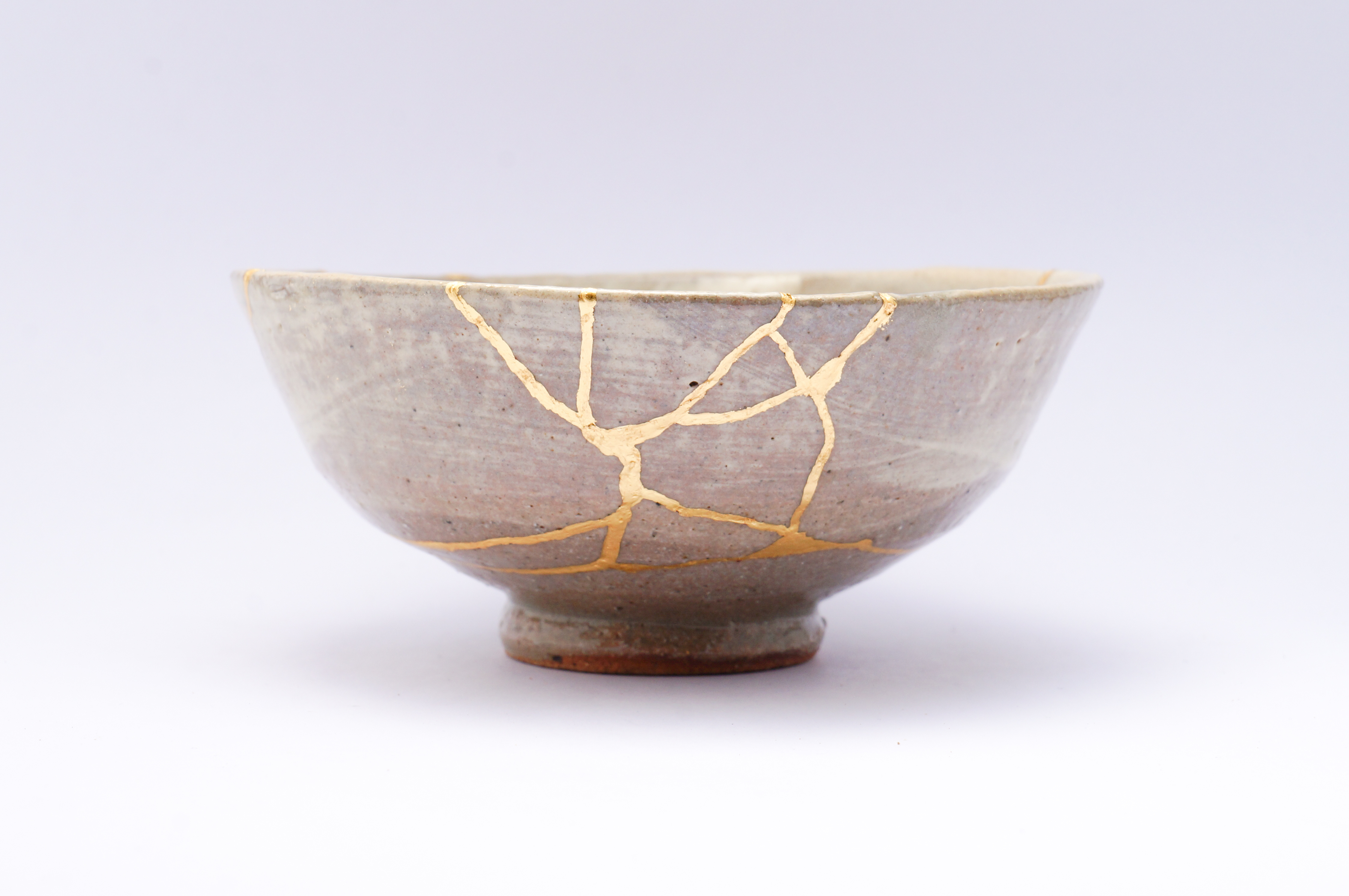
As the Kotzker Rebbe, a nineteenth century Hasidic rabbi, said: “There is no heart more whole than a broken one.”
Sent by a friend, uncertain origin
Sublimation happens when we are no longer attached to our pain. It is not that our pain vanishes, nor that we become immune. Tender sentiments continue to flow and, in fact, appreciation of beauty intensifies. When we are no longer consciously and deliberately fighting it, the pain itself is reconfigured into the very substance of compassion and sensitivity.
Thus, in the work of these three great masters [Saigyō, Hōnen, and Dōgen], we see a pathway out of tragedy that transforms its energy into the signs of enlightenment, signs that do not designate a sterile and frigid person, but one full of feeling and tender. It is this transformation and this process that Dōgen seeks to explicate in Genjō Kōan.
The Dark Side of the Mirror: Forgetting the Self in Dōgen’s Genjō Kōan by David Brazier, p. 37
May this help those who need it.
Gassho!
Cross-Post: The Post-Rock Way – Transformation | Spotlight: Mono
01 May 2022 Leave a comment
in Music Tags: Buddhism, Growth, Poetry, Post-rock, Spirituality, Transformation, William Blake
This post was originally on my other blog about exploring spirituality and philosophy through post-rock music. I recently wrote a post on the best albums of 2021 in post-rock, so I recommend checking that out if you find the music in this post interesting.
Earlier this week, I went to see my favorite band live for the 4th time: Mono. Up to the concert, I’d had some mixed feelings due to personal history, but I came out of the concert feeling deeply cleansed. Here’s what I wrote on Instagram:
Words cannot capture how much this concert from my favorite band, @monoofjapan , meant to me tonight. I nearly cried several times through what truly felt like a pilgrimage of the soul. The artistry is so powerful it breaks your heart wide open. At the end, an encounter with a friend led to us staying for autographs, and I got a copy of the first Mono album I fell for as a piece to sign and frame. So thrilled for every moment of this night. #postrocklive #concert #musicasspiritualexperience
To be clear, as this might just feel like fanboyish excitement: Mono’s newest album is called “Pilgrimage of the Soul“, and it’s inspired in part by William Blake’s poem, “Auguries of Innocence“. Lines from the earliest section of the poem are regularly quoted as inspirational and highlight Blake’s spiritual aspirations/virtues. In fact, not only are several song titles based on these lines, an audio clip of a reading of the poem played at one point, closing out a song in the set.
To see a World in a Grain of Sand
Auguries of Innocence, opening lines
And a Heaven in a Wild Flower
Hold Infinity in the palm of your hand
And Eternity in an hour
The set was interspersed with tracks between this album and the previous, “Nowhere, Now Here“. The feelings of nature and pushing to greater heights of a spiritual pilgrimage had the counterpoints of the more minor key of the previous album, and the balance was stunning. Beyond this, there were a couple classics: Halcyon and Ashes in the Snow (arguably Mono’s best song).
In thinking of my experience, the album, and Mono’s greater discography, I realized that this idea of transformation in the strongest, most beautiful sense, although one facing the challenges of suffering and sadness, is something I’ve always taken from Mono’s work, and I’m convinced it’s a dynamic thread throughout. Their first album is titled “Under the Pipal Tree”, a direct reference to the Buddha’s enlightenment under the Bodhi Tree (the Pipal Tree). The Buddha’s spiritual journey is one of recognizing the problem of suffering in the life of all sentient beings and seeking peace in response to it.
Subsequent releases riff on problems like this, thinking on fantastic takes of the connection with others, the remembrance of family, dealing with disappointment, and a sojourn through Hell.
A much younger me discovered “Hymn to the Immortal Wind” (the album I refer to in my Instagram post), and the experimentation of rock crossed with classical orchestra with a delay-laden tremolo lead guitar, immediately got through this focus on nature, humanity, connection, and heart/soul. It was a turning point in my life, from which I’ve never been the same, and furthermore, after which, I’ve struggled to share these feelings with others. My trepidation at the concert was grief: a feeling of sharing that having been lost.
However, with the opening riff of the first song, “Riptide“, and the subsequent shift to crushing power and speed, I felt all my clinging of attachment unmoored, and this feeling of having my narrative torn apart by beauty, by majesty, and my sheer, powerful abundance of all that is, came through multiple times, leaving me nearly in tears.
There are few post-rock bands as masterful as Mono, and Taka’s songwriting and presence on stage are nothing short of genius, and this kind of spiritual experience is intentional in their music, especially live. As Taka said when touring for “Requiem for Hell”:
“Music is about experiences,” Goto says. “Witnessing extremely loud sounds live is one type of experience. It’s almost like seeing a spark of thunder in a quiet night sky, then hearing the echoes of loud thunder. It’s beautiful, yet crushing – an unusual experience.”
Taka, from this story
“At the same time, subliminal music is extremely spiritual. Every sound and melody start to soak into every cell in your body, takes them subconsciously and moves them. Music can speak to everyone more eloquently than words. It’s close to philosophy. It’s a gift from God.”
This quote summarizes both my feelings about post-rock’s intensity of expression and the intensity of Mono’s live shows. I highly recommend exploring the spiritual experience of transformation that their music offers.
Philosophy Riffing | Ethics – excellence, ethics vs. morality, good and evil, and a spiritual expansion
16 Mar 2022 Leave a comment
in Philosophy Riffing Tags: Aristotle, Buddhism, Creativity, Ethics, Excellence, Happiness, Morality, Nicomachean Ethics, The Dhammapada, Utilitarianism, Virtue
This was a meandering recording that pulled up a lot of details I didn’t originally have in mind and left many others unsaid that I had originally intended. May come back with a part 2 soon. I hope this gives others many things to ponder or at least some ideas/sources for them to go look at further. Feel free to ask questions in comments.
Note: At about an hour and 10 minutes, I make a mistake with Carl Schmitt. He described the distinction that grounds the concept of the political as the friend-enemy distinction.
Heartbreak | Poetry | Crimson Drops
24 Feb 2022 Leave a comment
in Compassion, Heartbreak, Poetry Tags: Buddhism, Kwan Yin, Mahayana, Tarot, Tattoo, Tonglen, Wisdom
A rough attempt at poetry – initially thought of during a recent run. The beginning is merely a symbolic expression of the pain of loss – not any message of intention at self-harm.
Languid flow oozes – ebbing life and death
Crimson crystals coagulate
Drops fall to the ground
Mixing with the salt of tears
The stain of such a staunched flow
Crimson – the deep color of compassion
Mahayana monk’s tender tone
A reminder: death (XIII) is transition
Romance may have withered and fallen
The faded crimson of a dead rose
Yet heart’s vulnerability
Can hear the cries of the entire world
Twisted knot on my arm
Crimson dyes of tattooed ink
A lucky symbol and inspiration
Wisdom and compassion: entwined as reality

No matter my despair
My raw flesh of heart
Can pull in all the despair of the world
And push out peace to all – tonglen
May this pull in the despair of heartbreak from all those who feel it, take it upon myself, and replace it in everyone out there with warmth, acceptance, and peace.
Gassho!

 On the Way
Recent Comments