This post was originally on my other blog about exploring spirituality and philosophy through post-rock music. I just wrote a post on the best albums of 2021 in post-rock, so I recommend to check that out if you find the music in this post interesting. I haven’t written many posts on the other blog, and it’s only roughly a year old, but in looking back over my experiences of the last year, I couldn’t help but feel like this post perhaps captured the mood and ambience of most of it better than any other, and it fits perfectly with this blog as well. May this resonate with others as well.
As we go through life, there will be loss. Everything composite is impermanent, and everything is composite. All falls apart, eventually. Even atoms will slowly break apart into heat death, according to thermodynamics. This inevitability of change alongside our attachment to beloved events, places, situations, and people means that there will be the pain of losing the things and people we love, and it will hurt.
One translation I love of the preeminent Zen philosopher-monk, Dogen, puts this in the most poetic light:
Therefore flowers fall even though we love them; weeds grow even though we dislike them.
Shohaku Okumura, translation of Dogen’s Genjokoan, Realizing Genjokoan: The Key to Dogen’s Shobogenzo, p. 1
The experiences of big losses, big loves, are some of the hardest transitions we face in life. Dealing with them, living through them, is about as human and mortal as life can be.
As such, it’s no surprise that this is a theme for exploration in post-rock. One of the most iconic songs for this is Caspian’s “Hymn for the Greatest Generation”. The title track and the following track are both seemingly about the band’s process of moving through and honoring the death of a fellow band member.
The sound in this song is gentle, intimate, riding on the picking of an acoustic guitar that builds into a fuller rock instrumentation. We feel the bittersweet moving forward of time, with an almost metronome drum, reminding of the clunky ticking of change, moving on despite loss. The song builds further into something like a celebration for all the joy and love of those we have lost, facing it head on and embracing the memories and warmth of what was. Finally the song melts down to a poignant violin and a return to the bittersweet acoustic guitar slowly going on, knowing that what was had will never be had again.
You can feel both the joy and the sadness in this song. It’s utterly beautiful and unforgettable. Friends of mine have resonated with these feelings slightly differently, claiming to hear the guitarist crying in the song, and I’ve even seen memes about how heart-wrenching it is. This song displays the full beauty of having loved someone and lost them. I highly recommend sitting with it and letting it inspire the greatest affirmation within yourself for these cycles of love, loss, and grief that you will inevitably face in life. There’s perhaps no deeper spiritual experience to sit with.
I’m taking another journey through the Buddha’s lessons on the path of the Dharma (one way you could translate the title Dhammapada). A few years ago, I wrote posts on a handful of chapters, but I didn’t go over every chapter. This time, I’m challenging myself to post on every chapter and share them here.
This chapter has two key focuses:
There is an apparent ease to the corrupt path, but this overlooks the ongoing samsaric suffering of such an approach to life.
Focus on your own efforts – it’s easy to see the faults in others and to hide your own from yourself, and moreover – your goodness is achieved through your own efforts, so focus on purifying yourself.
So what does one purify? It’s come up multiple times throughout the previous chapters, but let’s take a moment to look at three passages that line out everything regarding these two points.
Easy is life For someone without conscience, Bold as a crow, Obtrusive, deceitful, reckless, and corrupt.
Difficult is life For someone with conscience, Always searching for what’s pure, Discerning, sincere, cautious, and clean-living
The Dhammapada, 244-245, trans. Fronsdal
This speaks to both points – it seems like life is easy for someone who selfishly does for him or herself, but ultimately (as is emphasized in other lines and in all the other chapters), it is not. This chapter doesn’t necessarily elucidate this well, but we might think here of Plato’s discussion of the tyrant in the Republic. When taken to the ad absurdum, someone who acts with impunity in life moves into a path of obsession of self-protection and protecting his/her possessions. It’s a life of paranoia and clinging. This is perhaps a good transition into our next passage, as it emphasizes exactly what ails the mind of one who lives that life:
There’s no fire like lust, No grasping like hate, No snare like delusion, No river like craving.
The Dhammapada, 251, trans. Fronsdal
More pithy poetic examples could certainly be provided, but the point is that a life of apparent selfish ease is actually a life full of samsaric pain.
However, we’re then counselled not to judge the faults of others. In a sense it’s the bad faith (as from Sartre) of Buddhist practice. It’s easy to look outward and just miss the efforts that oneself must make.
It’s easy to see the faults of others But hard to see one’s own. One sifts out the faults of others like chaff But conceals one’s own, As a cheat conceals a bad throw of the dice.
If one focuses on others’ faults And constantly takes offense, One’s own toxins flourish And one is far from their destruction.
The Dhammapada, 252-253, trans. Fronsdal
As elsewhere in The Dhammapada, the emphasis is on self-mastery and that the path to Nirvana depends on your own efforts. Perhaps the simplest game to avoid that difficult path (the difficult path of continually searching for what’s pure from our first quote above) is to find fault in others, while hiding your own, thereby appearing to shine and not need any effort. However, this is simply a mild version of the grasping of hate and the snare of delusion.
As such, let’s close with one of the most poetic passages in this chapter as our focus for purification:
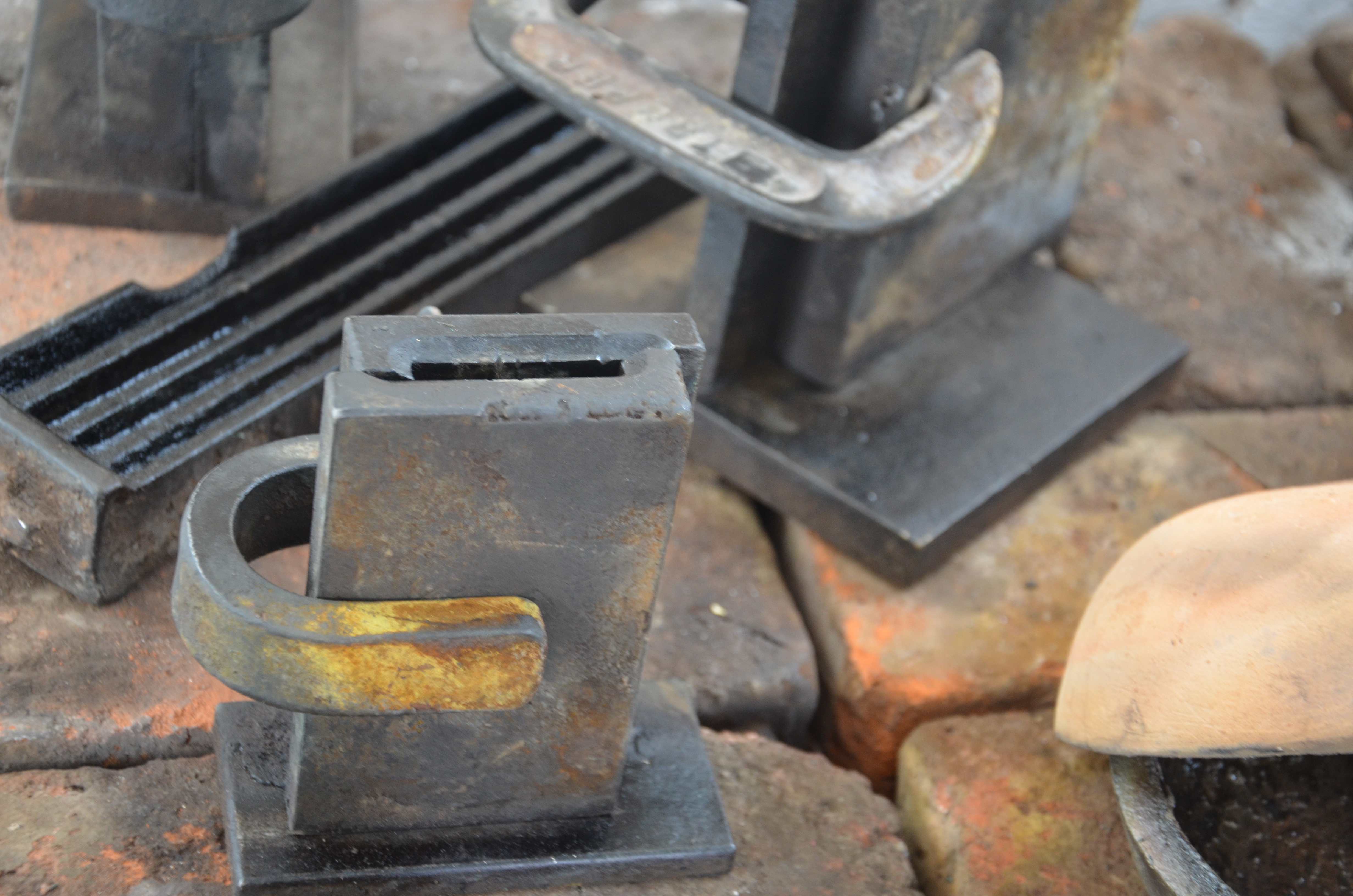
As a smith does with silver, The wise person Gradually, Bit by bit, Moment by moment, Removes impurities from herself.
The Dhammapada, 239, trans. Fronsdal
May this inspire the ongoing purification of mindfulness of self and world that is practice and purification.
As I said in my last post, there’s going to be a struggle to feel empowered and on top of my path forward. At times, like in the last post, that will be the driving energy. At others, my long tail of pain and existential despair from this year will have the upper hand, and I’ll have to use that strength and courage to sit as calmly as I can in the darkness. The last week since that last post has felt much more the latter than the former.
I looked back through pictures today from this last year and realized that I spent pretty much the entire year sad, depressed, and heartbroken. The worst months have been not only that but riddled with thoughts of suicide, and the worst days in that have been battling against negative self-talk about how the world wouldn’t miss me in the slightest other than my mom and some close friends. I got a response to my last post that I am strong and brave and am beginning to tap into that, but that’s the thing – I’m not beginning. I’ve weathered so much pain and feelings that I’m meaningless and pointless because I’m so incredibly strong that even when I feel like I’m worth absolutely nothing, I still show up and try to do my best and be the kindest person I can be to those I encounter – most of whom have no idea how difficult of a time I’ve been going through.
I’ve talked about the why before – this all feels like a loss not only of a relationship but of love and partnership as meaningful pursuits in my life. I’ve spent the last few months seeing who’s out there, and ultimately, that doesn’t leave me feeling any better about the future. So, I’ve been letting go of the attachment to the idea of sharing my life with someone in the future. I don’t trust love anymore. I don’t trust that there’s a good match out there for me, and furthermore, I don’t trust myself. I seem to be attracted to those who don’t seem to see me or value me, so even if I did find someone who felt like a great match, I’d thoroughly doubt my evaluation.
So, here we are, at the cusp of a New Year, and I’ve decided that I’ll stop bringing up these bad feelings by looking through who’s out there on dating apps. I’ve only really been looking for friends or casual dating, but as I’ve scrolled through 100s of profiles, I can’t help but notice that none have sparked a deeper interest. I’ll leave my profile open so that others can perhaps find me, but I’ll stop with the effort on my end as the regular reminder seems to stir those feelings of apprehension about being alone.
I’ve struggled with this set of feelings for months now. At times, I’ve even thought of it in terms of Nietzsche saying that mankind would rather will nothingness than not will – his project’s concern regarding nihilism. I’ve worried that perhaps I have a nihilistic stance towards all of this at this point. In a way, I couldn’t blame myself. I feel like some big part of me is dead, and I need to amputate that to walk on with new invigoration. I do have some deep nihilism in my heart – I feel like something I had attached a lot of meaning to is gone, and as Frankl warns us, that sense of meaninglessness in one’s life is connected to a despair and surrender to death.
I can only hope for a Nietzschean great convalescence. At times, like in the last post, I feel on the cusp of it, and I think that willing something different is key, rather than willing the negation of all that hurts. As such, I will being a philosopher bachelor. I will that facing the absurd of meaninglessness pushes me towards greater wisdom about the interconnection of all and compassion for all other sentient beings. I will letting go of love, partnership, family, and fatherhood. If they find me in the future, great, but I will no longer worry about finding or building them myself.
I recently have been reading about Zen energetic practices which led me down a rabbit hole of the embodied energetics of chanting and the bodhisattva vow. Let’s take this vow up as the resolution for the new year:
Sentient beings are numberless; I vow to save them. Desires are inexhaustible; I vow to put an end to them. The dharmas are boundless; I vow to master them. The Buddha’s Way is unsurpassable; I vow to attain it.
from Soto School Scriptures for Daily Service and Practice, as quoted in Living by Vow: A Practical Introduction to Eight Essential Zen Chants and Texts by Shohaku Okumura
May the impossible nature of the above aspiration inspire patience and compassion with myself as I continue to struggle with self-mastery and as I fall short of any intentions of doing right by those I encounter in my life.
May this post act as an inspiration or companionship to those out there who need it.
I recently have been attending a Buddhist dharma talk weekly session through a local Buddhist temple. One of the monks reached out to me to chat and get to know me better. She asked me about my difficult emotional states I’ve brought up when we’ve shared in class. I rattled off some straightforward description with some points about how I’ve been too attached to certain ideas of partnership and love and that I just need to reevaluate and come to terms with the possibility for a different narrative, understanding, and path for myself. I thought I would get some sort of agreement or pat on the back, but the actual reaction I got surprised me and made me understand my treatment of myself differently. Instead of just seconding such a tough approach to my situation, she paused and told me that it makes sense I would be grieving and struggling with all the transitions and restructuring I described. I realized in that moment that something some friends tell me is right: I don’t have a lot of compassion for myself. I strive and push myself hard to be better, to understand deeper, to stand taller, and to be stronger. When I fail, I tend to focus on how I didn’t do well enough and have to be better next time. As such, recent transitions have been tough. I tend to think of myself as weak or stupid rather than as working through legitimate issues. The fact that a monk who is well-versed in the phrasing and concepts I used basically indicated that I should pause and grieve with grace, accepting those feelings as legitimate, was quite the message to me.
Then, today happened. The last few weeks have been hard in general in that there’s flashbacks to a year ago and shared moments, as well as shared intentions and aspirations. We had talked at some point during that time about spending holidays with her family – helping her cook and enjoying the time. So, the loneliness of today, being alone, facing the existential shifts of looking at no partnership, no family, no fatherhood in the future as quite likely outcomes (No, I’m not being dramatic – it’s going to be difficult to find a match who is not settling for my sense of compatibility; such a person will be rare. That’s a statistical certainty.) has been incredibly painful, much more so than regular recently, and regular is wishing that my heart would stop, daily.
I’ve sat with all the feelings and tried to muster up the energy to just focus on other things that need done. That’s kind of my Zen of heartbreak: chop wood, carry water (as I’ve spoken of before). However, it was difficult, and I tried to focus on being patient with precisely that process.
One key focus for that was to go on a Jingle Bell Run – a family tradition of running in the Christmas Eve darkness with bells for the kiddos to hear. I didn’t have any bells though but took the idea up in spirit. I haven’t been able to run for months until recently, so doing this particular run was quite meaningful.
As I left, my heart continued to ache with all the feelings. I turned on a live album by my favorite band as the running vibe. The soft nuances and crushing crescendoes of electric energy really jogged my heart and my mind as my feet moved along as well.
Somewhere in the middle of the run, I realized – “Why am I so worried about these future concerns and the loss I feel from the recent past? So what if I won’t end up in a partnership, as a father, or with a family? I can take the extra time and independence to invest in myself, to become smarter, stronger, and deeper. I can mentor others in a variety of ways, find opportunities to be helpful, compassionate, and involved, and help children in other aspects, perhaps volunteering. I can dedicate the love I felt for another in new directions, expanding my heart to hold and help others in the various ways they cross my path. So what if relationships have never left me feeling seen or valued? I can value myself better than anyone else ever will be able to.”
In recent months, tarot and I Ching have time and again counseled me to find strength, insight, solace, and equanimity within myself. Find and strengthen my inner light of truth has been the counsel, and let it shine — the Hermit card.
I’ve tried, but I fall away from it time and time again, as I’ve wanted love. I’ve wanted partnership, but honestly, it’s time. It’s time to accept the path of solitude from a place of strength and empowerment.
I was challenged at one point that the feelings of connection I had with my person of heartbreak were all stories in my head. They weren’t. That’s not how I exist or engage with life. I don’t get lost in stories that I create. I push myself for insight, truth, authenticity – as said above, and sometimes, I’ll even sanity-check with other people just to make sure I’m not getting lost in a bias. They were intense experiences. I didn’t get lost in my head. I got lost in my heart. It may be the closest I ever get to unconditional love for a romantic partner. The best I can describe: I saw the other person fully, even with all their myriad flaws and darkness, yet accepted them and would have challenged them to grow and get stronger – as they did me. Seeing our future together brought images of two birds flying together to the treetops and beyond, soaring in accompaniment. It doesn’t matter that the other person didn’t feel the same. That doesn’t invalidate this as a true experience that I had, and I’m certain that evaluation of what we could have been is absolutely true, although it matters not. I was reminded of this again tonight, however, as the music at one point felt like it expressed that soaring, and fittingly enough, it’s a song called “Halcyon”.
To return to the events of tonight: I came home drenched. The rain tonight was steady and pretty hard. This too was somehow uplifting. In thinking of the Hermit’s Way, I remembered all the times I have had runs just like tonight: running through the wet and cold alone in the dark with so few people in life I could even describe such an experience to, nonetheless with whom I could share exactly what it feels like. I realized though that in some ways I always struggle with and resist this process but also always end up feeling enlivened and sometimes exhilarated by the sheer wildness of facing wind, rain, and cold for miles with nothing but resolve and a pair of shoes. Introversion and self-reliance have always been some of my greatest strengths. They’ve acted as an engine for many of my endeavors, even writing this blog right now, as well as learning many of the things that I reference in it all of the time.
In any case, I think it’s time to trust the process and move past the pain of struggling with being alone and the grief of losing a great love. It matters not that I’m pretty certain I won’t have anything like that again. It matters not that that certainty is bolstered by having looked through 100s of online dating profiles. I’ve played the field or cast my nets, and it was just what I expected. The path forward for me is one of investing in the Hermit’s Way, and I will do so with the strength and sure-footedness of someone with light feet. As I wrote in a creative project for school long ago:
12) Healing thyself. As Nietzsche said: “Everything good is instinctive – and consequently light, necessary, free. Effort is an objection, gods and heroes belong to different types (in my language: light feet are the first attribute of divinity)”. Light feet as divinity – a revelation! Feeling the weight of heaviness keeps us from running, dancing, flying… We encounter the suffering of others all the time, but we are more than just vessels for suffering. Staying healthy requires a lightness of foot, mind, and soul, rather than the heaviness of disease; it requires a quick, easy readiness to laugh! Remember that to heal oneself is a dance with the abundant radiance that is in oneself, in the Other – “You”, and in the world. Light feet…
Writing mine. Quote from Nietzsche: Nietzsche, F. (2002). Beyond Good and Evil. Cambridge: Cambridge University Press.
Honestly, that’s an aspiration that’s hard to live up to. I’m sure I will struggle with accepting this still, but I felt bolstered tonight with a lightness of foot that I haven’t felt in quite some time. Whatever the case, I will aim to take up my hermit’s lantern and shine.
May this help others find their own lightness of foot and inner truth as they struggle to grieve and grow.
I’ve written about my dad’s death on the blog before. It’s always a bit of a difficult topic, and I’m not sure how best to open it this time. So let’s just say this is a post to share an experience of learning and connecting with him even after his death, hoping that others can also find their own resonance with that as they go through life.
This summer, when I started struggling with the clarity that the relationship I hoped for, the love I could see sharply, was not only unlikely to work out but rather abysmally so, I went for a walk to see a local rookery for great blue herons. It’s the largest rookery in the state. At peak, there were 70ish nesting pairs in the trees there – when I visited there in late May. When I was there again in July, it was pretty sparse. The fleeting partnership of these birds for procreation was waning as they shifted to their solitary territories again. Nevertheless, the now nearly adult hatchlings were impressive, filling the trees with their graceful forms.
For some reason, as I walked back from this, I flashed on my dad, and I had a sudden urge to shoot a bow again. I had grown up shooting traditional archery, long bows and recurves, which was a lifelong passion of my dad’s alongside hunting (traditional bowhunting, of course). I had never taken to hunting much, but I always had enjoyed the Zen nature of shooting these strung wooden wonders. I felt like it would be a way of enjoying something long lost in my life and of reconnecting with my dad, so I went home and called my mom to talk to her about the best approach to getting a bow and arrows in hands and shooting somewhere nearby.
Ultimately, my mom sent me some of my dad’s old gear, including my longbow from high school, and I looked into archery ranges in the area. Now, it’s the beginning of winter, a few months later. I recently procured a year-long membership to one of the archery ranges nearby with the perk that I have round the clock access to the range.
So, as my life is pretty independent, and I would much rather go to shoot by myself and avoid traffic and crowds, I went for the first time a couple nights ago at around midnight. The only reason it was that late was because depression makes me lethargic and even more of a procrastinator than I usually am. I drove through dark almost desolate streets on a pilgrimage to this reinvigoration of the past, to a reconnection with my dad. I even put on “Zen in the Art of Archery” to listen to on the ride, something I’ve meant to read for years but never have. Even just the 20 minute drive with these elements felt somehow profound, like a journey to something impactful.
I need to back up a bit and discuss some various things to set the stage for what shooting was like. First, shooting a traditional bow is very much about using your shoulders to pull. I’ve honestly struggled with this throughout my life. A couple years ago, I started getting back in shape and did an obstacle course race – the Spartan Race. About halfway through, I hurt my shoulder on a pretty basic obstacle – the monkey bars. I was swinging from one to the next and suddenly, something felt like it snapped right below/behind my arm pit on my right arm, and I couldn’t readily use that arm for much anything. Unfortunately, that’s my dominant arm as well. I followed up by going to a sports doctor and a physical therapist. I had torn some muscle in my back, and the PT worked on training me to use my muscles better. Well, it turned out that my body didn’t know how to utilize the muscles in my mid-back right along my spine but only on that side. There was a circuit there that simply didn’t activate, so I had to do exercises to force myself to use it more. This has transformed pull-ups for me in the last couple years. I had previously been over-using my arms to do it all.
Second, I have gone through some healing regarding my relationship with my dad since his passing, with a key point being around the anniversary of his death this year. Throughout my adult life, I’ve felt like I’m a disappointment to him, a feeling I was never able or maybe, more aptly, courageous enough to talk to him about when he was still here. I have shifted past most of this, but in a full depressive moment on the night of the journey to the range, I just suddenly felt these deep feelings that I’ll never be as good as my dad was. On some level, he’ll always be a greater than life legend in my mind, and in myself, I see my struggles, failures, and shortcomings – always trying to be good and do better but struggling and realizing that that’s always a journey underway. This may have just been a moment of my current depression really pushing itself to the fore, but it was a strong sentiment at the beginning of the archery outing.
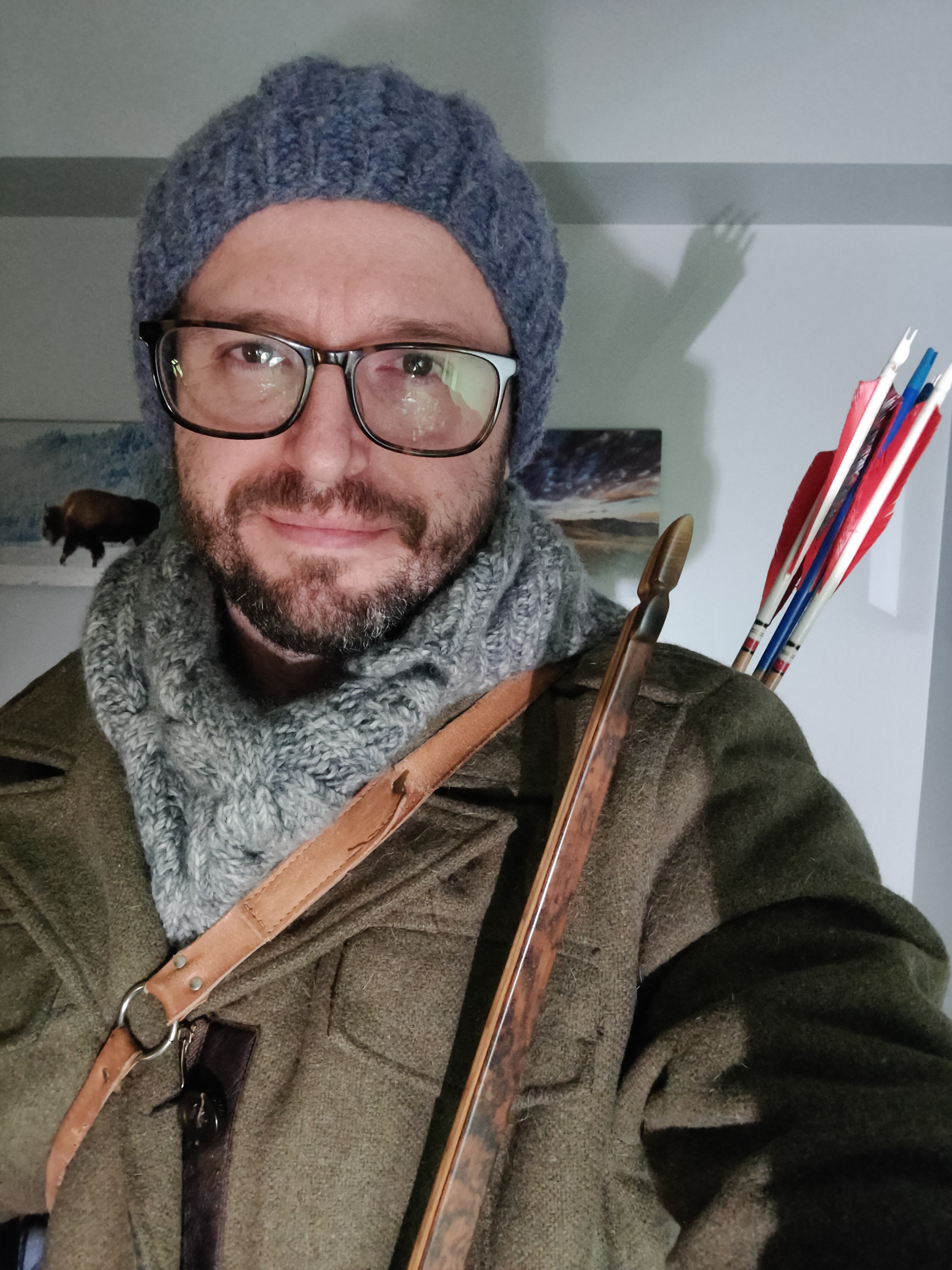
I got to the range, used my key code, and walked into a half-lit empty room. I positioned a bale and set up my target. I had to pull up some videos on my phone to understand how to use the bow stringer to string my longbow. I successfully strung the bow and excitedly got set up to shoot with arrows, armguard, and fingerguard.
I started to shoot. My longbow is pretty heavy – 64 pounds at full draw. So, I handled it as a mindful workout to get the form right and utilize the back muscles I’d always struggled with as a kid. It quickly became clear that all the advice about form my dad gave me as a kid didn’t connect because of a simple inability to feel and use my back. In thinking on how he would have guided me and trying time and again to do better, to try to feel and understand how to move differently, I felt a depth of understanding for him that I never had before. The whole activity became more profound, more intricate, and more beautiful. These feelings swelled with the post-rock poignancy playing through my head phones. I kept shooting, probably over a hundred shots, until I started to fall apart from fatigue, shots going wide, and the string dinging my arm a couple times. In the end, I felt closer to my dad than I had in a long time, maybe ever.
I took down my target, put the bale away, and unstrung the bow. I got all my gear in order and bundled up for the cold. I walked out with quiver on, carrying the bow, got in my car, and drove home. All in all, it was a beautiful night that I’m struggling to fully capture. I hope that this all serves as an anecdote about the opportunity to grow, learn, and continue to connect after loss and even in the long tail of process that is grief.
One of the standout albums of the year for me (and it’s no surprise given the excellence of their previous album) is BLAK’s El Tall d’Escil·la. It’s so excellent, and their musical skills are so fantastic that even the live album version from a few months later is mind-blowing. I’ll defer to Veil of Sound’s review to give a sense of the scope of this album:
So, let me give you the idea behind the new album’s title. El Tall d’Escil·la (Scylla’s Cut) ,tells a story of Nisos, who was the king of Megara and he possessed a single lock of purple hair which granted the city invincibility. His daughter, called Scylla, fell in love with Minos, king of Crete when he invaded Megara. In order to win his heart, Scylla cut off her father’s purple lock from his head and presented it to Minos. Minos, disgusted with her lack of filial devotion, tied Scylla to the bow of his ship until she drowned. It’s a sombre and hearbreaking end to Scylla’s life, however this kind of tragedy can play into the hands of bands like BLAK, who can musically narrate and express the despair and dejection with great skill and elegance. BLAK have the gift of reaching into the depts of your soul and bringing out all the emotions you have concealed and kept under wraps. Music is a powerful tool when it’s in the right hands and BLAK are craftsmen for sure. It will all make sense when you immerse yourself into Scylla’s cut, and let the music take hold and carry you to where it needs to go.
Veil of Sound, “Review of BLAK – El Tall d’Escil·la”, Pat O
The first track stands out in particular. The title “Contra nosaltres quan siguem forts” (Against ourselves when we’re strong) (thanks to the Veil of Sound review for the help with this) has a deep and evocative feeling. It’s pulled at my heart and supported me through many a drive and adventure this summer and fall. I even wrote about a meditation session on a paddle board recently that was accompanied by this song.
We face difficult, sometimes epic challenges, in life. I’ve felt that so many times in recent months. I’ve regularly felt like I’m meaningless and have wanted to die, regularly. However, there’s a certain resolve in standing in the midst of chaos and delving into your own inner strength and light. So often, tarot has told me to stand strong (Strength) and find my own truth and light (Hermit) while walking through the challenges of darkness, distortion, and delusion (Moon).
Daring the heights, facing death, standing strong despite our weakness, no matter what metaphor you choose, this song speaks to that majesty and courage. There’s something empowering at the core of this song that pulls you along into the swell of all challenge, and somehow you feel strong, even if the ego is destroyed in the process.
This is the path of the warrior, meant in the Shambhala way.
One of the most intoxicating aspects of Nietzsche’s philosophy is the ambience of hyperabundant overflowing of energy. This is the dynamism of the Dionysian, and it’s the strength of a healthy life. This sentiment comes forth perhaps nowhere as strongly as in the first section of the prologue to “Thus Spoke Zarathustra”, in which Zarathustra greets the sun (a symbol of the Apollonian here transformed to the hyperabundance of the Dionysian) and speaks to the task that he must undertake of “going under” from the heights of the mountains (we could possibly see this as the heavenly realm of the Forms) to the human realm. This choice resonates later – one must go under to go over, to become the overhuman, the Übermensch. The feeling of overflowing is here in the sunshine and the happiness and abundance associated with it and the final lines:
“Bless the cup that wants to overflow, that the water may flow from it golden and carry everywhere the reflection of your delight!” “Behold! This cup wants to become empty again, and Zarathustra wants to become human again.” – Thus began Zarathustra’s going-under.
Nietzsche, trans. Parkes, Thus Spoke Zarathustra, p. 9.
The overflowing energy is the strength of one who can climb the heights with the fullness of health, joy, and the ability to help others climb up the same paths. It’s the intensity that allows one to live dangerously with light feet dancing over the obstacles that one faces. It is the power of affirmation, of yay-saying — perhaps the greatest possibility in Nietzsche’s philosophy.
Recently, I’ve felt this sentiment greatly from a song from the new album released by Maybeshewill. The band has been broken up for years but has come back with a compelling album about facing climate change with hope and resolve to overcome and shape our futures. They describe this at length in the album’s description on Bandcamp.
The song is called “Invincible Summer”. When I listen to it, I find myself running, dancing, fist pumping, and screaming: “YES!!!”. I’m serious about all of those. I have done all of those in flowing with the feeling that arises in the later movements of the song when the strings swell and pull you along with the overflowing energy that would allow you to climb to the heights with light feet.
This session ended up being a journey into a lot of topics with quite a lot of musing and meandering through Buddhism, Taoism, Nietzsche, and Stoicism. May it provide benefit to those who listen to it.
I was recently spending time with a friend and flashed on a German song from years ago, half-remembered. I was driving us back to his place, and so I pulled it up on YouTube to play on the drive and amazingly, sang along, remembering almost all of the lyrics. It just felt so perfect for my vibe around heartbreak. I felt that I should translate it and share here. I love the opportunities to translate and share German on the blog, as seldom as they might be, and sometimes the sad, sad songs are precisely what makes us feel understood in difficult feelings. As such, I thought that others might enjoy it in that regard as well. The song is “Nichts in der Welt” (Nothing in the World) by die Ärzte, a band that had a huge place in my heart when studying German in my 20s.
This song is dark yet sweet and familiar. I showed my translation to a friend before posting, and she laughed and said this song was exactly the same as many things I have recently been saying about my process. I hope that others will find a shared experience in offering it here. The one thing I would say though… I loved her not because she was cruel, rather because I saw everything she was, including her darkest elements, and I accepted all of it. I don’t think there’s any deeper version of love than to see a person completely, accept them and yet still challenge them in their elements of not being the full light of who they could be, but maybe that’s just my perspective.
My translation: It is over, and the sky is black because the sun no longer shines here. It is over; however, I hope that that which separated us reunites us again. It is over, and nothing in the world will ever make it good again. It is over – if I could, then I would run away from my life. Would close my eyes and would try, To simply ignore my feelings. I want to be so cold that everyone freezes. Don’t want to ever fall in love again, in order to never lose again. It will be a while more before I comprehend what that means: It is over. I don’t know why – tell me what I’ve done wrong. It is over. You have ripped my heart to shreds and thought nothing of it. You are so cruel – that’s why I love you. Although I know of course that you aren’t good for me. My feelings are in and of themselves, Laughably simple and simply laughable. Because every thought only circles around the one: It is over, over, over. It is over, over, over. It is over, over, over. It is over, over, over. It is over; however, idiotically, I still want to be with you. It is over – and I don’t want to comprehend: every person is forever alone. Love is only a dream, an idea and nothing more. Deep in the inside, everyone remains lonely and empty. It means that every ending would also be a beginning. However, why does it hurt so much, and why is it so difficult? I let you go, even if it tears me apart. It is over, over, over. It is over, over, over. It is over, over, over. It is over, over, over. It is over, and nothing in the world will ever be able to make it good again.
Original lyrics:
Es ist vorbei und der Himmel ist schwarz, weil die Sonne hier nie wieder scheint. Es ist vorbei, doch ich hoffe, dass das, was uns trennte, uns wieder vereint. Es ist vorbei und nichts in der Welt wird es je wieder gutmachen können. Es ist vorbei – wenn ich könnte, dann würde ich vor meinem Leben wegrennen. Würd’ die Augen verschließen und ich würde probieren, meine Gefühle einfach zu ignorieren. Ich will so kalt sein, dass alle erfrieren. Will mich nie mehr verlieben, um nie mehr zu verlieren. Es dauert noch, bis ich begreife, was das heißt: Es ist vorbei, ich weiß nicht, warum – sag mir, was hab ich falsch gemacht. Es ist vorbei, Du hast mein Herz zerfetzt und Dir gar nichts dabei gedacht. Du bist so grausam – darum liebe ich Dich. Obwohl ich doch weiß, dass Du nicht gut bist für mich. Meine Gefühle sind an und für sich, lächerlich einfach – und einfach lächerlich. Weil jeder Gedanke nur um das Eine kreist: Es ist vorbei, vorbei, vorbei! Es ist vorbei, vorbei, vorbei! Es ist vorbei, vorbei, vorbei! Es ist vorbei, vorbei, vorbei! Es ist vorbei, doch idiotischerweise will ich immer noch bei Dir sein. Es ist vorbei – und ich will nicht begreifen: Jeder Mensch ist für immer allein. Liebe ist nur ein Traum, eine Idee und nicht mehr. Tief im Inneren bleibt jeder einsam und leer. Es heißt, dass jedes Ende auch ein Anfang wär’. Doch warum tut es so weh und warum ist es so schwer? Ich lasse Dich gehen, auch wenn es mich zerreißt. Es ist vorbei, vorbei, vorbei! Es ist vorbei, vorbei, vorbei! Es ist vorbei, vorbei, vorbei! Es ist vorbei, vorbei, vorbei! Es ist vorbei und nichts in der Welt wird es je wieder gutmachen können
I’ve kind of touched on the thoughts here in a recent post, but I thought they were important and weighty enough to address a bit more directly rather than abstractly. I’m hoping the vulnerability and sharing of process will support anyone else who needs it as finding the acceptance of friends and family has been crucial to continue sitting through these difficult feelings, whereas those who tell you you’re wrong, confused, or self-involved make it much more painful. I can only hope to give some companionship and feelings of being seen to those who need it.
I’ve honestly dealt with depression off an on throughout my adult life. It’s always around big changes and losses though – not the seemingly random nature of major depressive disorder, more the grief of the difficulties of a human life.
I’ve never really felt suicidal in depression, no matter how empty or meaningless life has felt. Not until this time. I’ve had the deep yearning to die regularly and escalating ideas of suicidal ideation since around mid-summer. It’s hard, and ultimately, it’s scary and tiring. Part of me has to struggle continuously not to sink into the abyss. Honestly, as someone deeply involved in existential psychology, I feel like it has to do with the famous quote: “He who has a Why to live for can bear almost any How” (Viktor Frankl, Man’s Search for Meaning). I’ve personally seen the withering away when a “Why” is lost. In many ways, this is precisely the problem of suicide that Camus lines out in his discussion of the absurd in The Myth of Sisyphus. Facing one’s existence and projects in life as meaningless is the ultimate existential angst. It’s facing the feeling that life wouldn’t matter if I wasn’t here. Rather than the Heideggerean state of being verfallen and covering over one’s death, it’s the inverse – staring life in the face and asking why you were even born at all while struggling to find any answer, as any you used to have have dissolved in your hands.
That’s all cerebral, but the experience is anything but – those are just philosophy riffs to explain the experience. The embodied experience is much more raw and crushing. I’ve thought numerous times how great it would be if I had the courage to jump out my window. I even had a sudden urge to stab myself with a knife recently, but ultimately, none of this has ever escalated to the point of having true plans, means, or intentions enough to where I felt I needed help, beyond some time to sit, cry, and be mindfully present for my feelings.
For me, it’s been all pulled forward by having attached to ideas of partnership and love – ideas that I didn’t fully realize were such a strong piece of my identity, desire, and meaning in life. Now, I’m just not so sure of those ideas, and ultimately, I don’t think the answer is to try to find them again with someone else, so it feels as though my life doesn’t really have something to aspire to, to build, to find meaning in.
Speaking of attachment – this is a klesha: clinging. Clinging to those ideas has caused such a traumatic crash of meaning and identity, and it doesn’t seem effective enough to take the existential, well, rather, Nietzschean, approach of building some new meaning/project/values, i.e. creating some new take on love or relationships. Instead, I’ve been inspired by the Buddhist ideas regarding attachment. I’ve tried to sit with the feelings of attachment and let them dissolve. Instead, I try to show up, connect with people, and provide my kindness and compassion for the struggles they go through, and ultimately, every time, it has led to gratitude and sometimes, even, growth in the engagement.
I feel that showing up to these hardest of feelings is like what I’ve posted about previously as a famous quote from Zen that before enlightenment you chop wood and carry water, while after enlightenment you chop wood and carry water. Facing the toughest moments of life is about mindfully sitting in them, realizing that it’s just more life. The world is as it was before. Your perception and emotional reactions are all over the place, but ultimately, the same billions of years of history are before this moment as in the past. The same world is there. It merely seems different because of that Wittgensteinian idea that the world of the sad person is different than that of the happy: i.e. your evaluations of it are different, but the aspects of living your life as a human being in your life and home are the same in the broader sense (this could very much be lined up with Stoic ideas as well, especially Epictetus).
Mindfully being present and being focused on showing compassion for others is a simple and yet deep shift in approaching the mystery of living in an existence that’s always greater and more mysterious than the meanings you find in your personal projects and interpretations. Being present and vulnerable in such a way offers the possibility of seeing life as precious, just as it is, just as painful and heartbreaking as it can be in its most samsaric of moments.
Which brings me to the greatest counter-perspective I can emphasize to that of the suicidal abyss: experiencing life as precious. I’ve recently been thinking of Atisha’s slogan practices from Tibetan Buddhism. The first slogan “First, train in the preliminaries” was key to facing my dad’s death a few years ago, and recent Buddhist classes I’ve been attending have been key to bringing these ideas back to the fore.
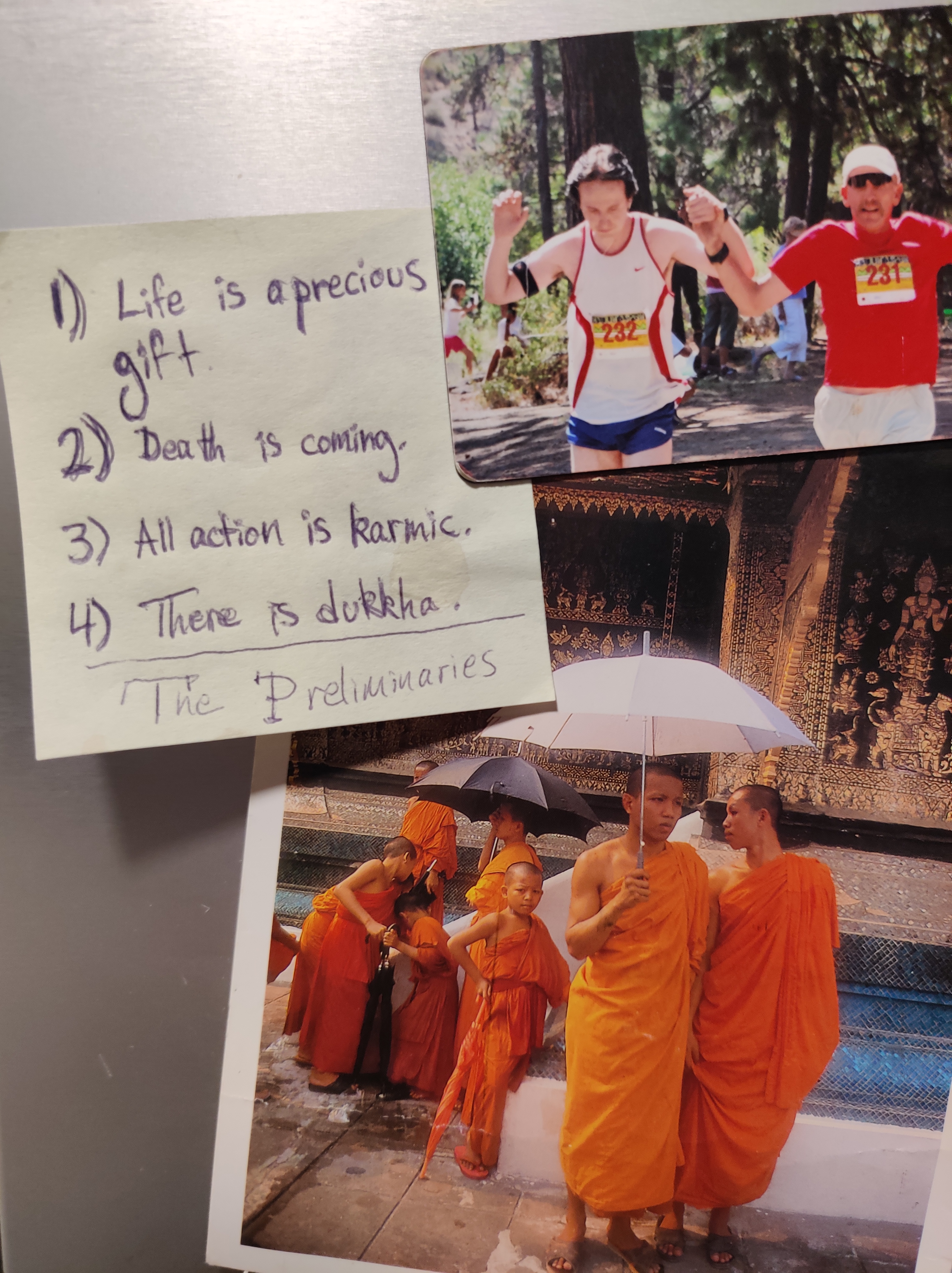
There are four “preliminaries”. I’ll attach a photo of a post-it note I wrote years ago with my own take of them to remember them by. It’s on my fridge. I took a picture of it before a recent trip because I was thinking about these suicidal thoughts and the counter effort I’ve been working on in seeing compassion and wisdom to pull me back into this more engaged mindset.
My summary of the preliminaries
I’ll speak of slogan practice more thoroughly in the future (hopefully), but I’ll summarize these points here. Tibetan Buddhism emphasizes how rare and precious it is to be born as a human being in a time and place where you can learn the Buddha’s dharma – the truths and wisdom that offer you the possibility of breaking free from the painful reactions that make life so difficult. In a way, this summary of preciousness captures the point of the other 3 preliminaries as well as the Four Noble Truths in one go. A sentient life is one of the pain, disappointment, and suffering of dukkha. It’s one of standard patterns of action, walking through life with the same conditioned ways of re-acting (writing that way because we think of it as action, but it truly isn’t – reactivity is the most passive of ways of being. The only truly active freedom is in being able to sit with challenges and see your inclinations and choose differently in ways that do not continue the reactive patterns of suffering in your life). Waking up to a different way of being requires seeing the opportunity and wisdom that is available to you, embracing it with gratitude, and rethinking your actions based on the outcomes and results you bring to yourself through them (recognizing the 3rd preliminary that all action is karmic), working now to embrace that opportunity because you see your time is limited (recognizing the 2nd preliminary that death is coming), and finally, doing all of this out of the understanding that there is dukkha (the first of the Four Noble Truths which opens the whole Buddhist path before you).
When I think of the samsaric pain of loss and meaninglessness that I’m going through with all the suicidal thoughts attached to them, in other words, when thinking of the fact that there is dukkha, I remember another Buddhist passage I’ve brought up before, the poetic lines from Dogen’s Genjokoan: “Therefore flowers fall even though we love them; weeds grow even though we dislike them” (Shohaku Okumura, Realizing Genjokoan: The Key to Dogen’s Shobogenzo). Desire and aversion put us at odds with the changing circumstances of the impermanent world around us, but if we recognize those samsaric poisons within us, we can take pause and sit more patiently with the difficulties of life, allowing us to instead continue on with compassion for others and mindful presence for the moment at hand. We may no longer have the flowers of beauty, or we may need to contend with the weeds popping up, but we can be right in this moment, doing our best in it, and giving to all the others who are here struggling with their own pain at the changing circumstances they’re in.
May these words inspire and offer companionship to those who need them.






 On the Way
Recent Comments